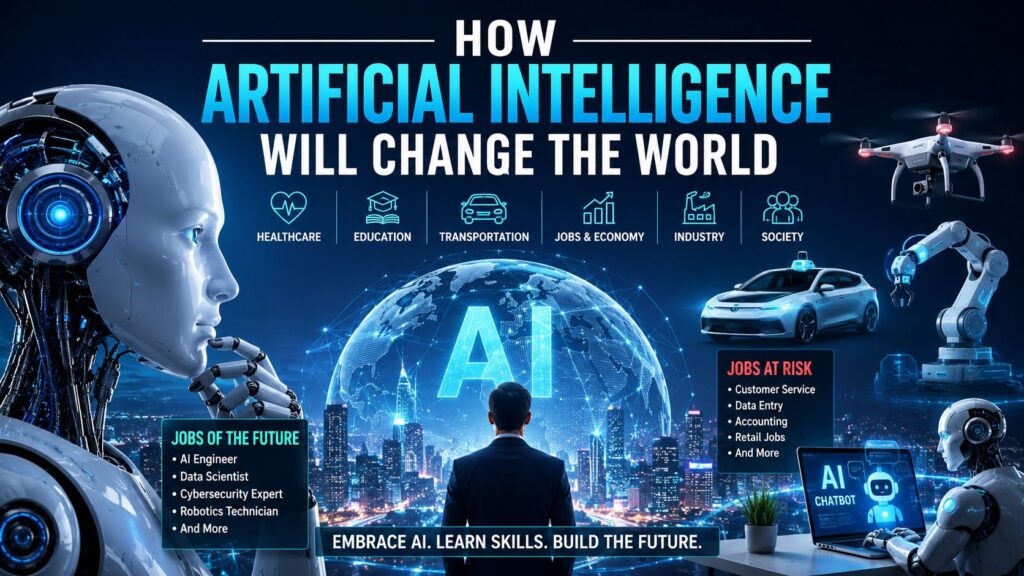
How Artificial Intelligence Will Change the World and the Future
How Artificial Intelligence Will Change the World and the Future
Imagine waking up tomorrow and finding that your calendar has already been organized, your emails have been summarized, your car has selected the safest route to work, and your smartwatch has warned you about a health issue before you notice any symptoms.
A few years ago, this sounded like science fiction.
Today, much of it is already happening.
Artificial intelligence has quietly become part of everyday life. Whether you’re unlocking your phone with facial recognition, asking a virtual assistant for directions, watching personalized movie recommendations, or shopping online, AI is working behind the scenes.
What makes this technology different from previous innovations is the speed at which it is evolving. Electricity changed the world over decades. The internet transformed communication over many years. Artificial intelligence is advancing at an extraordinary pace, introducing new tools and capabilities almost every month.
This rapid progress has sparked excitement, curiosity, and concern.
Some people believe AI will solve humanity’s biggest challenges. Others worry it could replace jobs, spread misinformation, or create ethical problems we are not prepared to handle.
The truth lies somewhere in the middle.
Artificial intelligence is neither a miracle nor a threat on its own. It is a powerful tool. Like every major invention in history, its impact depends on how people, businesses, and governments choose to use it.
In this guide, you’ll discover how artificial intelligence is transforming industries, changing careers, influencing economies, and reshaping everyday life. You’ll also learn about its biggest opportunities, potential risks, and the skills that will matter most in an AI-powered future.
Quick Answer
Artificial intelligence will change the world by automating repetitive tasks, improving decision-making, accelerating scientific discoveries, enhancing healthcare, personalizing education, and increasing business productivity. While AI may transform many existing jobs, it is also expected to create new industries and career opportunities. The greatest advantage will belong to individuals and organizations that learn to work alongside AI rather than compete with it.
Key Takeaways
- Artificial intelligence is transforming nearly every major industry.
- AI is more likely to change jobs than eliminate them completely.
- Healthcare, education, finance, manufacturing, and transportation will experience significant innovation.
- Human creativity, leadership, empathy, and critical thinking will become even more valuable.
- Learning AI-related skills today can create better opportunities in the future.
What Is Artificial Intelligence?
Artificial intelligence (AI) refers to computer systems designed to perform tasks that typically require human intelligence. These tasks include learning from data, recognizing patterns, understanding language, solving problems, and making predictions.
Unlike traditional software, AI improves over time by analyzing large amounts of information. This ability allows it to recognize trends, make recommendations, and support decision-making much faster than humans can in many situations.
For example:
- Streaming platforms recommend movies based on your viewing history.
- Navigation apps calculate the fastest route using live traffic data.
- Online stores suggest products you are likely to purchase.
- Email services automatically filter spam messages.
These everyday conveniences are powered by artificial intelligence.
Why AI Is Different From Previous Technologies
Throughout history, major inventions have changed the way people live and work.
The steam engine powered the Industrial Revolution.
Electricity transformed homes and industries.
The internet connected billions of people around the world.
Artificial intelligence builds on all of these advances but adds something new: the ability for machines to learn from information and improve their performance without being manually programmed for every situation.
Instead of simply following instructions, AI can identify patterns, predict outcomes, and assist humans in making smarter decisions.
This makes it one of the most influential technologies of the twenty-first century.
How Artificial Intelligence Will Change the Future
Artificial intelligence is expected to influence nearly every aspect of modern life over the next decade.
Rather than replacing people entirely, AI will become an intelligent assistant that helps individuals and businesses work faster, solve complex problems, and make better decisions.
Imagine visiting a hospital where doctors receive AI-assisted diagnoses within seconds, allowing them to focus more on patient care.
Picture classrooms where every student receives personalized lessons based on their learning pace instead of following the same curriculum.
Consider businesses that predict customer demand before products run out of stock, reducing waste while improving customer satisfaction.
These are not distant possibilities—they are already beginning to happen.
The future will likely see AI becoming as common as smartphones and internet access are today.
Instead of asking whether AI will change the world, the better question is:
How can we prepare ourselves to benefit from these changes?
AI in Healthcare: Smarter Care, Better Outcomes
Healthcare is one of the industries where artificial intelligence is already making a measurable difference. Around the world, hospitals, researchers, and healthcare providers are using AI to improve patient care, reduce medical errors, and speed up diagnoses.
Traditionally, doctors relied on years of experience, medical records, laboratory tests, and imaging scans to diagnose diseases. While these methods remain essential, AI can analyze enormous amounts of medical data in seconds, helping healthcare professionals identify patterns that might otherwise be missed.
For example, AI-powered systems can assist radiologists by highlighting potential signs of diseases such as lung cancer, breast cancer, and pneumonia in medical images. Instead of replacing doctors, these systems provide a second opinion that helps improve accuracy and supports faster decision-making.
AI is also transforming drug discovery. Developing a new medicine has traditionally taken many years and required billions of dollars in research. Today, AI can analyze millions of chemical compounds, helping scientists identify promising treatments much faster. This has the potential to reduce research costs while bringing life-saving medicines to patients sooner.
Wearable technology is another area where AI is changing healthcare. Smartwatches and fitness trackers monitor heart rate, sleep quality, oxygen levels, and physical activity. Some devices can even detect irregular heart rhythms and encourage users to seek medical advice before a serious condition develops.
Why It Matters
The future of healthcare isn’t about replacing doctors with machines. It’s about giving medical professionals better tools that allow them to make informed decisions, detect diseases earlier, and deliver more personalized treatment.
AI in Education: Learning Without Limits
Education has always faced one major challenge: every student learns differently.
Some students understand new concepts quickly, while others need additional explanations and practice. Traditional classrooms often follow the same teaching pace for everyone, making it difficult to meet every learner’s individual needs.
Artificial intelligence is changing this approach.
Modern learning platforms use AI to analyze a student’s progress, identify strengths and weaknesses, and recommend personalized learning paths. Instead of receiving identical lessons, students can learn at a pace that suits their abilities.
Teachers also benefit from AI-powered tools. Routine tasks such as grading quizzes, organizing assignments, and tracking student performance can be automated, allowing educators to spend more time teaching, mentoring, and supporting students.
Language learning provides another practical example. AI-powered applications can adjust lessons based on pronunciation, vocabulary, and learning speed, making language education more interactive and effective.
Real-World Example
Imagine two students studying algebra. One understands the lesson after a single explanation, while the other struggles with the same concept.
An AI-powered learning platform can automatically provide additional exercises, videos, and explanations to the second student while allowing the first student to move ahead. This creates a personalized learning experience that is difficult to achieve in a traditional classroom.
AI in Business: A Smarter Way to Work
Businesses of every size are discovering that artificial intelligence is no longer a luxury—it is becoming a competitive advantage.
Companies use AI to automate repetitive tasks, analyze customer behavior, predict future demand, improve marketing campaigns, and provide faster customer support.
For example, online retailers recommend products based on browsing history and previous purchases. Banks use AI to detect suspicious financial transactions in real time. Manufacturers predict equipment failures before they happen, reducing costly downtime.
Small businesses are also benefiting. AI-powered tools can draft emails, summarize meetings, organize schedules, create marketing content, and analyze sales reports within minutes.
Rather than replacing employees, these tools help teams focus on creative thinking, innovation, and customer relationships.
Why Businesses Are Investing in AI
Organizations that use AI effectively can improve productivity, reduce operational costs, deliver better customer experiences, and make faster data-driven decisions. As AI technology becomes more affordable, businesses of all sizes are expected to adopt it.
AI in Transportation: Building Safer and Smarter Mobility
Transportation is becoming faster, safer, and more efficient with the help of artificial intelligence.
Although self-driving cars receive the most attention, AI is already improving transportation in many other ways.
Logistics companies use AI to calculate the most efficient delivery routes, reducing travel time, fuel consumption, and operating costs. Airlines use predictive maintenance systems that analyze aircraft performance and identify potential mechanical issues before they become serious.
Many cities are also introducing intelligent traffic management systems that use AI to reduce congestion by adjusting traffic signals based on real-time road conditions.
Public transportation networks are beginning to use AI to improve scheduling, reduce delays, and provide more accurate travel information for passengers.
Looking Ahead
As autonomous vehicle technology continues to improve, transportation is expected to become safer, more efficient, and more environmentally sustainable. While widespread self-driving vehicles may still take time, AI is already transforming how people and goods move around the world.
AI in Scientific Research and Climate Innovation
Some of humanity’s greatest challenges—such as climate change, disease prevention, renewable energy, and food security—require analyzing enormous amounts of information.
This is where artificial intelligence excels.
Researchers use AI to study climate patterns, model future environmental changes, identify new materials for clean energy technologies, and accelerate scientific discoveries that would otherwise take years.
Instead of replacing scientists, AI acts as a powerful research assistant, helping experts process complex data more efficiently and focus on solving global problems.
As computing power continues to grow, AI is expected to play an even greater role in tackling some of the world’s biggest scientific and environmental challenges.
Will Artificial Intelligence Help the World or Hurt It?
Artificial intelligence is often described as one of the most important technological breakthroughs in history. It has the potential to improve healthcare, transform education, accelerate scientific discoveries, and help businesses become more productive.
At the same time, it also raises important concerns about privacy, cybersecurity, misinformation, and the future of work.
So, is AI good or bad?
The answer isn’t black and white.
Artificial intelligence is a tool. Just like electricity, the internet, or smartphones, its impact depends on how people choose to use it. When developed responsibly, AI can solve complex global challenges and improve quality of life. When used irresponsibly, it can create risks that affect individuals, businesses, and entire societies.
Rather than asking whether AI is good or bad, the more important question is:
How can we use artificial intelligence responsibly while minimizing its risks?
Let’s explore both sides.
The Benefits of Artificial Intelligence
1. Better Decision-Making
Every day, businesses and organizations generate enormous amounts of data. Analyzing this information manually can take days or even weeks.
AI can process millions of data points within seconds, helping organizations identify trends, predict future outcomes, and make smarter decisions.
For example, retailers can forecast customer demand, hospitals can identify patients at higher risk of certain diseases, and financial institutions can detect suspicious transactions before fraud occurs.
2. Increased Productivity
One of AI’s greatest strengths is automation.
Routine tasks such as scheduling meetings, organizing documents, responding to common customer questions, and preparing reports can now be completed in minutes.
Instead of spending valuable time on repetitive work, employees can focus on creativity, innovation, strategic planning, and problem-solving.
This doesn’t simply save time—it also allows businesses to become more efficient and competitive.
3. Improved Healthcare
Artificial intelligence is helping healthcare professionals diagnose diseases earlier, analyze medical images more accurately, and support personalized treatment plans.
Researchers are also using AI to speed up drug discovery, making it possible to identify promising treatments much faster than traditional research methods.
These advances have the potential to improve patient outcomes while reducing healthcare costs.
4. Personalized Education
Artificial intelligence is making education more flexible and accessible.
Instead of giving every student the same lesson, AI-powered learning platforms can adjust content based on individual progress, learning speed, and knowledge gaps.
Teachers can also use AI to automate administrative work, allowing them to spend more time helping students succeed.
5. Faster Scientific Innovation
Scientists are using AI to accelerate research in medicine, renewable energy, climate science, and space exploration.
Instead of manually analyzing massive datasets, researchers can use AI to identify patterns and generate insights much more quickly.
This allows scientists to spend more time developing solutions to some of humanity’s biggest challenges.
The Risks of Artificial Intelligence
While the opportunities are significant, AI also presents challenges that deserve careful attention.
Privacy Concerns
Artificial intelligence depends on data.
Many AI systems collect and analyze personal information to improve their performance. Without strong privacy protections, this information could be misused or exposed through cyberattacks.
Protecting user data will remain one of the biggest challenges as AI becomes more common.
Deepfakes and Misinformation
Modern AI systems can generate highly realistic images, videos, and voices.
Although these technologies have many legitimate uses, they can also be used to spread false information, impersonate individuals, or manipulate public opinion.
As AI-generated content becomes more convincing, learning to verify information from trusted sources will become increasingly important.
Cybersecurity Threats
Artificial intelligence is helping cybersecurity experts detect attacks faster than ever before.
However, cybercriminals are also using AI to automate phishing campaigns, identify security weaknesses, and create more convincing online scams.
This means organizations must continuously improve their security systems to stay ahead of emerging threats.
Job Displacement
Some routine jobs will inevitably change as businesses adopt AI-powered automation.
Tasks involving repetitive administrative work are most likely to be affected.
However, history shows that technological revolutions also create entirely new industries and career opportunities.
The challenge is helping workers develop new skills rather than resisting technological progress.
Bias and Ethical Challenges
Artificial intelligence learns from existing data.
If that data contains bias or inaccuracies, AI systems can unintentionally produce unfair results.
Developers, businesses, and governments must work together to ensure AI systems remain transparent, accountable, and fair.
Ethics will play a critical role in building public trust as AI continues to evolve.
Benefits vs Risks of Artificial Intelligence
| Benefits | Risks |
|---|---|
| Faster decision-making | Privacy concerns |
| Higher productivity | Job displacement |
| Better healthcare | Deepfakes and misinformation |
| Personalized education | Cybersecurity threats |
| Scientific breakthroughs | Bias in AI systems |
| Business automation | Ethical challenges |
Expert Insight
Many people believe the future will be a competition between humans and artificial intelligence.
The reality is likely to be very different.
The most successful professionals and businesses won’t be those who compete with AI—they’ll be those who learn how to use it effectively.
Artificial intelligence excels at analyzing information, recognizing patterns, and automating repetitive tasks.
Humans excel at creativity, emotional intelligence, leadership, ethical decision-making, and complex problem-solving.
The future belongs to those who combine both strengths.
Key Takeaway
Artificial intelligence is neither humanity’s greatest threat nor its ultimate solution.
It is one of the most powerful tools ever created.
If developed responsibly, AI can improve healthcare, education, scientific research, business productivity, and everyday life while helping solve some of the world’s biggest challenges.
The future of AI will ultimately depend on the choices people make today—how it is developed, regulated, and used for the benefit of society.
How Artificial Intelligence Will Affect Jobs and the Global Economy
One of the biggest questions surrounding artificial intelligence is whether it will replace human workers.
The short answer is no—but it will transform the way millions of people work.
Every major technological revolution has changed the job market. The Industrial Revolution replaced many forms of manual labor but created factories, engineering careers, and entirely new industries. The rise of computers eliminated some office jobs while creating opportunities in software development, cybersecurity, digital marketing, and information technology.
Artificial intelligence is following a similar path.
Instead of replacing every profession, AI is automating repetitive tasks while increasing the value of uniquely human skills such as creativity, leadership, emotional intelligence, communication, and critical thinking.
Professionals who learn how to work alongside AI will have a significant advantage in the future workplace.
Industries That Will Experience the Biggest Changes
Although AI will influence almost every industry, some sectors are expected to change more rapidly than others.
Customer Service
Businesses are increasingly using AI-powered chatbots and virtual assistants to answer frequently asked questions, process orders, and provide support around the clock.
However, complex situations that require empathy, negotiation, or human judgment will still rely on skilled customer service professionals.
Finance
Banks and financial institutions already use AI to detect fraud, analyze investment opportunities, assess financial risk, and improve customer experiences.
Financial professionals who understand AI tools will be able to make faster, more informed decisions while focusing on strategic planning.
Marketing
Artificial intelligence is transforming digital marketing by analyzing customer behavior, predicting buying trends, generating content ideas, and optimizing advertising campaigns.
Marketers will spend less time on repetitive tasks and more time developing creative strategies and building meaningful customer relationships.
Manufacturing
Factories are using AI-powered systems to monitor equipment, predict maintenance needs, improve quality control, and reduce waste.
As automation increases, demand will continue to grow for technicians, engineers, and AI specialists who can manage these advanced systems.
Jobs AI Is Most Likely to Change
Artificial intelligence performs best when tasks are repetitive, predictable, and based on structured data.
Roles expected to experience significant change include:
- Data Entry Clerks
- Basic Administrative Assistants
- Telemarketing Representatives
- Routine Customer Support Agents
- Basic Bookkeepers
- Appointment Schedulers
- Document Processing Specialists
- Basic Report Writers
Rather than disappearing overnight, these jobs are likely to evolve as AI takes over repetitive responsibilities.
Jobs AI Is Unlikely to Replace
Many careers depend on qualities that machines cannot easily replicate.
These include:
- Doctors and Surgeons
- Nurses
- Teachers
- Psychologists
- Therapists
- Entrepreneurs
- Scientists
- Engineers
- Skilled Trades (Electricians, Plumbers, Mechanics)
- Creative Directors
- Architects
- Lawyers handling complex legal matters
- Emergency Responders
These professionals may use AI as a powerful assistant, but human expertise, ethical judgment, and interpersonal skills will remain essential.
Essential Skills for the AI Era
Instead of fearing artificial intelligence, individuals should focus on developing skills that complement it.
The most valuable future skills include:
- Critical Thinking
- Creativity
- Problem Solving
- Emotional Intelligence
- Leadership
- Communication
- Adaptability
- Digital Literacy
- AI Tool Proficiency
- Continuous Learning
People who combine these abilities with AI technology will be well positioned for future career opportunities.
Final Thoughts
Artificial intelligence is no longer a concept from science fiction. It has become one of the most influential technologies shaping the modern world.
From improving healthcare and education to transforming businesses, transportation, and scientific research, AI is changing how people live and work. At the same time, it introduces new challenges involving privacy, ethics, cybersecurity, and workforce adaptation.
The future is unlikely to be defined by humans competing against machines.
Instead, success will belong to individuals and organizations that learn how to collaborate with artificial intelligence while continuing to develop the uniquely human qualities that technology cannot replace.
Artificial intelligence is a tool.
Like every powerful innovation throughout history, its impact depends on how wisely people choose to use it.
The future of AI is not something that simply happens to us—it is something we help create through our decisions, our creativity, and our commitment to responsible innovation.
Frequently Asked Questions (FAQs)
1. Will artificial intelligence replace all jobs?
No. AI is expected to automate repetitive tasks rather than replace every profession. Human creativity, leadership, empathy, and complex decision-making will remain valuable.
2. Which industries will benefit the most from AI?
Healthcare, education, finance, manufacturing, transportation, scientific research, retail, and cybersecurity are expected to benefit significantly.
3. What jobs are most at risk?
Jobs focused on repetitive administrative work, routine data processing, basic customer support, and simple bookkeeping are most likely to change.
4. Can AI improve healthcare?
Yes. AI helps doctors detect diseases earlier, analyze medical images, accelerate drug discovery, and personalize patient care.
5. Is AI safe?
AI can provide enormous benefits when developed and used responsibly. Strong regulations, ethical standards, and cybersecurity measures are essential for reducing risks.
6. How can I prepare for an AI-driven future?
Develop digital skills, learn how to use AI tools, strengthen communication and problem-solving abilities, and commit to lifelong learning.
7. Will AI create new jobs?
Yes. Just as previous technological revolutions created new industries, AI is expected to generate new careers in AI development, robotics, cybersecurity, automation, and data science.
8. What is the future of artificial intelligence?
Artificial intelligence is expected to become increasingly integrated into everyday life, helping people make better decisions, improve productivity, solve complex problems, and accelerate innovation across nearly every industry.
Conclusion
Artificial intelligence is transforming the world faster than almost any technology before it. While challenges such as privacy, misinformation, and workforce disruption must be addressed, the opportunities are even greater. Those who embrace AI responsibly, continue learning, and develop skills that complement technology will be best prepared for the future.
MORE FROM US
YOUTUBE AI DEMONITIZATION WAVE

Pingback: How to Make Money with AI Agents in 2026
Pingback: National Assembly Becomes Pakistan’s First AI-Enabled Assembly