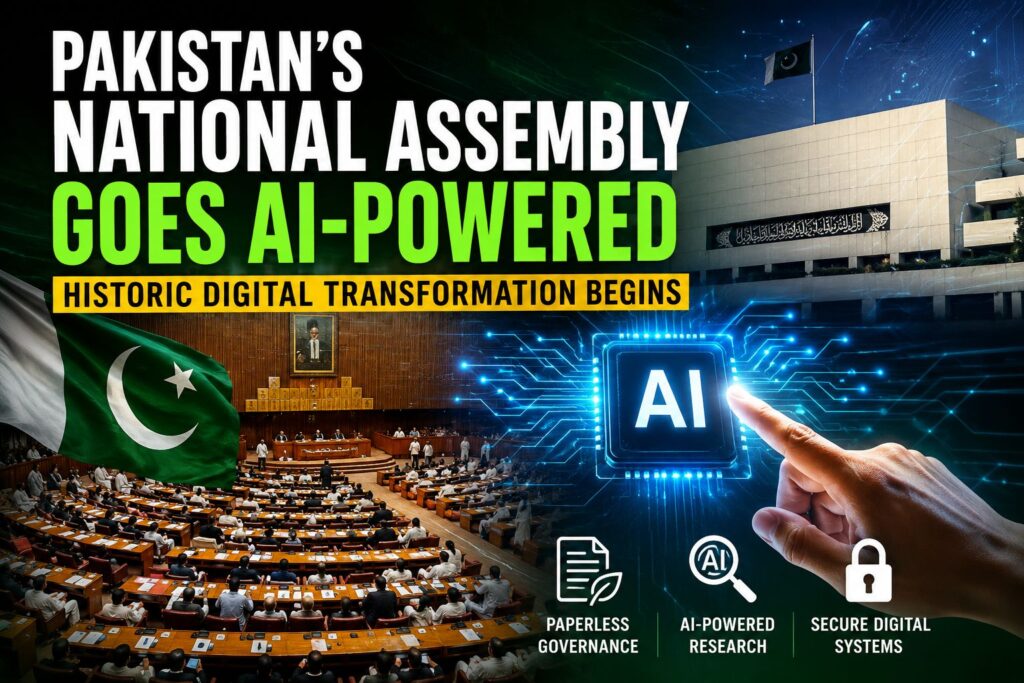
National Assembly Becomes Pakistan’s First AI-Enabled Assembly: A New Digital Era Begins
Pakistan has officially entered a new phase of digital governance as the National Assembly of Pakistan became the country’s first AI-enabled assembly. During a soft launch ceremony held at Parliament House, Speaker Sardar Ayaz Sadiq formally introduced the AI Parliament module along with an AI-enabled Speaker’s Office.
This major step aims to modernize parliamentary operations through artificial intelligence, paperless governance, and secure digital systems — marking a historic moment for Pakistan’s political and technological future.
Pakistan’s Parliament Steps Into the AI Era
The groundbreaking initiative was developed by the National Information Technology Board (NITB). The project focuses on improving efficiency inside Parliament by reducing paperwork, introducing digital workflows, and using AI-powered tools for research and administration.
Federal Minister for IT and Telecommunication Shaza Fatima Khawaja said that Prime Minister Shehbaz Sharif launched a nationwide digitalisation campaign soon after taking office. According to her, many government ministries are already moving toward paperless operations.
She explained that the National Assembly had earlier implemented the e-Office system under the leadership of Ayaz Sadiq, and the introduction of AI is another important milestone in Pakistan’s digital transformation journey.
AI and Paperless Governance to Improve Parliamentary Operations
The IT Minister highlighted that Parliament traditionally generates a massive amount of paper waste. Important documents are printed in bulk, regardless of whether lawmakers attend sessions or not.
With the introduction of AI systems and digital tools, the government plans to reduce unnecessary printing and make parliamentary operations more transparent, efficient, and environmentally friendly.
Shaza Fatima also noted that Pakistan’s Parliament was already the first parliament to establish an SDG Secretariat and had shifted the National Assembly toward green energy initiatives.
She admitted that adapting to new technology may initially be difficult for some lawmakers, especially those less familiar with digital systems. However, she stressed that digitisation would eventually make parliamentary affairs faster, smarter, and more effective.
ALSO READ THIS
MIT’s Incredible Innovation: AI Can Now Move Your Hands — The Complete Story of “Human Operator”
Ayaz Sadiq Announces Plans for Paperless Budget Sessions
Speaker Sardar Ayaz Sadiq said that older generations are often hesitant to adopt modern technology, but digital tools can significantly improve parliamentary work.
He pointed out that huge amounts of paper are consumed every year, particularly during budget sessions when heavy printed copies are distributed among members.
To solve this issue, future budget documents may be shared through USB devices instead of printed files, helping Parliament move closer to fully paperless operations.
The Speaker also revealed that the AI assistant will help lawmakers improve parliamentary research, prepare debates more effectively, and access important information quickly.
Pakistan’s Parliament to Get Its Own AI Data Center
One of the most important announcements during the ceremony was the plan to establish a dedicated AI data center for the National Assembly.
Ayaz Sadiq confirmed that work on the AI data center is expected to begin in July after budget approval. The facility will strengthen Parliament’s digital infrastructure and support future AI-powered operations.
Chairman of the National Assembly Standing Committee on IT Syed Amin Ul Haque described the launch as a historic achievement in Pakistan’s parliamentary history.
He said the AI initiative would benefit all parliamentarians and emphasized the importance of building a secure AI ecosystem for the country’s legislative system.
Beep App and Secure Digital Communication
During the event, officials also highlighted the importance of secure communication tools for lawmakers.
Syed Amin Ul Haque praised the Ministry of IT for promoting digital governance and specifically mentioned the Beep Pakistan app, a secure communication platform designed to enable safe and reliable communication among parliamentarians and government officials.
ALSO READ THIS
How Artificial Intelligence Will Change the World
A Historic Step Toward Digital Pakistan
The launch of the AI Parliament module represents more than just a technological upgrade — it reflects Pakistan’s growing focus on digital governance, artificial intelligence, and sustainable parliamentary practices.
By adopting AI-powered systems, paperless operations, and secure communication technologies, Pakistan’s National Assembly is setting an example for other institutions across the country.
As AI continues to reshape governments around the world, Pakistan’s first AI-enabled assembly could become a major milestone in the country’s journey toward a smarter and more digitally connected future.