MIT’s Incredible Innovation: AI Can Now Move Your Hands — The Complete Story of “Human Operator”
MIT students have created an AI-powered wearable device called Human Operator that guides hand movements using electrical muscle stimulation (EMS). Learn how it works, its real-world applications, and why this breakthrough could change the future of learning and rehabilitation.
Imagine Playing Piano Without Learning It
Imagine sitting in front of a piano for the very first time. You do not know the notes, you have never practiced finger placement, and you have no musical training. Suddenly, your fingers begin moving on their own, pressing the correct keys and playing a melody perfectly.
This is not science fiction. It is the result of an innovative project developed by students at Massachusetts Institute of Technology called Human Operator.
The device combines artificial intelligence with electrical muscle stimulation technology to physically guide a person’s hand movements in real time. What once sounded impossible is now becoming reality.
What Is Human Operator?
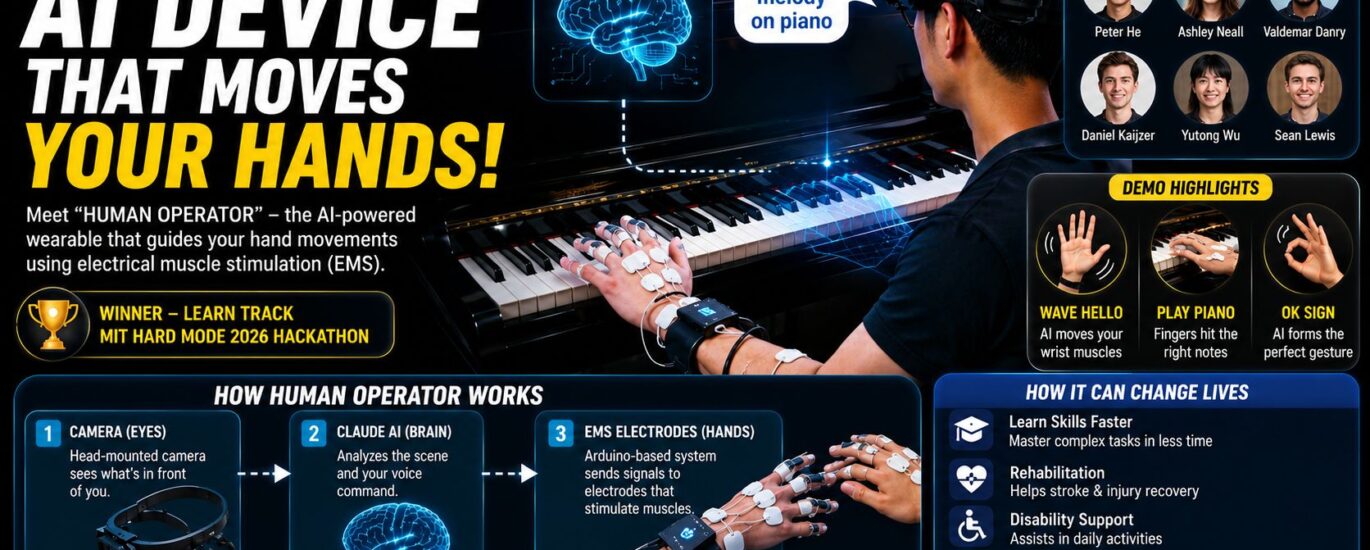
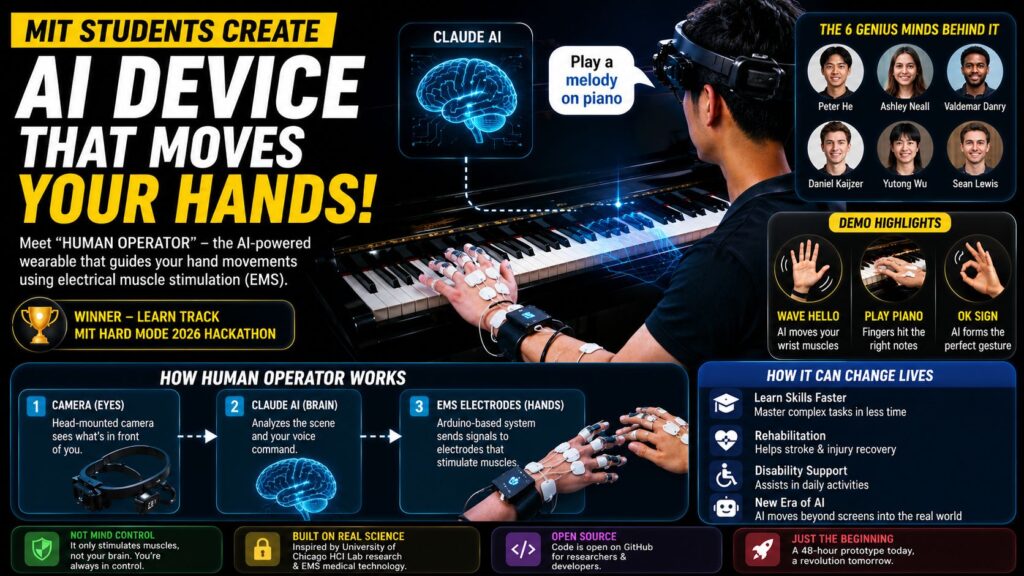
Human Operator is a wearable AI-powered system that uses Electrical Muscle Stimulation (EMS) to guide hand and finger movements.
The device places small electrodes on the user’s wrist and fingers. These electrodes send carefully controlled electrical pulses to the muscles, causing them to move automatically. It works almost like having an expert teacher physically guiding your hands step by step.
The project was presented at the MIT Hard Mode 2026 Hackathon, where it won first place in the Learn Track category. Even more impressive, the entire system was developed by a six-person student team in only 48 hours.
Who Created Human Operator?
The project was built by six talented undergraduate students from Massachusetts Institute of Technology:
- Peter He
- Ashley Neall
- Valdemar Danry
- Daniel Kaijzer
- Yutong Wu
- Sean Lewis
Their rapid innovation has attracted global attention from both the AI and robotics communities.
How Does Human Operator Work?
The Human Operator system works through three major components:
1. Vision System — The Camera
The wearable setup includes a head-mounted camera that observes the environment in front of the user. For example, if the user is sitting at a piano, the camera captures the keyboard and hand positions.
2. Intelligence Layer — Claude AI
The video feed and user voice commands are sent to Anthropic’s Claude AI through its API. The AI analyzes what the user wants to do and determines which hand movements are required.
3. Muscle Activation — EMS Electrodes
The AI instructions are sent to Arduino-based hardware connected to electrodes attached to the user’s wrist and fingers. These electrodes stimulate specific muscles, causing the hand to move naturally.
The entire process happens almost instantly, allowing users to receive real-time physical guidance.
What Was Shown in the Demo?
The Human Operator demonstrations quickly went viral because of several impressive examples:
- Waving Hello: The AI stimulated the wrist muscles to make the hand wave naturally.
- Playing a Piano Melody: Fingers moved automatically across the correct piano keys to complete a melody.
- Making an OK Gesture: The system guided the fingers into a perfect “OK” hand sign.
These demonstrations showed that AI can move beyond screens and begin interacting directly with the physical world.
The Science Behind Human Operator
Human Operator is not just a flashy tech demo. The project is built on serious scientific research.
The team drew inspiration from the University of Chicago Human Computer Integration Lab, which has been researching neuromuscular interfaces and human-computer interaction technologies for years.
EMS technology itself is already used in medical rehabilitation, especially for stroke recovery and muscle therapy. Human Operator takes this existing medical technology and combines it with modern AI systems to create a completely new type of interaction.
Real-World Applications of Human Operator
The potential applications of this technology are enormous.
Faster Skill Learning
Imagine medical students learning surgery while their hands are physically guided through expert movements. Music students could learn proper finger placement much faster than traditional practice methods.
Rehabilitation and Physical Therapy
People recovering from strokes, injuries, or neurological conditions could use AI-guided muscle stimulation to rebuild movement and coordination more effectively.
Accessibility and Disability Support
Individuals with motor impairments may eventually use systems like Human Operator to receive physical assistance with daily activities.
A New Era of Human-AI Interaction
Until now, AI mainly interacted with humans through screens, text, and voice. Human Operator introduces the possibility of AI physically assisting and guiding human movement in the real world.
This could become a major shift in the future of technology.
Is This Mind Control? Should People Be Concerned?
One of the biggest questions surrounding Human Operator is whether it could become a form of “mind control.”
The developers have made it clear that the answer is no.
The system does not interact with the brain. It only stimulates muscles externally, similar to how TENS therapy devices work in physical rehabilitation and pain treatment. Users remain fully conscious and can stop the system at any time.
The goal is not to control humans, but to create an AI-powered physical teacher and assistant.
However, as the technology evolves, discussions about privacy, consent, and ethical use will become increasingly important.
Is Human Operator Available Today?
At the moment, Human Operator is still a hackathon prototype rather than a commercial product.
However, the team has released the project as open source on GitHub, allowing researchers and developers to improve and expand the technology further.
While still in its early stages, Human Operator may represent the beginning of a much larger technological revolution.
Final Thoughts
Human Operator is more than just an experimental gadget. It raises a powerful question about the future of artificial intelligence:
Should AI remain limited to screens, or should it physically interact with the human body to help people learn, heal, and perform tasks?
In only 48 hours, six students from Massachusetts Institute of Technology demonstrated that this future may already be possible.
Today, Human Operator is an exciting prototype.
Tomorrow, it could transform the way humans learn and interact with AI forever.
FAQs
What is Human Operator by MIT?
Human Operator is an AI-powered wearable device created by Massachusetts Institute of Technology students that uses Electrical Muscle Stimulation (EMS) to guide hand and finger movements in real time.
How does Human Operator work?
The device uses a camera, AI software, and EMS electrodes. The AI analyzes the task and sends electrical signals to the muscles, helping the user perform specific hand movements automatically.
Is Human Operator mind control technology?
No. Human Operator does not control the brain or read thoughts. It only stimulates muscles externally, similar to medical EMS therapy devices.
What are the real-world uses of Human Operator?
Human Operator could help with skill learning, physical rehabilitation, disability support, surgical training, and music education.
Is Human Operator available to buy?
No. Human Operator is currently a hackathon prototype developed by MIT students and is not yet available as a commercial product.