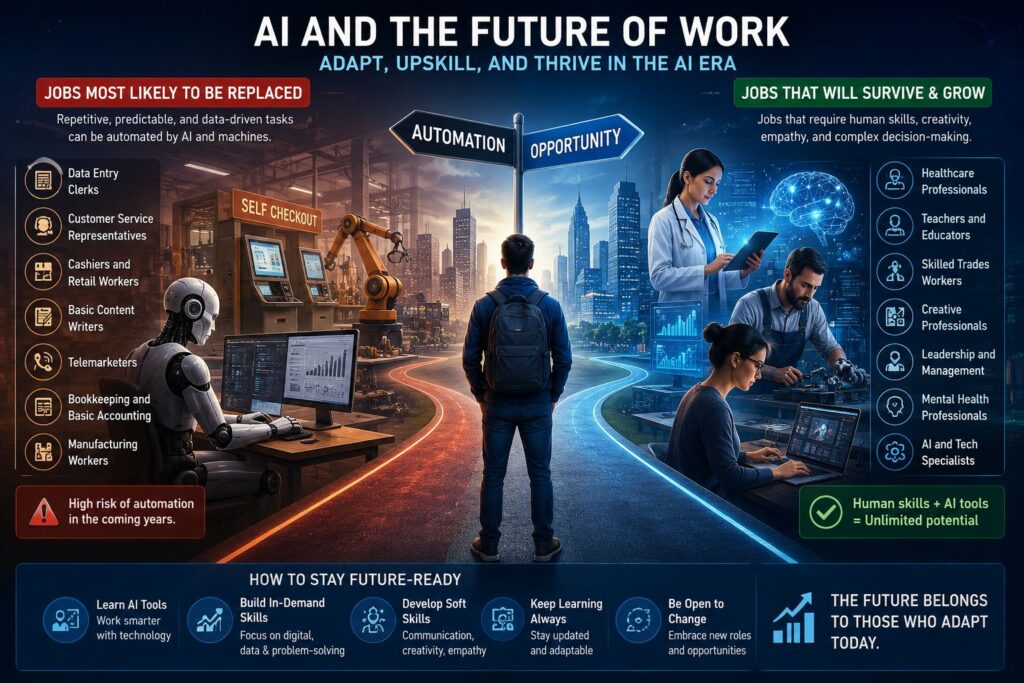
What jobs will AI replace in the next few years? It is one of the biggest questions people are asking today. From customer service to content creation, artificial intelligence is changing how companies hire and work.
Many workers fear that AI could replace millions of jobs. At the same time, new career opportunities are also emerging. Some roles may disappear, while others will become more valuable than ever.
In this article, you will discover what jobs are most at risk, which careers are safer, and how you can stay relevant in the AI-powered future.
What Jobs Will AI Replace in the Coming Years?
Artificial intelligence is advancing faster than many experts expected. Businesses around the world are investing heavily in automation and AI-powered tools. Because of this, many people are wondering what jobs will AI replace in the future.
The biggest risk is for jobs that involve repetitive and predictable tasks. AI systems can complete these tasks quickly, accurately, and at a lower cost. Companies see automation as a way to improve efficiency and reduce expenses.
Here are some of the jobs most likely to be affected by AI:
Customer Service Representatives
Many companies now use AI chatbots and virtual assistants to handle customer questions. These systems can answer common queries instantly without human support. Basic customer service roles may continue to decline as AI technology improves.
Data Entry Clerks
Data entry is one of the easiest tasks to automate. AI software can organize, process, and manage large amounts of information much faster than humans. Businesses are already replacing manual data entry with automated systems.
Cashiers and Retail Workers
Self-checkout machines and AI-powered payment systems are reducing the need for traditional cashiers. Many stores are adopting automated technology to speed up the shopping experience and lower labor costs.
Content Writers for Basic Tasks
AI writing tools can now create product descriptions, simple blog posts, social media captions, and email drafts. While creative writers are still valuable, repetitive writing jobs may become less common.
Telemarketers
AI voice assistants and automated calling systems are replacing many telemarketing roles. Businesses can now reach customers with AI-driven communication tools that operate around the clock.
Manufacturing and Factory Workers
Factories have used robots for years, but AI is making automation even more advanced. Machines can now perform tasks with greater precision and fewer errors. This may reduce the demand for certain manual labor jobs.
Bookkeeping and Basic Accounting Roles
AI accounting software can track expenses, generate reports, and manage financial records automatically. Simple bookkeeping tasks are becoming easier to automate with modern technology.
Although these jobs face higher risks, AI is unlikely to replace every worker completely. In many industries, humans and AI will work together instead of competing directly. People who learn new skills and adapt to technology will have better opportunities in the future job market
How What Jobs Will AI Replace Is Changing the Modern Workplace
Artificial intelligence is already transforming the way businesses operate. Companies are using AI tools to save time, reduce costs, and increase productivity. Tasks that once required human workers can now be completed in seconds by advanced software.
This shift is happening across many industries. Customer support teams now use AI chatbots to answer common questions. Marketing companies use AI to write content, create images, and analyze data. Banks use AI systems to detect fraud and manage transactions faster than humans.
One major reason businesses are adopting AI is efficiency. AI can work 24/7 without breaks. It can process huge amounts of data quickly and make decisions based on patterns. For companies, this means lower operating costs and faster results.
The rise of remote work has also accelerated AI adoption. Businesses want automated systems that can handle repetitive work without constant supervision. As a result, many traditional office tasks are becoming automated.
However, AI is not only replacing jobs. It is also changing the skills employers look for. Companies now value creativity, critical thinking, communication, and technical knowledge more than ever. Workers who can use AI tools effectively may have a better chance of staying competitive.
The discussion around what jobs will AI replace is becoming more important because technology is improving rapidly. Jobs that involve repetitive and predictable tasks are the most vulnerable. At the same time, careers that require emotional intelligence, leadership, and human interaction are expected to remain valuable for years to come.
Why What Jobs Will AI Replace Is Affecting Entry-Level Careers
Entry-level jobs are becoming one of the biggest concerns in the AI era. Many of these roles involve repetitive tasks that artificial intelligence can automate easily. As companies adopt smarter software, fewer beginner-level positions may be available in some industries.
In the past, entry-level jobs helped people gain experience and learn workplace skills. Today, AI tools can perform many of those tasks faster and more efficiently. This is changing the traditional career path for millions of workers.
Administrative Assistant Roles
AI scheduling tools, virtual assistants, and automated email systems are reducing the need for basic administrative work. Tasks like appointment booking, data organization, and document management can now be handled by software.
Junior Content Creation Jobs
Many companies use AI writing tools to create simple articles, captions, and marketing copy. Because of this, some beginner content writing positions are becoming more competitive.
Basic Graphic Design Tasks
AI image generators and design platforms can quickly create logos, social media graphics, and marketing materials. Junior designers may face pressure to develop more advanced creative skills to stay competitive.
Entry-Level Programming Jobs
AI coding assistants can generate code, fix bugs, and automate simple programming tasks. While software developers are still in demand, basic coding jobs may evolve rapidly in the coming years.
Customer Support Positions
Many companies now rely on AI chatbots for handling routine customer questions. This reduces the number of support agents needed for simple tasks, especially in large businesses.
However, entry-level jobs are not disappearing completely. Instead, they are changing. Employers now expect workers to have problem-solving abilities, creativity, communication skills, and knowledge of AI tools.
The discussion around what jobs will AI replace shows that adaptability is becoming more important than ever. People who continuously learn new skills and understand modern technology will have a stronger advantage in the future job market.
What Jobs Will AI Replace and Which Careers Will Survive?
While AI is expected to automate many tasks, some careers are likely to remain strong for decades. Jobs that require human creativity, emotional intelligence, leadership, and complex decision-making are much harder for AI to replace.
Artificial intelligence works best with patterns and data. However, it still struggles with deep human interaction, empathy, and original thinking. That is why many careers will continue to depend heavily on people.
Healthcare Professionals
Doctors, nurses, therapists, and caregivers perform work that requires empathy and human judgment. AI can assist with diagnosis and data analysis, but patients still need emotional support and personal care from real people.
Teachers and Educators
Education is more than sharing information. Great teachers motivate students, understand emotions, and adapt to different learning styles. AI tools may support education, but human teachers remain essential.
Skilled Trades
Electricians, plumbers, mechanics, and construction workers perform hands-on tasks in unpredictable environments. These jobs require physical problem-solving that AI and robots still struggle to handle efficiently.
Creative Professionals
Writers, filmmakers, designers, musicians, and artists use originality and emotional storytelling. Although AI can generate content, human creativity and unique perspectives continue to hold significant value.
Leadership and Management Roles
Business leaders make strategic decisions, manage teams, and handle workplace relationships. Strong leadership depends on communication, emotional intelligence, and experience, which AI cannot fully replicate.
Mental Health and Counseling Careers
Psychologists, counselors, and social workers rely heavily on trust, empathy, and emotional understanding. AI may provide assistance tools, but human connection is critical in these professions.
AI and Technology Specialists
As AI technology grows, the demand for AI engineers, cybersecurity experts, data scientists, and software developers is also increasing. People who understand technology may benefit greatly from the AI revolution.
The conversation around what jobs will AI replace often creates fear, but it also highlights new opportunities. The future workforce will likely combine human skills with AI tools rather than replace humans entirely. Workers who focus on creativity, adaptability, and lifelong learning will remain valuable in the evolving job market.
What Jobs Will AI Replace and What Are AI’s Biggest Limitations?
Artificial intelligence is powerful, but it still has many limitations. Despite rapid advancements, AI cannot think, feel, or understand the world the same way humans do. This is one reason why many experts believe humans will continue to play a critical role in the future workforce.
The debate around what jobs will AI replace often focuses on automation, but it is equally important to understand what AI cannot do well.
Lack of Emotional Intelligence
AI cannot genuinely understand human emotions. It may recognize emotional patterns in text or speech, but it does not experience feelings or empathy. Jobs that require emotional connection, trust, and compassion still depend heavily on people.
Limited Creativity and Original Thinking
AI can generate content based on existing data, but true originality is still a human strength. Creative ideas, storytelling, innovation, and artistic expression often come from human experiences and emotions that AI cannot fully replicate.
Difficulty Handling Unpredictable Situations
AI performs best in structured environments with clear rules and patterns. In unexpected or rapidly changing situations, humans are usually better at adapting and making decisions.
Dependence on Data
AI systems rely on large amounts of data to function properly. If the data is incomplete, outdated, or biased, the AI may produce inaccurate results. This creates risks in industries like healthcare, finance, and law.
Ethical and Security Concerns
AI can raise serious ethical issues, including privacy risks, misinformation, and job displacement. Businesses and governments are still working on regulations to ensure AI is used responsibly.
Lack of Human Judgment
Some decisions require moral reasoning, intuition, and human understanding. AI cannot fully replace human judgment in sensitive situations involving ethics, leadership, or personal relationships.
Physical Limitations in Real-World Environments
Although robotics technology is improving, many physical tasks remain difficult for AI-powered machines. Jobs that require flexibility, manual skill, and real-world problem-solving are still challenging for automation.
The conversation about what jobs will AI replace should not focus only on fear. AI is a tool that can improve productivity and support human workers. However, its limitations show that human skills will remain essential in many industries for years to come.
What Jobs Will AI Replace and How Will the Future of Work Look?
The future of work will not be a simple replacement of humans by machines. Instead, it will be a mix of humans and AI working together. AI will handle repetitive and data-heavy tasks, while humans will focus on decision-making, creativity, and strategy.
This shift is already visible in many industries. Companies are redesigning jobs instead of removing them completely. Work is becoming more digital, more flexible, and more skill-based.
Human + AI Collaboration
In the future workplace, most jobs will involve AI tools. Employees will use AI to analyze data, write reports, generate ideas, and automate routine tasks. This will allow workers to focus on higher-level responsibilities.
Instead of replacing workers completely, AI will act like a “digital assistant” in many roles.
Faster and More Efficient Workplaces
AI will make companies faster and more productive. Tasks that used to take hours or days will be completed in minutes. This will increase competition between businesses and push industries to adopt automation more quickly.
Remote and Hybrid Work Growth
AI-powered communication and collaboration tools are making remote work easier than ever. More companies will continue to adopt hybrid work models where employees work both from home and the office.
This will also open job opportunities for people across different regions of the world.
While some jobs will disappear, new roles will emerge. Future careers may include:
- AI trainers and supervisors
- Prompt engineers
- Automation specialists
- Data ethics officers
- Human-AI interaction designers
These roles will focus on managing and improving AI systems.
Shift Toward Skill-Based Hiring
In the future, degrees alone may matter less than skills. Employers will focus more on what a person can actually do. Skills like problem-solving, adaptability, digital literacy, and creativity will become more valuable than ever.
Continuous Learning Will Be Essential
The biggest change in the future of work is the need for lifelong learning. Workers will need to continuously update their skills to keep up with AI advancements. Online learning platforms, certifications, and training programs will become a normal part of every career.
More Flexible Career Paths
Traditional career paths will become less rigid. People may switch industries multiple times in their lives. AI will make it easier to learn new skills quickly, allowing more career flexibility.
The future of work is not about humans versus AI. It is about how humans can work with AI to achieve better results. Understanding what jobs will AI replace helps us prepare, but adapting to change will define long-term success.
How to Stay Employable in the AI Era
The rise of AI is changing job requirements across almost every industry. Instead of focusing only on what jobs will AI replace, the real question is how to stay relevant in this new environment. The good news is that people who adapt will still have strong career opportunities.
Employability in the AI era is less about doing repetitive tasks and more about developing skills that AI cannot easily replace or replicate.
Learn to Work With AI Tools
AI is becoming part of everyday work. Instead of avoiding it, you need to learn how to use it effectively. Whether it is writing, design, data analysis, or marketing, AI tools can help you work faster and smarter.
People who understand how to use AI will have a clear advantage over those who do not.
Focus on Problem-Solving Skills
AI can process data, but it cannot fully understand complex human problems. Employers now value workers who can analyze situations, think critically, and find practical solutions.
Problem-solving is one of the most important skills for long-term job security.
Build Strong Communication Skills
Clear communication is still a human strength. Whether you are working in a team, dealing with clients, or presenting ideas, communication plays a key role.
AI can generate text, but it cannot replace genuine human interaction, persuasion, or emotional understanding.
Develop Creativity and Innovation
Creative thinking is one of the hardest things for AI to replicate. Jobs that involve imagination, design, storytelling, and innovation will continue to grow in value.
The more creative your thinking, the harder it becomes for AI to replace your role.
Improve Digital and Technical Skills
Basic digital literacy is no longer enough. In the AI era, understanding data, software tools, and automation systems is becoming essential.
You don’t need to become an expert programmer, but having technical awareness will help you stay competitive.
Be Open to Lifelong Learning
The job market is changing quickly. Skills that are valuable today may become outdated in a few years. Continuous learning is now a requirement, not an option.
Online courses, certifications, and self-learning can help you stay updated with industry trends.
Develop Emotional Intelligence
AI lacks emotional depth, but humans do not. Skills like empathy, teamwork, leadership, and conflict resolution are becoming even more important.
These human qualities will always be valuable in workplaces that rely on collaboration.
Adaptability Is the Key
The most important skill in the AI era is adaptability. People who are flexible, open to change, and willing to learn new tools will have better long-term success.
Instead of fearing change, embracing it will create new opportunities.
In the end, the question of what jobs will AI replace is only part of the bigger picture. The real focus should be on how individuals can evolve with technology and build future-proof careers.
How to Prepare for an AI-Driven Career Future
Preparing for the future of work is no longer optional. AI is already reshaping industries, and the pace of change is accelerating. Instead of waiting to see what happens, it is better to actively prepare and position yourself for new opportunities.
The goal is not just to avoid being replaced, but to become someone who can work effectively alongside AI.
Understand Where AI Is Headed
Start by staying aware of how AI is being used in your industry. Every field is being affected differently. Some are heavily automated, while others are only partially impacted.
When you understand trends early, you can make smarter career decisions before major changes happen.
Upgrade Your Skill Set Regularly
Skills become outdated faster in the AI era. That is why continuous upskilling is essential. Focus on a mix of:
- Technical skills (basic AI tools, software, data understanding)
- Soft skills (communication, leadership, teamwork)
- Analytical skills (critical thinking, decision-making)
A balanced skill set makes you more adaptable to different roles.
Learn High-Demand Digital Skills
Some skills are becoming especially valuable due to AI growth, such as:
- Data analysis and interpretation
- AI tool usage (automation platforms, AI assistants)
- Digital marketing and content strategy
- Cybersecurity awareness
- Basic coding or no-code tools
Even a basic understanding of these areas can significantly improve your career opportunities.
Build a Strong Personal Brand
In a competitive job market, visibility matters. A strong online presence can help you stand out. Platforms like LinkedIn or personal portfolios allow you to showcase your skills, projects, and achievements.
People who can clearly present their value will have better chances of getting hired.
Gain Real-World Experience
Practical experience is more important than ever. Freelancing, internships, side projects, or volunteering can help you build hands-on skills.
Employers value proof of ability, not just theoretical knowledge.
Network With Industry Professionals
Connections play a big role in career growth. Networking helps you learn about opportunities, industry changes, and skill requirements.
Talking to professionals can also give you insight into how AI is affecting real jobs in your field.
Stay Flexible With Career Paths
In the past, people often stayed in one job or industry for life. That is changing. In the AI era, switching roles or industries may become normal.
Being open to change allows you to take advantage of new opportunities instead of being limited by old career paths.
Develop a Future-Focused Mindset
Instead of fearing what jobs will AI replace, focus on what you can become in the future. A growth mindset helps you stay motivated, learn faster, and adapt to change.
Those who prepare early will find it easier to succeed in an AI-driven world.
Final Thought
AI will continue to evolve, but so will human skills. The people who prepare, learn, and adapt will not only survive the changes—they will benefit from them.
Final Thoughts on AI and Job Security
Artificial intelligence is not just a trend. It is a long-term shift in how work is done. The concern around what jobs will AI replace is understandable, but the reality is more balanced than it first appears.
Some jobs will disappear, especially those based on repetitive and predictable tasks. At the same time, many new roles will be created that did not exist a few years ago. This is how every major technological shift has worked in history.
AI is powerful, but it is not a complete replacement for human intelligence. It lacks emotions, creativity, real-world judgment, and ethical understanding. These gaps ensure that humans will still play a central role in the workforce.
The real challenge is not AI itself, but how quickly people can adapt to it. Workers who resist change may struggle, while those who learn new tools and upgrade their skills will find new opportunities.
The future of work will belong to people who can combine human abilities with AI technology. Instead of competing with machines, success will come from learning how to use them effectively.
In the end, AI is not just replacing jobs—it is reshaping them. And those who prepare today will be the ones leading tomorrow’s workforce.
FAQs
Which jobs are most likely to be replaced by AI?
AI is most effective in jobs that involve repetitive, routine, and data-based tasks. This includes roles like data entry, basic bookkeeping, telemarketing, translation work, and simple customer support. These jobs can often be automated because they follow clear patterns and rules.
Are skilled jobs safe from AI?
Yes, most skilled and hands-on jobs are currently very safe from AI. Careers like electricians, plumbers, mechanics, and construction workers require physical work, real-world problem-solving, and human judgment. These tasks are very difficult for machines to fully replace.
Is AI replacing jobs completely or just changing them?
In most cases, AI is changing jobs rather than completely replacing them. Many roles are being reshaped where humans still do the work, but with the help of AI tools. This means workers are expected to be faster, more skilled, and more tech-savvy than before.
Can I make my job safe from AI?
You cannot make any job 100% “AI-proof,” but you can reduce risk by improving your skills. Focus on creativity, communication, critical thinking, and emotional intelligence. Also, learning how to use AI tools can make you more valuable in almost any role.
What skills are important for the future job market?
The most important skills for the future include problem-solving, adaptability, digital literacy, and creativity. Soft skills like teamwork, leadership, and emotional intelligence are also becoming more valuable because AI cannot replace them easily.
Will AI create new job opportunities?
Yes, AI is also creating new careers. Jobs in AI development, data science, cybersecurity, automation management, and AI ethics are growing rapidly. Many of these roles did not exist a few years ago but are now in high demand.
What should I do to stay future-ready?
The best approach is continuous learning. Keep updating your skills, stay aware of industry trends, and be open to change. People who adapt quickly to new technology will have the strongest career security in the AI-driven future.

Pingback: AI Coworkers 2026: The Complete Truth About the Future of Work & Jobs