AI Coworkers 2026: The Complete Truth About the Future of Work & Jobs
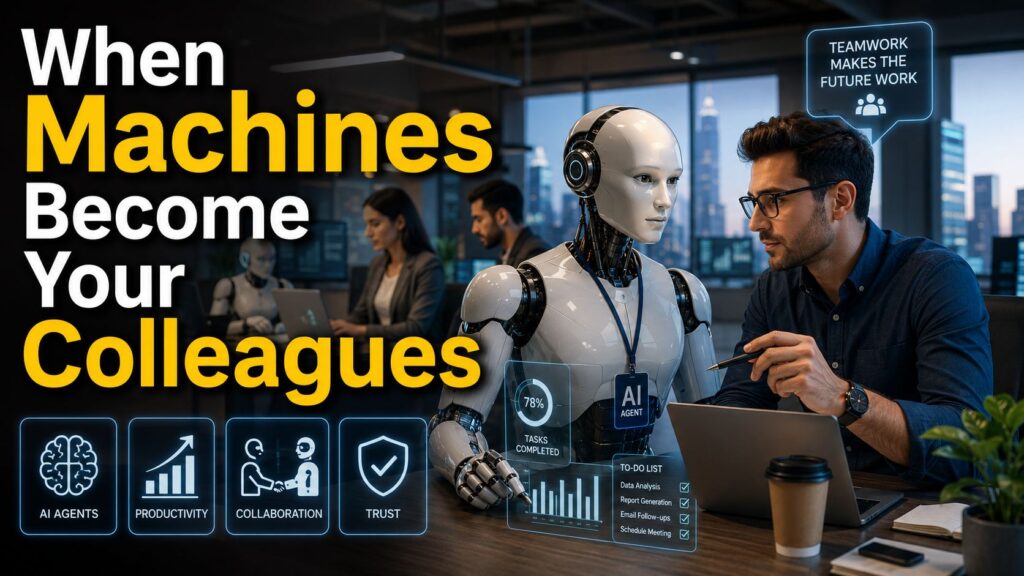
AI can now move your hands : incredible inovation in history
Introduction: When Machines Become Your Colleagues
The workplace of 2026 is no longer the same.
Today, many companies have a new kind of “colleague” working alongside humans — one that never gets tired, never asks for leave, and never arrives late. Its name is the AI Agent, and it is no longer just software. It has become a real coworker.
Salesforce reduced its customer support workforce from 9,000 to 5,000 because of AI agents. Salesforce
Atlassian cut 1,600 jobs due to AI-driven productivity improvements. Meta shifted or eliminated nearly 20% of parts of its workforce as it moved aggressively toward AI.
These are not just headlines. This is a new reality.
But there’s another side to the story.
According to PwC’s 2025 Global AI Jobs Barometer, workers with AI skills earn 56% higher salaries than their peers. Agentic AI job postings have grown by 280% in just one year. LinkedIn declared “AI Engineer” the #1 fastest-growing job title of 2026.
So the real question is not:
“Will AI take jobs?”
The real question is:
“Are you ready to work with AI?”
In this article, we’ll explore:
- What AI coworkers actually are
- Which jobs are at risk in 2026
- Which new careers are emerging
- Salary and market trends
- And most importantly — how you can future-proof yourself
Part 1: What Is an AI Coworker? (It’s Not Just a Chatbot)
Many people think AI coworkers and chatbots are the same thing. That’s a mistake.
A chatbot simply answers questions. You ask something, it responds — that’s it. No long-term memory, no independent actions.
An AI Agent or AI Coworker is far more advanced. It has four major characteristics:
1. Persistent Goals
You can give it a task like:
“Schedule all patient follow-ups for this week.”
The AI agent creates a plan, takes the necessary steps, and completes the work without constant instructions.
2. Tool Usage
AI agents can:
- Send emails
- Update calendars
- Fill spreadsheets
- Search databases
- Manage workflows
— all autonomously.
3. Memory
Unlike normal chatbots, AI agents remember previous conversations and project details. They use past context in future decisions.
4. Autonomous Decision-Making
AI coworkers can make small operational decisions without needing human approval every time.
Real-World Example
A marketing AI agent can:
- Check analytics reports automatically
- Identify underperforming ads
- Draft new ad copy
- Send a summary email to its manager
—all without anyone asking.
That is what an AI coworker looks like in 2026.
Part 2: The Reality of 2026 — Numbers That Shock
Research and surveys reveal massive changes already happening.
Enterprise Adoption
- 85% of enterprises are expected to use at least one agentic AI system by mid-2026 (Gartner forecast)
- 62% of organizations are experimenting with AI agents (McKinsey State of AI)
- 23% have already scaled agentic systems in at least one business function
- 52% of global talent leaders plan to deploy autonomous AI agents by the end of 2026 (Korn Ferry survey)
Job Market Changes
- AI-related job postings increased by 25.2% in Q1 2026
- Agentic AI job postings grew 280% year-over-year (Stanford AI Index 2026)
- Machine Learning Engineer demand increased by 41.8%
- Traditional programmer employment dropped by 27.5%
- Entry-level tech hiring declined by 25%
Worker Sentiment
- 18% of U.S. employees believe their jobs are at risk from AI within 5 years
- 27% of employees in AI-adopting companies say their jobs have already changed significantly
- 65% of workers say AI improved their productivity
The Financial Side
- The global AI agent market could reach $182 billion by 2033
- AI-skilled workers receive a 56% wage premium
- Goldman Sachs estimates AI could automate work equivalent to 300 million full-time jobs
Part 3: Which Jobs Are at Risk?
Let’s be direct: some jobs are already being heavily affected by AI.
High-Risk Categories
1. Data Entry & Administrative Roles
Scheduling, bookkeeping, and repetitive administrative work are increasingly handled by AI systems.
2. Tier-1 Customer Support
By Q1 2026, 62% of B2C companies had deployed AI-powered support systems for basic customer queries.
3. Middle Management
AI can now handle:
- Scheduling
- Reporting
- Performance tracking
This makes many traditional management layers vulnerable.
4. Entry-Level White-Collar Jobs
Research from the University of Pennsylvania and OpenAI suggests educated white-collar workers earning under $80,000 are among the most exposed to automation.
5. Routine Content Writing
Template-based writing and basic information gathering are increasingly automated.
6. Basic Accounting & Bookkeeping
Invoice processing, tax filing, and routine reporting are rapidly shifting to AI systems.
Medium-Risk Jobs
These jobs are changing, not disappearing:
- Graphic Designers
- Junior Lawyers
- Healthcare Administrators
- Marketing Coordinators
Humans still provide creativity, judgment, and emotional intelligence.
Low-Risk Jobs
Currently safer categories include:
- Strategic leadership roles
- Complex creative professions
- Therapy and counseling
- High-stakes technical decision-making
- Organizational leadership
Part 4: New Jobs Being Created by AI
This is where the biggest opportunities exist.
1. AI Orchestration Specialist
Manages multiple AI agents and ensures they work correctly.
Salary: $120,000–$180,000/year
2. Prompt Engineer
Designs instructions that help AI systems produce accurate and useful outputs.
Salary: $90,000–$150,000/year
3. AI Ethics Officer
Ensures AI systems remain fair, legal, and transparent.
Salary: $100,000–$160,000/year
4. Forward-Deployed Engineer
Deploys and customizes AI systems in real-world business environments.
Job listings for this role increased by 800% in 2025.
5. Human-AI Collaboration Designer
Designs workflows where humans and AI work together effectively.
6. AI Trainer / Data Labeling Specialist
Creates and verifies training data for AI systems.
This role is growing rapidly in developing countries.
7. Agentic Systems Auditor
Audits AI decision-making systems for accountability and compliance.
8. AI-Augmented Specialists
Doctors, teachers, marketers, and lawyers who use AI effectively are becoming more valuable than traditional professionals.
Part 5: Industry-Wise Analysis
Healthcare
AI handles documentation and workflow optimization, while doctors focus on patient care and complex decisions.
Education
AI enables personalized learning and automated grading, allowing teachers to focus more on mentoring and creativity.
Manufacturing
Repetitive tasks are increasingly automated, while workers move toward supervision and improvement roles.
Finance
Routine analysis and reporting are automated, but strategic planning still requires human expertise.
Marketing
AI handles analytics and content generation, while humans focus on branding, storytelling, and emotional connection.
Legal
AI is excellent at document review and research, but courtroom strategy and ethical judgment remain human strengths.
Part 6: How Organizational Structures Are Changing
Traditional company structures are becoming flatter.
Old Model
CEO → VPs → Directors → Managers → Team Leads → Employees
Emerging 2026 Model
Senior Leaders → AI-Augmented Specialists → AI Systems
AI now performs many middle-layer tasks such as:
- Reporting
- Scheduling
- Workflow monitoring
This creates both opportunities and challenges.
The biggest issue:
entry-level pathways are shrinking because AI handles beginner-level work.
That means reskilling early is becoming critical.
Part 7: Developing Countries & Pakistan’s Perspective
For countries like Pakistan, AI creates both risks and opportunities.
Threat to Outsourcing
An AI agent in New York can now perform many outsourcing tasks at a fraction of the previous cost.
This directly affects outsourcing economies such as Pakistan, India, and the Philippines.
The Digital Divide
Developing countries risk technological unemployment if workers fail to adapt quickly.
Opportunities for Pakistan
Freelancing
Pakistan already has a strong freelancing ecosystem. AI tools can help freelancers become faster and more competitive globally.
AI Training Data
Global AI companies need multilingual data including:
- Urdu
- Pashto
- Regional languages
Pakistani workers can benefit greatly here.
AI Education
People learning AI skills today are entering one of the world’s fastest-growing markets.
Call Centers
Call centers must evolve into AI-assisted service centers focused on solving complex customer issues.
Part 8: AI Regulations in 2026
AI is no longer just a technology issue — it’s also a legal issue.
EU AI Act
The European Union introduced strict AI workplace regulations for hiring and performance evaluation systems.
AI-Free Assessments
Many companies now require “AI-free” tests to verify employees actually possess critical thinking skills.
Worker Rights
Labor organizations are increasingly pushing back against AI-driven layoffs and excessive monitoring.
Transparency Rules
Companies can no longer say:
“The AI made the decision.”
They must explain how the decision was made and where human oversight existed.
Part 9: Most In-Demand Skills in 2026
Tier 1 — Highest Demand
- Strategic AI Prompting
- AI Orchestration
- AI Ethics & Bias Mitigation
- Emotional Intelligence
Tier 2 — Strong Demand
- Data Interpretation
- Workflow Design
- Domain Expertise + AI Skills
Tier 3 — Emerging Demand
- AI Security
- Regulatory Compliance
- Change Management
Research from the IMF shows that 1 in 10 job postings now require at least one entirely new skill.
Part 10: How to Future-Proof Yourself
Step 1: Assess Your AI Exposure
Ask yourself:
How much of my work is repetitive or rule-based?
If the answer is “a lot,” it’s time to adapt.
Step 2: Treat AI as a Tool, Not an Enemy
People who refuse to learn AI are more at risk than those who embrace it.
Start using tools like:
- OpenAI ChatGPT
- Anthropic Claude
- Google Gemini
daily in your workflow.
Step 3: Deepen Your Domain Expertise
Become an AI-enhanced expert in your field rather than a basic worker.
Step 4: Build Human Skills
Develop abilities AI still struggles with:
- Negotiation
- Leadership
- Creative problem-solving
- Ethical judgment
- Relationship building
Step 5: Make Continuous Learning a Lifestyle
Learn constantly through platforms like:
- Coursera
- edX
- LinkedIn Learning
- YouTube tutorials
Step 6: Network Strategically
Connect with professionals in AI transformation communities and tech ecosystems.
Part 11: The Human Advantage — What AI Still Cannot Replace
Genuine Creativity
AI generates based on patterns. Truly original breakthroughs still come from humans.
Ethical Judgment
AI can calculate outcomes, but humans decide what is morally acceptable.
Human Connection
Therapy, leadership, counseling, and emotional support still require authentic human presence.
Accountability
When things go wrong, humans remain responsible.
Physical Interaction
Many physical-world tasks remain extremely difficult for AI and robotics.
Conclusion: Two Realities Exist at the Same Time
Two truths are simultaneously real in 2026:
Reality #1
AI coworkers are real. Some jobs are disappearing, especially repetitive and entry-level roles.
Reality #2
AI is also creating one of the biggest waves of new opportunities in modern history.
People who only see one side of the story miss the complete picture.
The future does not belong to people who fear AI.
It belongs to people who learn how to work with it.
The question today is not:
“Will AI replace you?”
The real question is:
“Will you learn to work alongside AI?”
Those who adapt will not only survive — they will thrive.
Quick Statistics Summary
| Metric | Figure |
|---|---|
| AI skill wage premium | 56% higher |
| Enterprises using AI agents by mid-2026 | 85% |
| Agentic AI job posting growth | 280% |
| AI-related jobs growth Q1 2026 | 25.2% |
| ML Engineer demand growth | 41.8% |
| Organizations experimenting with AI agents | 62% |
| Workers reporting productivity improvement | 65% |
| AI agent market by 2033 | $182 billion |
| Middle management positions at risk | 50%+ |
| Forward-deployed engineer growth | 800% |
Frequently Asked Questions
Q: Will AI take all jobs in 2026?
No. AI automates tasks, not entire professions. However, workers who fail to adapt face real risks.
Q: Which careers are safest?
Healthcare, cybersecurity, education, AI engineering, and skilled trades are currently more resilient.
Q: Are there AI opportunities in Pakistan?
Yes. Freelancing, AI data labeling, multilingual AI training, and AI-assisted services are growing rapidly.
Q: How long does it take to learn AI skills?
Basic AI proficiency can take 2–3 months. Job-ready expertise may take 6–12 months.
Q: Is AI always better than humans?
AI is better at repetitive, data-heavy tasks. Humans remain stronger in creativity, ethics, leadership, and emotional intelligence.

Pingback: What Is the Google May 2026 Core Update?