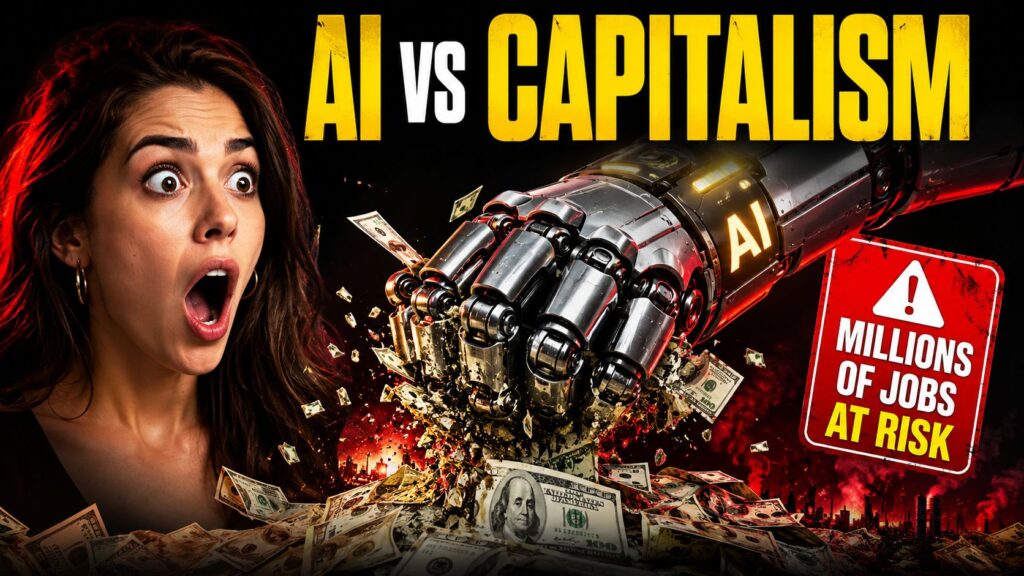
Will AI kill capitalism?
Will AI kill capitalism?
Will AI Kill Capitalism? The Question That’s Keeping Economists Up at Night
Picture this.
It’s 2031. You wake up, check your phone, and see a notification from your bank. Your monthly Universal Basic Income has arrived — $1,200 deposited automatically because, well, there are simply not enough jobs left for everyone to work a traditional 9-to-5. The factory near your town? Fully automated. The customer service center that employed 400 people? Replaced by an AI that handles 50,000 calls a day without a single coffee break.
Science fiction? Maybe. Maybe not.
This is the scenario that economists, philosophers, tech CEOs, and ordinary people are debating right now. And the question at the center of it all is deceptively simple:
Will AI kill capitalism?
Before you dismiss this as doomsday talk, consider the facts. <cite index=”1-1″>AI capital expenditure in the United States alone is estimated at $660 billion in 2026</cite> — money pouring into data centers, chips, and cloud infrastructure at a speed that is genuinely unprecedented. At the same time, <cite index=”3-1″>the World Economic Forum has estimated that artificial intelligence will replace some 85 million jobs by 2026.</cite>
Those two facts sitting side by side tell a very interesting story. The economy is growing. Investment is booming. And yet, millions of jobs are disappearing. This is not how capitalism is supposed to work — at least not the version most of us were taught in school.
So what is actually happening? And should you be worried?
Let’s find out.
What Is Capitalism, Really? (A Quick Refresher)
Before we talk about whether AI can kill capitalism, we need to be clear about what capitalism actually is — because a lot of people use the word without fully understanding it.
Capitalism is an economic system built on three core ideas:
Private ownership. Individuals and companies — not governments — own businesses, property, and the tools of production. Elon Musk owns Tesla. Jeff Bezos built Amazon. A local baker in Birmingham owns her bakery. That’s private ownership.
Free markets. Prices, wages, and production levels are mostly determined by supply and demand rather than government decree. If everyone suddenly wants oat milk, oat milk producers make more money. If nobody wants fax machines, fax machine companies go broke. The market decides.
Profit motive. People and companies do things because they expect to make money. This profit motive drives innovation, efficiency, and growth. The desire to get rich is, in capitalism’s view, a feature — not a bug.
Now here’s where it gets interesting. Capitalism has an implicit assumption baked into it: humans provide the labor. A factory needs workers. A law firm needs lawyers. A hospital needs doctors. When people work, they earn wages. When they earn wages, they spend money. When they spend money, businesses make profits. And the cycle continues.
AI threatens to break this cycle. Not quickly, not all at once, but gradually — and then, potentially, all at once.
The Robot Has Entered the Building
Let’s start with what’s already happening, because the future is not as far away as you might think.
Walk into any Amazon fulfillment center today and you will find thousands of robots doing the work that used to require thousands of humans. These robots don’t ask for sick days. They don’t join unions. They work 24 hours a day, 365 days a year, and they get better — and cheaper — every year.
Now zoom out. This is happening everywhere, across almost every industry.
In banking: JPMorgan Chase uses an AI called COIN that reviews commercial loan agreements in seconds. This used to take lawyers 360,000 hours of work every year. The AI does it in seconds and makes fewer mistakes.
In media: The Associated Press uses AI to write thousands of routine financial earnings reports. These are real news articles, published to real readers, written by software.
In medicine: AI systems are now diagnosing certain types of cancer from medical images with accuracy that matches or exceeds experienced radiologists. A radiologist spends roughly a decade in training. The AI learned in months.
In customer service: If you’ve ever been frustrated by a chatbot that actually understood your question and gave you a useful answer — that’s the new generation of AI at work. Companies are replacing entire call center teams with these systems.
In coding: <cite index=”4-1″>Online job vacancies explicitly requesting AI-related skills have shown a steep rise,</cite> while demand for traditional coding roles is shifting. Senior developers who know how to direct AI tools are becoming more valuable. Junior developers who do repetitive work are becoming less so.
The pattern is consistent. AI doesn’t just do one thing. It compresses entire categories of work — and it’s getting better every single year.
The Core Problem: Who Buys Things If Nobody Has a Job?
Here is the question that should keep every capitalist awake at night.
Henry Ford — the man who built the Ford Motor Company and essentially invented mass-market car manufacturing — once said something very smart. When asked why he paid his workers $5 a day (a high wage for the time), he reportedly said he needed to pay them enough so they could afford to buy his cars.
This was not generosity. This was business logic. Ford understood something fundamental about capitalism: workers are also consumers. If workers don’t have money, they can’t buy products. If they can’t buy products, companies can’t make profits. If companies can’t make profits, the whole system breaks down.
Now apply this logic to AI.
If AI replaces enough workers — or keeps wages low enough that most people can barely afford necessities — then who buys all the things that AI-powered factories and AI-powered companies produce?
<cite index=”1-1″>Productivity gains from AI flow to corporate profits and shareholder wealth, not workers. Consumers experience employment shock with a 2-4 quarter lag; corporations experience profit upside within quarters.</cite>
Translation: companies get richer faster than workers lose their jobs. But eventually, the workers lose their jobs. And when they do, the consumers disappear too.
This is the core contradiction at the heart of the AI-capitalism debate. It’s not a fringe concern. It’s a structural problem that serious economists are wrestling with right now.
Three Possible Futures: Which One Are We Heading Toward?
When economists and futurists look at the relationship between AI and capitalism, they generally describe three possible trajectories. Understanding these helps you form your own view.
Future 1: The Optimist’s View — AI Creates More Jobs Than It Destroys
History is on the optimist’s side — at least so far.
Every major technological revolution in human history has followed a similar pattern. New technology destroys old jobs and creates new ones. The printing press put scribes out of work but created publishing industries. The automobile eliminated horse carriage drivers but created mechanics, road builders, gas station workers, and traffic police. The internet killed travel agents and Blockbuster but created web designers, app developers, social media managers, and entire new economies.
<cite index=”2-1″>AI is driving higher productivity, wage, and job growth in leading companies, accelerating skill shifts and transforming entry-level roles, with AI-powered jobs growing faster and requiring advanced skills.</cite>
The optimists argue that AI will follow the same pattern. Yes, it will destroy certain categories of jobs. But it will create entirely new categories that we can’t yet imagine. Just as nobody in 1990 could have predicted that “social media influencer” or “app developer” would become viable careers, nobody today can fully predict what the AI economy will create.
There’s also the argument that AI will make everything cheaper. When production becomes cheaper, prices fall. When prices fall, people’s purchasing power increases. When purchasing power increases, demand rises. When demand rises, new businesses form to meet that demand. And those businesses hire people.
This is the optimist’s loop. It has worked before. It might work again.
Future 2: The Pessimist’s View — This Time Is Different
The pessimists have a compelling counter-argument: this time really is different.
Previous technological revolutions replaced human muscle. Machines took over physical labor — farming, manufacturing, construction. But humans still had cognitive superiority. We were still needed for thinking, analyzing, creating, deciding, and connecting.
AI is different because it replaces human cognition. It can analyze data faster than any human. It can write, design, code, diagnose, and decide. When AI can do most of what humans do with their minds — not just their bodies — the historical precedent may no longer apply.
<cite index=”3-1″>PwC estimates that by the mid-2030s, up to 30% of jobs could be automatable.</cite> That is not a small number. If 30% of the workforce is displaced faster than new jobs can be created — and in a global economy where AI itself accelerates the pace of change — the transition period could be devastating for millions of people.
The pessimists also point to a distribution problem. Even if AI creates new wealth overall, that wealth is not automatically distributed to the people who lost their jobs. A laid-off factory worker in rural Ohio doesn’t automatically become an AI prompt engineer in San Francisco. The skills gap, the geographic gap, and the age gap are all real barriers.
Goldman Sachs Research has been direct about this: <cite index=”8-1″>”The big story in 2026 in labor will be AI. Entry-level workers in their 20s and 30s, coming into the knowledge and content creation sectors, are likely to be most affected by new deployments of AI.”</cite>
These are not retired workers nearing the end of their careers. These are young people just starting out. If AI hits them hardest, the human cost is measured in decades of lost opportunity, not just quarterly earnings reports.
Future 3: The Hybrid View — Capitalism Transforms But Survives
The most nuanced view — and probably the most likely — is that capitalism doesn’t die. It transforms.
Capitalism has always adapted. It has survived wars, depressions, pandemics, and previous technological revolutions. It has evolved from agrarian capitalism to industrial capitalism to financial capitalism to platform capitalism. Each transformation was painful. Each transformation eventually produced a new equilibrium.
The question is what the AI version of capitalism looks like. And here, the answers vary widely:
Some economists argue for stakeholder capitalism — where companies are required to share AI productivity gains with workers and communities, not just shareholders.
Others argue for platform capitalism — where most work becomes gig-based and people earn from multiple AI-augmented side hustles rather than traditional employment.
Still others argue for a hybrid of capitalism and social policy — maintaining free markets but supplementing them with Universal Basic Income, funded by taxes on AI-generated corporate profits.
None of these futures is guaranteed. All of them are being actively debated right now in the corridors of power from Washington to Brussels to Beijing.
The Wealth Concentration Problem
One of the most serious criticisms of AI-era capitalism is not that it destroys jobs — it’s that it concentrates wealth in the hands of a very small number of people and companies.
Think about it this way. In 1970, the most valuable company in America was General Motors. GM employed hundreds of thousands of workers, paid them good wages, and those wages flowed through local economies — supporting diners, hardware stores, schools, and hospitals in cities across the Midwest.
Today, the most valuable companies in America are Apple, Microsoft, Nvidia, and Google. These companies are worth trillions of dollars. And yet their total global employee count is a fraction of what GM employed at its peak — relative to their market value. Nvidia, for example, became a $3 trillion company with roughly 30,000 employees. GM at its peak employed 600,000 people.
AI accelerates this trend. An AI system that replaces 100 workers generates profits for the company’s owners, not for the 100 workers. The owners are, by definition, already wealthy. The workers — who are often from lower and middle economic classes — lose their income.
<cite index=”5-1″>AI can lead to job displacement and increase the risk of economic inequality. According to a review of the economics of artificial intelligence, AI to a certain extent would rescind jobs and increase inequality.</cite>
When wealth concentrates too aggressively at the top, capitalism’s own mechanisms begin to break down. Wealthy individuals and corporations cannot consume enough to keep the economy running at full capacity. The mass market — which capitalism requires — depends on mass purchasing power. And mass purchasing power depends on broadly distributed wages.
This is not a radical observation. It’s classical economics.
What About the Developing World? A View From South Asia
This conversation takes on a different dimension when you look at it from the perspective of countries like Pakistan, India, Bangladesh, or the Philippines.
For decades, developing countries have lifted millions of people out of poverty through a well-established path: manufacturing jobs. Cheap labor attracts factories. Factories create employment. Employment raises wages. Rising wages create a middle class. A middle class drives domestic consumption and economic growth.
This is how South Korea went from a war-devastated country to a high-income economy in one generation. It’s how China lifted 800 million people out of poverty. It’s how Vietnam is currently industrializing at breakneck speed.
AI — and more specifically, AI combined with advanced robotics — threatens to close this pathway.
If AI-powered robots can manufacture goods in the United States or Germany at costs comparable to using human labor in Pakistan or Bangladesh, the economic logic of outsourcing manufacturing to cheap-labor countries disappears. The factories don’t move to developing countries anymore. They stay in wealthy countries, fully automated.
For a country like Pakistan — which has a young, rapidly growing population and desperately needs job creation — this is not an abstract concern. It’s an existential economic question.
The bright side is that AI also creates new opportunities. The global freelance economy, powered by platforms like Upwork and Fiverr, allows skilled workers in Pakistan and India to serve clients in the United States and Europe without leaving home. AI tools make individual freelancers more productive, potentially allowing them to earn more while working on more interesting projects.
But this path requires skills, reliable internet, and access to technology. It is not automatically available to everyone. And it is not a substitute for the broad-based employment that manufacturing once provided.
The developing world faces a genuine risk of being caught in a trap: too advanced for traditional manufacturing (which is being automated away) and not advanced enough to compete in the AI-powered knowledge economy. Navigating this trap will be one of the defining challenges of this generation.
The UBI Debate: A Capitalist Solution to AI Disruption?
If AI disrupts employment on a large scale, how does capitalism respond?
One increasingly mainstream answer is Universal Basic Income (UBI) — a policy where every citizen receives a regular cash payment from the government, regardless of employment status.
The idea sounds socialist on the surface. But many of its strongest advocates are actually libertarians and tech entrepreneurs — people who are deeply committed to capitalism. Elon Musk has said UBI is “necessary.” Sam Altman, CEO of OpenAI, ran a major UBI experiment in the United States. Several Silicon Valley investors actively support the policy.
Their reasoning is capitalist, not socialist: if AI destroys enough jobs, consumption collapses. If consumption collapses, capitalism collapses. UBI is a mechanism to maintain consumer spending — to keep the economic engine running — in a world where traditional employment can no longer do that job.
Whether UBI is the right answer is a genuinely open question. Critics argue it would be prohibitively expensive, reduce the incentive to work, and cause inflation. Proponents argue it would empower workers, stimulate innovation, and provide a necessary safety net in an AI-disrupted economy.
What’s significant is that this debate is happening at all. Five years ago, UBI was considered a fringe idea. Today, it’s a mainstream policy discussion in multiple countries. That shift reflects just how seriously serious people are taking the AI employment question.
What History Teaches Us — And What It Doesn’t
When people argue that AI will follow historical patterns and ultimately create more jobs than it destroys, they point to the Industrial Revolution as the primary example.
The Industrial Revolution, which began in Britain in the late 18th century, did eventually create massive prosperity and millions of new jobs. But the transition period — lasting roughly 60 to 80 years — was brutal for millions of people. Child labor. 16-hour workdays. Dangerous factory conditions. Entire communities destroyed when traditional crafts became obsolete.
The transition eventually worked out. But not for the generation that lived through the early decades. For them, it was genuinely catastrophic.
This is an important distinction. When economists say “historically, technology creates more jobs than it destroys,” they are describing outcomes measured over generations. The people who suffer displacement in the transition period don’t experience those long-term statistics. They experience unemployment, poverty, and social disruption in real time.
AI’s transition period may be shorter than the Industrial Revolution’s — because AI advances faster than steam engines did. But “shorter” might still mean 20 or 30 years of significant disruption. That’s an entire working lifetime for someone who is 25 today.
History teaches us that economies ultimately adapt. It does not teach us that the adaptation is painless, fast, or equitably distributed.
The Skills You Need in an AI Economy
Enough doom and gloom. Let’s talk about what you can actually do.
Whether AI kills capitalism or transforms it, certain skills will be valuable in almost every scenario. Understanding what those skills are gives you a practical framework for navigating whatever comes next.
Critical thinking and judgment. AI can process information. It struggles to make nuanced judgments in ambiguous situations. The ability to evaluate complex situations, weigh competing considerations, and make sound decisions under uncertainty will remain valuable.
Creativity and originality. AI can generate content. It does so by recombining patterns from existing data. Genuine originality — the ability to create truly novel ideas, art, stories, and solutions — remains a human advantage, though this advantage is narrowing.
Emotional intelligence. AI cannot genuinely empathize. It cannot build authentic human relationships. Roles that require deep human connection — therapy, leadership, teaching, caregiving, negotiation — remain largely AI-resistant, at least for now.
AI literacy. <cite index=”4-1″>Rather than eroding employment, AI is restructuring the value of skills. AI skills can act as a partial equalizer in hiring, shifting attention away from static characteristics toward demonstrable, current capabilities.</cite> Knowing how to use AI tools effectively — to direct, evaluate, and improve AI outputs — is rapidly becoming as fundamental as knowing how to use a computer.
Interdisciplinary thinking. AI is excellent within well-defined domains. It struggles to connect insights across very different fields. People who can bridge disciplines — combining, say, biology with economics, or engineering with psychology — provide something AI currently cannot replicate.
Entrepreneurship. In an AI-powered economy, the barriers to starting a small business are lower than ever. AI can handle many of the tasks — marketing copy, basic bookkeeping, customer service, content creation — that previously required hiring staff. A single skilled person with good judgment and AI tools can now do what previously required a small team. This is disruption, but it’s also opportunity.
The Regulatory Question: Can Governments Keep Up?
One of the most critical variables in the AI-capitalism equation is government policy. Markets don’t exist in a vacuum — they operate within regulatory frameworks that shape what is permitted, what is taxed, and what is prohibited.
The challenge is that AI is moving faster than any government has ever moved in response to a technological shift. The European Union’s AI Act — the world’s first comprehensive AI regulation — took years to negotiate and is still being implemented. By the time any major regulation is fully in force, the technology it regulates has already moved multiple generations forward.
This regulatory lag creates a window — which may last years or decades — during which the AI economy is largely ungoverned. In that window, the benefits of AI accrue primarily to the companies and investors who control the technology, while the costs — job displacement, wage stagnation, skill obsolescence — fall primarily on workers.
How governments respond will fundamentally shape whether the AI economy is compatible with broad-based prosperity. Options on the table include:
AI taxes or “robot taxes” — levying taxes on companies for each human job replaced by automation, with proceeds funding retraining programs or UBI.
Profit-sharing mandates — requiring companies above a certain size to share AI productivity gains with workers.
Data rights — establishing that individuals have property rights over their personal data, which is a critical input to AI systems, entitling them to compensation.
Public AI investment — governments funding AI research and development as a public good, ensuring the benefits are broadly shared rather than monopolized by private companies.
None of these policies is straightforward. All of them involve genuine tradeoffs. But the absence of policy is itself a choice — one that defaults to outcomes determined entirely by market forces.
Real People, Real Consequences: Three Stories
Sometimes the most powerful way to understand a global trend is through individual stories.
Maria, 34, Manila, Philippines. Maria has worked in a business process outsourcing call center for eight years, handling customer service calls for an American telecommunications company. The work is repetitive but pays well by local standards and has supported her family. In 2025, her employer began piloting an AI system that handles 70% of calls without human involvement. Maria has been told her team will be “restructured” by the end of the year. She is now taking online courses in digital marketing, hoping to pivot. She is worried it won’t be fast enough.
James, 28, Manchester, UK. James is a junior software developer who graduated two years ago into what seemed like a booming job market. He’s now competing for roles against both experienced developers and AI coding tools that can generate functional code faster than he can. His more senior colleagues are more valuable than ever — they direct the AI tools and review outputs. James is in an uncomfortable middle ground: not senior enough to lead AI, not irreplaceable enough to ignore. He’s doubling down on specialized knowledge in AI security, an area where human judgment remains essential.
Aisha, 41, Karachi, Pakistan. Aisha runs a small content writing agency with five employees, producing articles and marketing copy for clients in the US and UK. Her clients are increasingly asking if she can lower prices because “AI can do this.” She has adapted by positioning her agency as providing AI-assisted but human-verified content — using AI for drafts and speed, her team for quality control and cultural nuance. Her revenue is down 20% from peak but she’s still operational. She believes the agencies that survive will be those that figure out the right human-AI collaboration model.
Three people. Three countries. Three different situations. All navigating the same fundamental shift in real time.
So — Will AI Kill Capitalism?
After all of this, here is the most honest answer available: probably not kill it, but almost certainly transform it in ways we can’t fully predict.
Capitalism is remarkably adaptable. It has survived world wars, the Great Depression, the Cold War, and multiple technological revolutions. It will likely survive AI too — but in a form that may look quite different from what we have today.
The most plausible near-future scenario is not the death of capitalism but its bifurcation: an AI-powered economy that is extraordinarily productive and generates enormous wealth, combined with a social and political crisis about how that wealth is distributed. The economic system produces abundance. The political system struggles to distribute that abundance in ways that maintain social stability.
This is not a hypothetical. It is already happening. <cite index=”1-1″>AI capital spending creates demand for materials, construction labor, and semiconductor manufacturing, while productivity gains flow to corporate profits and shareholder wealth, not workers.</cite> The economy grows. The gains concentrate. And the political tension that results from that concentration is visible in elections and social movements across the developed world.
The question is not really “will AI kill capitalism?” The more important question is: what kind of capitalism do we want in an AI world, and who gets to decide?
That question is not answered by economists or technologists. It is answered by voters, policymakers, workers, entrepreneurs, and citizens — by people making choices about what kind of society they want to live in.
And that means it is partly answered by you.
Practical Takeaways: What You Can Do Right Now
Whatever the macro outcome, here are actionable steps for navigating the AI economy at an individual level.
Invest in AI literacy. You do not need to be a programmer. But understanding how AI tools work, what they can and cannot do, and how to use them effectively in your work is rapidly becoming a baseline professional skill. Start with tools relevant to your field.
Develop skills that complement AI. Focus on judgment, creativity, emotional intelligence, and interdisciplinary thinking — areas where human capability currently exceeds AI capability and where the gap is likely to close more slowly.
Think like an entrepreneur. In an AI-augmented economy, the leverage available to a skilled individual is greater than ever before. AI tools lower the cost of starting and running a business. If you have valuable knowledge or skills, think about how you can offer them directly — not just as an employee, but as a service provider or creator.
Stay informed. The AI economy is moving fast. Policies, tools, and opportunities are changing constantly. Staying informed is not optional — it’s a form of professional maintenance.
Advocate for fair policy. Individual adaptation matters. But systemic change requires collective action. The policy choices made in the next five to ten years will shape the AI economy for decades. Engaging with those choices — voting, advocating, participating in public debate — matters more than most people realize.
Conclusion: The Most Important Economic Question of Our Time
The question “will AI kill capitalism?” is really a proxy for a deeper question: will the people who create and deploy AI share the benefits with everyone, or will they capture those benefits for themselves?
Capitalism has produced extraordinary prosperity. It has also produced extraordinary inequality. AI amplifies both capabilities. In the hands of a small number of powerful actors, operating without regulation or accountability, AI could accelerate inequality to levels that undermine the social contract that capitalism depends on.
But AI could also be a democratizing force — lowering barriers to entrepreneurship, expanding access to information, making expertise available to people who previously couldn’t afford it.
The technology itself doesn’t determine the outcome. Policy, culture, and collective choices do.
<cite index=”2-1″>AI is creating a two-track labor market — AI-powered jobs growing faster and requiring advanced skills, while traditional roles transform or disappear.</cite> The challenge for societies is to ensure that the track to AI-powered prosperity is not a private road accessible only to those who are already wealthy and well-positioned.
Whether capitalism survives AI is, in a real sense, up to us.
And that might be the most hopeful thing about this entire conversation.
Frequently Asked Questions
Q: Will AI replace all human jobs? Almost certainly not all of them. But it will significantly transform most of them and directly replace a substantial number. <cite index=”3-1″>PwC estimates that by the mid-2030s, up to 30% of jobs could be automatable.</cite> The most vulnerable are routine cognitive tasks — data processing, basic writing, customer service, and entry-level analysis.
Q: Which jobs are safest from AI disruption? Jobs requiring genuine human connection, complex physical dexterity in unstructured environments, creative originality, and high-stakes judgment under uncertainty are currently most resistant to AI replacement. Healthcare (especially caregiving and complex diagnosis), skilled trades, original creative work, and roles requiring deep relationship management tend to be more resilient.
Q: What is Universal Basic Income and why is it relevant? UBI is a policy where every citizen receives a regular unconditional cash payment from the government. It’s relevant to the AI debate because if AI displaces enough workers, traditional employment can no longer sustain consumer spending. UBI is one proposed mechanism to maintain purchasing power in an AI-disrupted economy.
Q: How does AI affect developing countries differently? Developing countries face specific risks: AI and automation may reduce the economic logic of locating manufacturing in cheap-labor countries, closing off a proven development pathway. At the same time, AI tools create new opportunities for skilled workers in developing countries to participate in the global knowledge economy as freelancers and entrepreneurs.
Q: Is capitalism the only economic system that can coexist with AI? No. Different economic systems could theoretically coexist with AI. But capitalism’s flexibility and adaptability give it a reasonable chance of surviving the transition — though almost certainly in a modified form that incorporates stronger social safety nets and more active redistribution mechanisms than today’s version.
Sources and Further Reading:
- Goldman Sachs Research — How Will AI Affect the US Labor Market?
- PwC Global AI Jobs Barometer 2026
- World Economic Forum — AI Skills and the Future of Work
- McKinsey Global Institute — AI and the Future of Work
- Nexford University — How Will AI Affect Jobs 2026-2030
- Bureau of Economic Analysis — US GDP Data
- Harvard Business Review — AI and the Future of Work
MORE FROM US

Pingback: How to Use Claude AI for Lead Generation