GPT-5.5 Review 20261
GPT-5.5 Review 2026
GPT-5.5 Review 2026: Features, Benchmarks & Is It Worth the 2x Price Hike?
Complete hands-on analysis with real benchmark data, pricing breakdown, and an honest verdict on who should actually upgrade.
🚀 Introduction: OpenAI’s Fastest Release Cycle Ever
Six weeks. That is all the time that passed between GPT-5.4 (March 5, 2026) and GPT-5.5 (April 23, 2026). For context, OpenAI used to take six months to a year between major model releases. Now they are shipping flagship models faster than some companies ship software updates.
This pace is not confidence. It is pressure.
The AI race in 2026 has never been tighter. OpenAI chief scientist Jakub Pachocki told reporters that “the last two years have been surprisingly slow” and that gains will accelerate from here. Claude Opus 4.7 dropped on April 16. GPT-5.5 dropped one week later on April 23. DeepSeek V4 launched the same day with pricing so aggressive it felt like a typo. The frontier is being pushed from every direction simultaneously. Orange MonkE
Into this environment, OpenAI released GPT-5.5 — codenamed “Spud” internally — and positioned it as their most capable model ever. Developer reactions were split. Some teams switched immediately. Others looked at the benchmarks, shrugged, and kept running Claude. The honest answer is that no single model wins across every workload in April 2026. The differentiation has shifted from raw intelligence to specificity: which model is best for your tasks, at your price point, on your infrastructure. SEO-Kreativ
This review cuts through the noise. Real benchmarks. Verified pricing. Honest verdict on who should switch and who should not.
🤖 What Is GPT-5.5?
GPT-5.5, also known by its codename “Spud”, is a large language model released by OpenAI on April 23, 2026. It became ChatGPT’s default model on May 5, 2026 — replacing GPT-5.4 for all users on paid plans. Expresso Company
GPT-5.5 is the first fully retrained OpenAI base model since GPT-4.5. Every model in between was an incremental update built on the same foundation. GPT-5.5 is a ground-up rebuild, and that distinction matters. Orange MonkE
What does “ground-up rebuild” actually mean in practice? It means the model was not patched or fine-tuned from a previous version. The weights, architecture decisions, and training pipeline were redesigned from scratch — resulting in fundamentally different behavior patterns, not just marginal benchmark improvements.
The result is a model that OpenAI has positioned squarely at agentic use cases: autonomous multi-step task execution, long-context reasoning, computer use, and coding workflows that run for hours without human intervention.
Key facts at a glance:
| 📋 Detail | ✅ Information |
|---|---|
| Full name | GPT-5.5 (codename: “Spud”) |
| Developer | OpenAI |
| Release date | April 23, 2026 |
| Default in ChatGPT | May 5, 2026 |
| Predecessor | GPT-5.4 (March 5, 2026) |
| Architecture | Ground-up retrained base model |
| Context window | 1 million tokens (API) / 400K (Codex) |
| Overall benchmark rank | #4 out of 119 models (BenchLM.ai) |
| Primary strength | Agentic coding, computer use, long-context tasks |
⚡ GPT-5.5 Key Features
🧠 1. Native Omnimodal Architecture
GPT-5.5 processes text, images, audio, video, and documents natively — not as separate modalities bolted together, but as a unified architecture. This means the model does not switch modes when you upload an image or attach a document. It reasons across all input types simultaneously, which produces significantly better results on multi-modal tasks than previous models that handled each type separately.
📄 2. One Million Token Context Window
The MRCR v2 benchmark at 1 million tokens jumped from 36.6 percent on GPT-5.4 to 74.0 percent on GPT-5.5. This is not just a larger number on a spec sheet — it represents a genuine improvement in how effectively the model uses long context. Previous models with large context windows often degraded in quality as they approached their limits. GPT-5.5 maintains coherence significantly better across the full million token range. The DigitalFlix
For practical purposes, one million tokens means you can load an entire codebase, a book-length document, or months of chat history into a single conversation and the model will reason across all of it effectively.
🔧 3. Hardware Co-Designed with NVIDIA
The NVIDIA integration makes this concrete. 10,000-plus NVIDIA employees across engineering, legal, marketing, and HR now have GPT-5.5-powered Codex access. Jensen Huang’s internal email calling it a “jump to lightspeed” moment is a landmark data point: this is not a developer tool anymore. A company of 30,000 people is restructuring around it. Orange MonkE
The co-design with NVIDIA means GPT-5.5 is optimized for the hardware it runs on at a level that previous models were not — resulting in better inference efficiency, lower latency, and cost structures that support the model’s broad enterprise deployment.
🤖 4. Agentic Workflow Optimization
This is GPT-5.5’s defining characteristic. GPT-5.5 is not a better chatbot. It is a model designed to do work autonomously — calling tools, maintaining state across long tasks, and recovering from errors without human intervention. If you are evaluating it as a general-purpose assistant, you will probably feel underwhelmed. If you are building agentic workflows, you might be looking at your new primary model. Launchcodex
📉 5. Reduced Hallucination Rate (With a Major Caveat)
Hallucination rates dropped by about 3 percent compared to GPT-5.4. However, it is critical to understand that GPT-5.5 still has a significantly higher hallucination rate than Claude Opus 4.7 on long-form factual tasks — a point we cover in detail in the comparison section below. The DigitalFlix
🔀 GPT-5.5 Variants Explained
Not all GPT-5.5 is the same. OpenAI launched two variants with meaningfully different capabilities and price points:
| 🔢 Variant | 💰 Price | 📱 Available On | 🎯 Best For |
|---|---|---|---|
| GPT-5.5 (Standard) | $5/M input, $30/M output | Plus, Pro, Business, Enterprise, API | General use, agentic tasks, long documents |
| GPT-5.5 Thinking | Included in Plus+ | Plus, Pro, Business, Enterprise | Complex reasoning, math, step-by-step problems |
| GPT-5.5 Pro | $30/M input, $180/M output | Pro, Business, Enterprise only | High-stakes business, legal, data science tasks |
| GPT-5.5 in Codex | Included in paid plans | Codex CLI and API | Autonomous coding, 400K context |
GPT-5.5 Pro is roughly 6x more expensive per token than the base model — a price point that targets enterprise deployments where the additional capability justifies the cost, not individual users or small teams. Digital Applied Team
📊 GPT-5.5 Benchmarks: The Numbers That Actually Matter
OpenAI published a 100-page system card at launch with extensive benchmark data. Most of it is technical noise for general users. Here are the five benchmark results that actually matter for understanding what GPT-5.5 can and cannot do:
Full Benchmark Comparison: GPT-5.5 vs Claude Opus 4.7 vs Gemini 3.1 Pro
| 🏆 Benchmark | 🟦 GPT-5.5 | 🟠 Claude Opus 4.7 | 🔵 Gemini 3.1 Pro | 🏅 Winner |
|---|---|---|---|---|
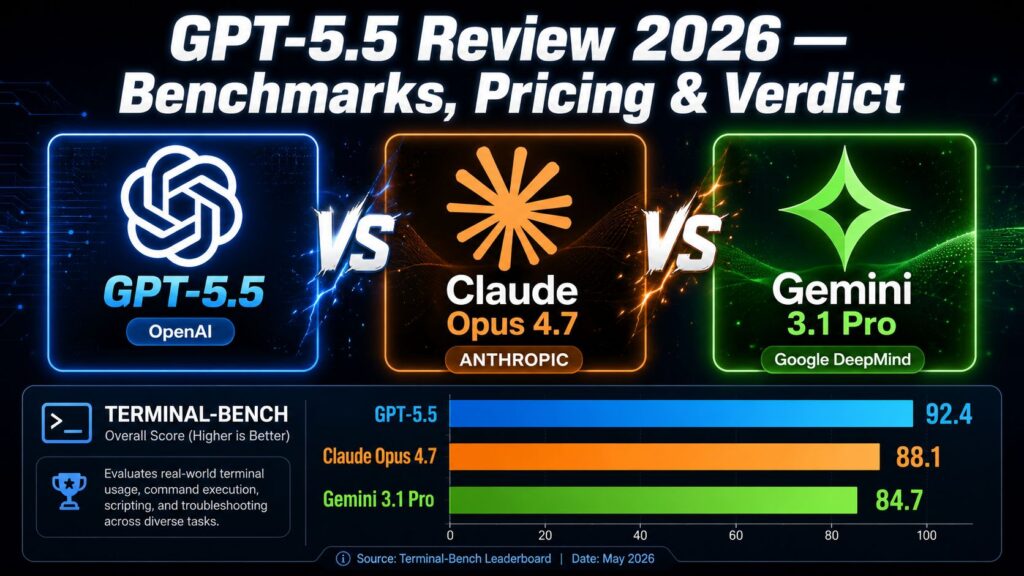
| Terminal-Bench 2.0 | 82.7% | 69.4% | 71.3% | GPT-5.5 ✅ |
| SWE-Bench Pro | 58.6% | 64.3% | 55.1% | Claude ✅ |
| ARC-AGI-2 | 85.0% | 75.8% | 79.2% | GPT-5.5 ✅ |
| MRCR v2 (1M tokens) | 74.0% | 32.2% | 68.1% | GPT-5.5 ✅ |
| FrontierMath Tier 1–3 | 51.7% | 44.1% | 48.3% | GPT-5.5 ✅ |
| FrontierMath Tier 4 | 35.4% | 30.2% | 33.1% | GPT-5.5 ✅ |
| Humanity’s Last Exam | 41.4% | 46.9% | 39.7% | Claude ✅ |
| OSWorld (Computer Use) | 78.7% | 71.2% | 63.4% | GPT-5.5 ✅ |
| MMMU-Pro (Multimodal) | 71.3% | 68.4% | 83.6% | Gemini ✅ |
| Hallucination Rate | 86% ❌ | 36% ✅ | 52% | Claude ✅ |
| Overall BenchLM Rank | #4/119 | #6/119 | #8/119 | GPT-5.5 ✅ |
Sources: OpenAI System Card, BenchLM.ai, DEV Community Analysis
🔑 Key Takeaways From the Benchmarks
GPT-5.5 wins: Autonomous agent tasks, computer use, long-context retrieval, general reasoning benchmarks, and math.
Claude Opus 4.7 wins: Real-world coding (SWE-Bench Pro), factual accuracy, and complex multi-file software engineering — the benchmarks that map most directly to day-to-day developer work.
Gemini 3.1 Pro wins: Multimodal tasks, cost efficiency, and speed — at $12 per million output tokens it is the cheapest of the three frontier models.
The April 2026 frontier is differentiated enough that routing by task type is now the correct architecture. GPT-5.5 on terminal and browser tasks, Claude Opus 4.7 on complex multi-file coding and tool orchestration, Gemini 3.1 Pro on research, video, and long-context analysis — that is not hedging, it is the optimal engineering decision given where benchmarks actually sit. SEO-Kreativ
📈 GPT-5.5 vs GPT-5.4: What Actually Changed?
If you are currently using GPT-5.4 and wondering whether to upgrade, here is the specific delta:
| 📊 Metric | GPT-5.4 | GPT-5.5 | 📈 Change |
|---|---|---|---|
| Terminal-Bench 2.0 | 75.1% | 82.7% | +7.6 points |
| MRCR v2 (long context) | 36.6% | 74.0% | +37.4 points ⚡ |
| Hallucination rate | ~89% | ~86% | -3 points |
| Context window (API) | 256K | 1M tokens | 4x increase |
| Architecture | Incremental update | Ground-up retrain | Major rebuild |
| Default in ChatGPT | No | Yes (from May 5) | ✅ |
The MRCR v2 jump from 36.6% to 74.0% is the most significant improvement and the most underrated number in the entire launch. The MRCR v2 benchmark at 1 million tokens jumped from 36.6 percent on GPT-5.4 to 74.0 percent on GPT-5.5. GPT-5.5 is most useful for agentic coding, multi-step tasks, and long-document work. The DigitalFlix
For users who primarily use ChatGPT for writing, research, or general Q&A, the difference between GPT-5.4 and GPT-5.5 will feel modest. For developers building agentic systems or working with long documents, the improvement is substantial.
💰 GPT-5.5 Pricing: Is the 2x Price Hike Justified?
The pricing story is one of the most controversial aspects of the GPT-5.5 launch. Here is the complete breakdown:
API Pricing
| 🔢 Model | 📥 Input (per 1M tokens) | 📤 Output (per 1M tokens) |
|---|---|---|
| GPT-5.5 Standard | $5 | $30 |
| GPT-5.5 Pro | $30 | $180 |
| Claude Opus 4.7 | $5 | $25 |
| Gemini 3.1 Pro (under 200K) | $2 | $12 |
| Gemini 3.1 Pro (over 200K) | $4 | $18 |
Source: OpenAI Pricing Page, Anthropic Pricing, OpenRouter
Real Cost Comparison for Developers
Assume a coding session with 50K input tokens and 5K output tokens. Over 100 sessions per month, that comes to $12 with Gemini versus $33 with GPT-5.5 versus $113 with Claude Opus 4.7. The difference is massive at scale. Channelpro
Is the 2x Price Hike Justified?
Yes, if: You are building autonomous agents, running multi-hour computer use tasks, or processing million-token documents where GPT-5.5’s specific capabilities deliver measurable value.
No, if: You are using AI primarily for writing assistance, content creation, customer support, or general Q&A — where Claude Opus 4.7 or even GPT-5 delivers equivalent output at lower cost.
The honest answer: for most individual users and small businesses, GPT-5.5 Pro is overpriced. The standard GPT-5.5 at $5 input / $30 output is competitive. GPT-5.5 Pro at $30 input / $180 output is enterprise territory.
🎯 Who Should Use GPT-5.5?
✅ Best Use Cases for GPT-5.5
Agentic Coding and Developer Workflows If you are building AI agents that execute code autonomously, GPT-5.5’s Terminal-Bench score of 82.7% — the highest of any current frontier model — makes it the clear choice for this use case. Cursor, Codex CLI, and similar agentic coding tools running GPT-5.5 will outperform equivalent Claude-powered setups on pure execution speed and tool orchestration.
Long Document Processing The jump from 36.6% to 74.0% on MRCR v2 means GPT-5.5 is dramatically better than GPT-5.4 at maintaining accuracy across million-token contexts. For businesses processing lengthy legal documents, financial reports, or technical specifications, this improvement is genuinely meaningful.
Computer Use and Browser Automation OSWorld score of 78.7% makes GPT-5.5 the leading model for computer use tasks — controlling browsers, filling forms, navigating interfaces, and executing multi-step desktop workflows.
Enterprise Automation The company that gets tens of millions of ChatGPT users standardized on its interface — and enterprises locked into annual procurement contracts — wins the enterprise AI race regardless of which model scores highest on SWE-Bench Pro in Q3 2026. That is the bet OpenAI is making. Orange MonkE
❌ When to Stick With Claude or Gemini
High-Accuracy Writing and Research GPT-5.5 hallucinates at roughly 86% on a long-form factuality test, compared to 36% for Claude Opus 4.7. That gap matters most for client-facing writing, research summaries, and any work where accuracy is the product. If factual precision is your priority — legal documents, medical content, financial reports, journalism — Claude Opus 4.7 is the significantly safer choice. Digital Applied Team
Production Code That Ships to Users Claude Opus 4.7 produces more careful output with better handling of edge cases and uncertainty. For high-stakes code where correctness and reviewability matter more than speed, Opus 4.7 is typically the better choice. Launchcodex
Budget-Conscious High-Volume Use At $2 input / $12 output, Gemini 3.1 Pro is dramatically cheaper for high-volume API use. For content generation at scale, batch processing, or any use case where cost per token is the dominant variable, Gemini wins.
🗣️ Real User Reactions and Community Response
The developer community response to GPT-5.5 has been genuinely split — which itself tells you something important about where the model lands.
The enthusiasts: Developers building autonomous agents were immediately impressed. The Terminal-Bench improvement and long-context MRCR v2 jump translated directly into better performance on real workflows. Teams running Codex for automated coding tasks reported measurable speed improvements.
The skeptics: Developers who primarily use AI for writing, code review, and reasoning were less impressed. Claude Opus 4.7 — released just one week earlier — was widely seen as the better choice for these use cases, and the 86% hallucination rate on factual tasks became a major discussion point.
The enterprise buyers: Jensen Huang’s “jump to lightspeed” email about deploying GPT-5.5-powered Codex across NVIDIA’s 30,000-person workforce was the most significant real-world endorsement the model received. It confirmed that GPT-5.5 delivers enterprise value beyond benchmark numbers.
The Sam Altman controversy: Altman’s post-launch quotes generated significant debate about whether the 2x price increase for GPT-5.5 Pro was justified given the competitive landscape. The developer community was vocal about the pricing optics relative to Claude and Gemini alternatives.
🔮 What Is Coming Next — GPT-5.6?
Prediction markets as of mid-May 2026 gave 80 to 89 percent odds for a GPT-5.6 public release by June 30, 2026. Context window probes suggest developers using ChatGPT Pro OAuth reportedly invoked the model with up to 1.5 million tokens — a roughly 43 percent increase over GPT-5.5’s reported capabilities in some environments. Channelpro
Based on available leak data and prediction market consensus, GPT-5.6 is expected to bring:
- Deeper long-context reasoning — potentially beyond 1M tokens effective use
- Improved planning and error recovery in multi-step agentic execution
- UltraFast mode in Codex — rumored 2 to 5x speed boosts for coding tasks
- Better performance on Terminal-Bench and GPQA benchmarks
- Response to Claude competition — particularly in coding domains where Anthropic has gained ground
The six-week release cadence means GPT-5.6 could arrive before you finish reading this article. If you are planning a major infrastructure commitment to GPT-5.5, it is worth waiting a few weeks to see what GPT-5.6 delivers before locking in enterprise contracts.
🏆 Final Verdict: Should You Use GPT-5.5?
After reviewing the benchmarks, pricing, and real-world user feedback, here is our honest assessment:
| 👤 User Type | ✅ Recommendation | 💡 Reason |
|---|---|---|
| Agentic developers | Use GPT-5.5 | Terminal-Bench 82.7% is the best available |
| Production code engineers | Stick with Claude Opus 4.7 | SWE-Bench Pro 64.3% and lower hallucinations |
| Long document analysts | Use GPT-5.5 | MRCR v2 74% is a genuine leap |
| Content creators and writers | Stick with Claude | 86% hallucination rate is too high for accuracy-critical work |
| High-volume API users | Use Gemini 3.1 Pro | 3x to 10x cheaper for equivalent quality |
| Computer use / browser agents | Use GPT-5.5 | OSWorld 78.7% leads the field |
| Enterprise teams | GPT-5.5 or Claude | Depends on primary use case |
| General ChatGPT users | GPT-5.5 is now your default | It replaced GPT-5.4 on May 5 automatically |
The honest summary: if you can only license one of these three models for your team this quarter, license Claude Opus 4.7 — it has the lowest hallucination rate, leads the coding benchmarks that map to actual product work, and its weaknesses are well-mapped enough that you can route around them. If you do enterprise-scale long-document analysis, add Gemini 3.1 Pro as the second seat. Pravinkumar
GPT-5.5 is a genuinely impressive model for specific use cases — particularly agentic coding and long-context tasks. But the 2x price hike for GPT-5.5 Pro is hard to justify for most users, and the hallucination rate remains a significant concern for accuracy-critical applications. For the majority of knowledge workers, Claude Opus 4.7 remains the safer, more reliable daily driver.
✅ Conclusion
GPT-5.5 is OpenAI’s most capable model as of April 2026 — rebuilt from the ground up, optimized for agentic workflows, and delivering a genuine breakthrough in long-context performance. The MRCR v2 jump from 36.6% to 74.0% alone makes it a significant release for anyone working with million-token documents or multi-step autonomous agents.
But “most capable” does not always mean “best choice.” The 86% hallucination rate on long-form factual tasks, the 2x price hike for Pro variants, and Claude Opus 4.7’s sustained lead on real-world coding benchmarks mean that GPT-5.5 is a specialist tool, not a universal replacement.
The right approach in mid-2026 is to match your model to your task: GPT-5.5 for autonomous agents and long-context work, Claude Opus 4.7 for production code and accuracy-critical writing, Gemini 3.1 Pro for cost-sensitive high-volume use. The era of one model for everything is over — and that is actually good news for developers who know how to route intelligently.
❓ Frequently Asked Questions
When did GPT-5.5 launch? GPT-5.5 launched on April 23, 2026 and became ChatGPT’s default model on May 5, 2026.
What is GPT-5.5’s codename? GPT-5.5 is codenamed “Spud” internally at OpenAI.
Is GPT-5.5 better than Claude Opus 4.7? It depends on the task. GPT-5.5 leads on agentic coding (Terminal-Bench 82.7%), long-context tasks (MRCR v2 74%), and computer use (OSWorld 78.7%). Claude Opus 4.7 leads on real-world coding (SWE-Bench Pro 64.3%) and has a dramatically lower hallucination rate (36% vs 86%). Neither model wins across all categories.
What is GPT-5.5’s context window? GPT-5.5 has a 1 million token context window in the API and a 400K context window in Codex.
How much does GPT-5.5 cost? GPT-5.5 Standard costs $5 per million input tokens and $30 per million output tokens. GPT-5.5 Pro costs $30 per million input tokens and $180 per million output tokens.
Is GPT-5.5 available for free? GPT-5.5 is available to ChatGPT Plus, Pro, Business, and Enterprise subscribers. Free tier users do not have access to GPT-5.5.
What is coming after GPT-5.5? GPT-5.6 is expected in late June or July 2026, with prediction markets giving 80 to 89 percent odds of a public release by June 30, 2026. Expected improvements include deeper long-context reasoning, faster Codex performance, and improved agentic planning.
Should I switch from GPT-5.4 to GPT-5.5? For most ChatGPT users, GPT-5.5 replaced GPT-5.4 automatically on May 5. For API users, the upgrade is worth it if you are running agentic workflows or processing long documents. For general writing and research tasks, the improvement over GPT-5.4 is meaningful but not dramatic.
MORE FROM OUR BLOG
AI IS REPLACING PEOPLE ARE YOU NEXT

Pingback: MIT’s Incredible Innovation: AI Can Now Move Your Hands — The Complete Story of “Human Operator”
Pingback: Will AI kill capitalism?