China AI university degrees
China AI university degrees
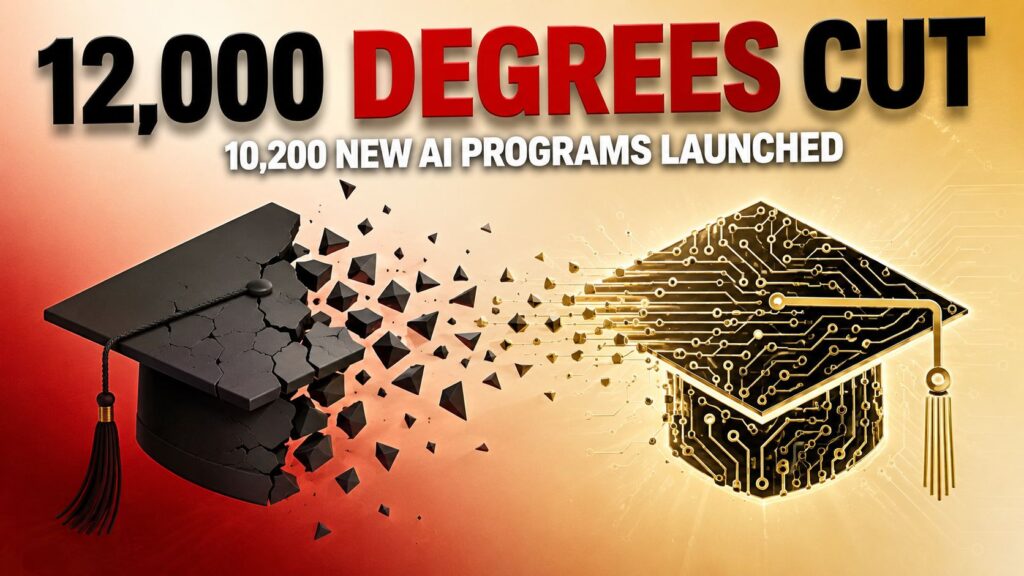
Picture a university that quietly stops admitting students into a program that used to fill lecture halls every fall. No press conference, no dramatic announcement, just a line item in a Ministry of Education report. That’s roughly how this played out across China, thousands of times over, until the total added up to something genuinely hard to ignore: more than 12,000 university degree programs eliminated, and over 10,000 new ones launched to replace them, almost all pointed squarely at artificial intelligence, robotics, and advanced computing.
If you’ve seen this figure circulating recently with dramatic framing, “China just axed 12,000 degrees overnight,” it’s worth slowing down on the actual timeline before reacting to it. This wasn’t a single announcement or a sudden policy shock. It happened gradually, between 2021 and 2025, and only became widely discussed once the cumulative scale of it became clear. That doesn’t make it any less significant. If anything, a five-year, deliberate restructuring of a third of a country’s university system says more about long-term intent than a single dramatic decree ever could.
The Actual Numbers, Without the Exaggeration
According to Ministry of Education data cited by China’s state news agency Xinhua, and reported in detail by the South China Morning Post, Chinese higher education institutions revoked or suspended 12,200 undergraduate degree programs between 2021 and 2025, while introducing 10,200 new ones over the same stretch. That means more than 30% of the country’s entire undergraduate program catalog was touched by this restructuring, a scale that’s genuinely unusual for any national education system, anywhere.
The programs getting cut cluster heavily in a specific set of fields: arts, humanities, foreign languages, human resources management, accounting, public administration, and international economics. According to a detailed breakdown from WION’s coverage of the overhaul, these were fields that produced millions of graduates annually in China but are increasingly viewed by administrators as oversaturated or misaligned with where the job market is actually heading, particularly as AI systems take over tasks like hiring screens, financial reconciliation, content moderation, and basic customer service work that used to require a dedicated graduate.
What’s replacing them is pointed almost entirely at one direction. Universities are launching new majors in semiconductor design, robotics engineering, AI systems integration, and a field most people outside academia have never heard of: embodied intelligence, essentially the science of building AI systems that can operate physical machines and humanoid robots in the real world rather than just process information on a screen. Nine universities have already introduced formal degree programs specifically in embodied intelligence, a subject that, as WION’s report notes, barely existed as a distinct academic discipline five years ago.
This Is a Jobs Crisis Response, Not Just an AI Enthusiasm Play
It would be easy to read this purely as China racing to dominate AI for its own sake, and that’s certainly part of the motivation. But the more immediate driver, according to multiple reports, is a genuine graduate employment emergency.
China’s youth unemployment rate has hovered at levels high enough to worry policymakers directly, and a huge chunk of that pressure sits specifically among university graduates holding degrees the job market increasingly doesn’t want. Bloomberg’s coverage of the restructuring frames it plainly: Beijing has “shredded the old college prospectus,” dismissing many previously standard programs as relics of a bygone era, precisely because graduates from those programs were struggling to find work that matched their training.
One recent graduate from the University of Shanghai for Science and Technology, cited in the South China Morning Post’s reporting, described how the university halted admissions to its product design program specifically because of AI’s impact on that field. “The rapid development of AI has hit product design hard,” the graduate said. “Many core tasks” that used to require a trained human designer are now handled, at least partially, by AI tools. That’s not an abstract policy argument, that’s a specific field getting restructured because the jobs it used to feed into are genuinely shrinking.
What This Looks Like Compared to How Other Countries Are Handling the Same Pressure
Here’s where China’s approach becomes genuinely distinctive, and it comes down to a structural difference in how education systems work, not just a difference in ambition.
According to Forbes’ analysis of the policy, China’s central government exercises extensive oversight over university curricula and can steer academic priorities directly through national policy and funding decisions. When Beijing decides arts and humanities programs are oversaturated, it has the direct administrative levers to shrink them at scale and redirect resources toward AI-focused alternatives, across the entire country, in a coordinated way.
The US and most Western systems don’t work that way at all. Universities operate with far greater institutional autonomy, and what gets taught is shaped primarily by individual institutional leadership, faculty governance, and market demand rather than a single centralized national strategy. That’s not a flaw exactly, it protects academic independence in ways China’s more centralized model doesn’t, but it also means no American university system could replicate this specific kind of rapid, coordinated, nationwide curriculum shift even if it wanted to.
A few other countries are moving in a similar direction, just at a different pace and scale. Spain has built AI literacy directly into its national curriculum as part of a broader “Digital Spain” strategy. In the UK, the Department for Education has been exploring a dedicated data science and AI qualification to sit alongside GCSEs and A-levels, though the biggest planned overhaul to the national curriculum in over a decade isn’t set to begin implementation until September 2028, a timeline that looks almost leisurely next to China’s already-completed five-year sweep.
| Country | Approach | Pace | Mechanism |
|---|---|---|---|
| China | Mass program elimination + AI-focused replacement | Completed 2021-2025 | Centralized Ministry of Education directive |
| Spain | AI literacy woven into existing curriculum | Ongoing | National “Digital Spain” strategy |
| UK | New AI/data science qualification under exploration | Implementation from 2028 | Department for Education review |
| US | No coordinated national policy | Varies by institution | Individual university and market-driven decisions |
Which Fields Actually Got the Axe
Digging into the specifics helps make this less abstract. The programs facing elimination weren’t randomly selected, they follow a clear logic tied to where China’s Ministry of Education sees oversupply relative to actual job market demand.
Public administration, accounting, and HR management programs were producing graduates in numbers that outpaced available roles, particularly as AI tools increasingly handle routine administrative and financial reconciliation work. International economics and foreign language programs, once seen as safe, prestigious choices, have seen shrinking demand as translation AI and broader economic automation reduce the number of specialized roles that specifically require those degrees. Editing and advertising programs, similarly, are being scaled back as AI content tools take over a growing share of work that used to require a dedicated graduate specifically trained in those crafts.
On the other side of the ledger, the fastest-growing new programs cluster around a few clear priorities: semiconductor design and manufacturing, tied directly to China’s push for chip self-sufficiency; robotics engineering, feeding into the country’s manufacturing and automation ambitions; AI systems integration, the practical skill of actually deploying AI tools inside real businesses and infrastructure; and embodied intelligence, the newest and most specialized of the group, focused specifically on AI that operates in physical space through robots and machines rather than staying confined to software.
The Part That’s Easy to Miss: This Isn’t Just About Teaching AI Skills
It would be a mistake to read this purely as “China is teaching more students to use ChatGPT-style tools.” The framing in WION’s coverage captures the deeper intent well: this isn’t just about training students to use AI, it’s about training an entire generation to build, deploy, and iterate on the systems that will power the next stage of China’s industrial base.
That distinction matters. Plenty of countries are adding basic AI literacy to their curricula right now, teaching students to use AI tools effectively as part of general digital literacy. China’s restructuring goes considerably further than that, aiming to produce large numbers of graduates who can design the chips, build the robots, and engineer the systems underlying AI infrastructure itself, not just operate the tools once they exist. Positioning nine universities to offer dedicated embodied intelligence degrees, a field that’s barely five years old as an academic discipline, is a specific bet that the next major frontier isn’t just software-based AI, but AI physically integrated into machines operating in the real world.
The Trade-offs Nobody’s Pretending Don’t Exist
This kind of top-down restructuring comes with real costs, and it’s worth naming them honestly rather than treating this purely as an unambiguous success story.
Centralized curriculum planning, done at this speed and scale, inevitably makes some bets that won’t pan out. Predicting exactly which technical fields will actually have strong job markets five or ten years from now is genuinely difficult, even for a well-resourced Ministry of Education with access to detailed labor market data. If China’s AI and robotics job market doesn’t grow quite as fast as anticipated, a large cohort of graduates trained specifically for that market could end up facing a mismatch problem similar to the one this restructuring was designed to solve in the first place, just pointed at a different set of fields.
There’s also a genuine cultural and intellectual cost to shrinking humanities and arts education at this scale, one that doesn’t show up cleanly in employment statistics. Fields like foreign languages, editing, and the arts contribute to a society in ways that don’t reduce neatly to job placement rates, and a generation of students with dramatically fewer options to study those fields formally represents a real trade-off, not just an efficient reallocation of resources.
And the individual-level disruption is real too. Students already partway through programs that got suspended, or who had planned around studying a field that’s since been deprioritized, face genuine uncertainty that a five-year policy timeline doesn’t fully smooth over, even if the aggregate national strategy makes sense on paper.
Why This Story Keeps Getting Reposted With Misleading Framing
If you’ve come across this story through a social media post rather than a direct news source, there’s a good chance the framing you saw wasn’t entirely accurate. Viral content pages have a habit of taking a real, well-documented policy shift like this one and repackaging it with urgency it doesn’t actually have, present-tense language suggesting it “just happened” when the underlying data spans a five-year window, or dramatic imagery that implies a single sweeping announcement rather than a gradual administrative process.
That doesn’t make the underlying story any less real or any less significant, the actual numbers, verified independently across Bloomberg, Forbes, the South China Morning Post, and Reuters-sourced coverage, hold up. But it’s worth being the kind of reader, and if you’re covering this yourself, the kind of writer, who separates a genuinely important structural shift in how a major country trains its workforce from the adrenaline-spiking way it sometimes gets repackaged for a social feed.
This Didn’t Start in 2021 — The Longer Build-Up
To understand why China was able to execute a restructuring this large this fast, it helps to look further back than the 2021-2025 window most headlines focus on. China’s push to build AI expertise into its university system didn’t start from zero five years ago, it had already been building momentum for the better part of a decade.
By 2023, roughly 500 Chinese universities already had some form of dedicated AI program running, according to research summarized in an academic briefing on China’s AI education strategy. Institutions like Peking University and Tsinghua University had already launched elite AI-focused tracks years earlier, expanding enrollment and deliberately tying research output to industry needs rather than keeping it purely academic. That earlier foundation is part of why DeepSeek, the AI lab that produced one of the most talked-about open-weight model releases of the past two years, was able to draw so heavily on homegrown, university-trained talent rather than needing to import expertise from abroad.
Seen in that light, the 12,200-program cut isn’t really the beginning of China’s AI education strategy, it’s closer to the acceleration phase of something that had already been quietly building for the better part of a decade. The 2021-2025 window is when the restructuring scaled up from “add AI programs alongside everything else” to “actively remove the programs that no longer make sense given where the economy is heading.”
What Embodied Intelligence Actually Means, in Plain Terms
The phrase “embodied intelligence” shows up constantly in coverage of this restructuring, and it’s worth unpacking properly rather than letting it float by as jargon, since it’s arguably the most forward-looking piece of the entire policy shift.
Most AI most people interact with day to day, a chatbot, a recommendation algorithm, an image generator, exists purely in software. It processes text or images and produces text or images back. Embodied intelligence is about AI that has to operate in physical space: a humanoid robot navigating a warehouse, a robotic arm handling delicate assembly work, a machine that has to understand not just what to do but how to physically move through a real environment full of obstacles, friction, and unpredictable conditions software never has to deal with.
That’s a genuinely different, and in many ways harder, engineering problem than building a better chatbot. It requires expertise spanning mechanical engineering, real-time sensor processing, motion planning, and AI decision-making all working together, which is part of why it’s being treated as its own distinct academic discipline rather than just a specialization inside a broader computer science degree. China formalizing this into standalone degree programs at nine universities, this early, is a specific signal about where the country expects the next major wave of AI-driven industrial competitiveness to come from: not just smarter software, but smarter physical machines built to work alongside, or instead of, human labor in factories, warehouses, and eventually homes.
How This Fits Into the Broader Global AI Talent Race
China’s education restructuring doesn’t exist in isolation, it’s one move in a much larger, increasingly explicit competition among major economies to secure the human talent pipeline that AI development depends on.
The US has historically relied heavily on a different strategy: attracting top AI talent globally through its universities and tech industry, rather than mass-producing homegrown specialists through a centrally planned curriculum shift. That approach has worked well for decades, a huge share of AI researchers at top American labs were trained abroad and moved to the US specifically for graduate school or industry opportunities. But it also means the US strategy is more exposed to shifts in immigration policy and global talent mobility than China’s more self-contained, domestically-focused approach.
Europe has generally taken a slower, more distributed path, with countries like Spain and the UK making incremental curriculum adjustments rather than anything resembling China’s scale of restructuring. That’s partly a function of the same institutional autonomy issue mentioned earlier: no single European government has the same direct lever over university curricula that China’s Ministry of Education does, and coordinating a similar shift across the EU’s patchwork of national education systems would be a considerably harder political and administrative task.
What makes China’s approach notable in this broader race isn’t necessarily that it’s smarter than the alternatives, it’s that it’s fast and coordinated in a way that’s structurally very difficult for most other major economies to replicate, even ones that might want to. That structural advantage, more than any single policy detail, is probably the part worth paying closest attention to going forward.
A Quick Checklist for Evaluating Viral Claims Like This One
Given how often stories like this circulate with misleading framing, it’s worth having a quick mental checklist for sorting real, well-documented policy shifts from exaggerated repackaging, whether you’re reading this kind of story or writing about one yourself.
- Does the claim specify an actual timeframe, or does it imply something happened instantly with vague present-tense language?
- Are the numbers traceable to an original source, like a government ministry or a major outlet’s direct reporting, rather than just repeated across several aggregator posts?
- Does the accompanying image or graphic actually relate to the claim, or is it a generic stock-style visual attached for dramatic effect?
- Is the framing proportionate to what actually happened, a real five-year restructuring is significant on its own merits without needing to be inflated into an overnight shock?
- If a specific person’s photo is attached to the story, did that person actually make the announcement being described, or are they just a recognizable face attached for attention?
Running a story like the China degree cuts through this checklist doesn’t diminish it, if anything it holds up well under scrutiny, which is exactly why the real version is worth telling accurately rather than needing embellishment to feel significant.
What to Watch For Next
A few things worth paying attention to as this plays out further. Whether the job market for AI, robotics, and semiconductor graduates in China actually absorbs this scale of new supply at the pace the Ministry of Education is betting on, since that’s the entire premise the restructuring rests on. Whether other centralized education systems, particularly in parts of Asia and the Gulf region where governments hold similarly strong influence over university curricula, attempt a comparable rapid pivot rather than the slower, market-driven adjustments happening in the US and much of Europe. And whether China’s specific bet on embodied intelligence as a distinct academic discipline turns out to be genuinely ahead of the curve or simply an early, narrower niche that gets absorbed into broader robotics and AI programs over time.
The Economic Logic Behind Betting This Big on One Direction
Committing a third of a national university system’s program catalog to a specific technological direction is an enormous bet, and it’s worth understanding the economic reasoning behind it rather than treating it as ideology alone.
China’s leadership has been explicit for years about wanting to move the country’s economy up the value chain, away from lower-margin manufacturing and toward high-value technology sectors where China currently depends on imports, semiconductors being the most obvious example. Training a large domestic workforce specifically in semiconductor design, robotics, and AI systems integration is a direct educational response to that broader industrial strategy, not a separate initiative running in parallel to it.
There’s also a demographic pressure point worth factoring in. China’s working-age population has been shrinking for several years now, which makes workforce productivity, getting more economic output per available worker, a much bigger priority than it would be in a country with a growing labor pool. AI and robotics, done right, are precisely the kind of technologies that can offset a shrinking workforce by automating tasks that would otherwise require more workers than the country actually has available. Training graduates specifically to build and deploy those systems, rather than just training more workers into fields where AI itself is going to reduce headcount needs, is a coherent response to that specific demographic problem, even if it’s a genuinely uncomfortable trade-off for anyone who would have preferred to study one of the fields getting deprioritized.
None of this guarantees the bet pays off as cleanly as planned. Industrial policy of this scale has a mixed track record globally, and a five-year curriculum shift is a blunt instrument for something as unpredictable as a decade-out labor market forecast. But the underlying economic logic, move the workforce toward the sectors the country is explicitly trying to dominate, while using AI and robotics to offset a shrinking labor pool, is at least internally consistent, which is more than can be said for a lot of policy shifts that get this much attention.
A Few Specific Universities Worth Knowing
Abstract national statistics only tell part of the story, so it’s worth grounding this in a couple of concrete examples that show how this plays out at the institutional level.
The University of Shanghai for Science and Technology, mentioned earlier in the context of its discontinued product design program, offers a useful specific case study. According to reporting cited in the South China Morning Post’s coverage, the university didn’t cut the program purely on ideological grounds, it was a direct response to declining graduate employment outcomes in that specific field as AI tools increasingly absorbed core parts of the design workflow that used to require a dedicated human specialist. That’s the pattern repeating across many of the 12,200 discontinued programs: not a blanket dismissal of entire academic categories, but field-by-field decisions tied to actual employment data.
On the other end, the nine universities that have introduced embodied intelligence degree programs represent some of China’s strongest existing engineering and robotics research institutions, building on infrastructure and faculty expertise that, in several cases, was already partially in place before the formal degree program existed. This matters because it suggests the new programs aren’t being built entirely from scratch, they’re often formalizing and scaling up research and teaching capacity that institutions had already been quietly developing, which makes the five-year execution timeline considerably more plausible than it would be if universities were starting completely from zero.
What This Could Mean for the Global AI Industry, Not Just China’s Own Economy
It’s worth stepping back from China’s domestic policy details for a moment and considering the wider ripple effect this kind of workforce investment could have on the global AI industry over the next several years.
A significantly larger pipeline of graduates trained specifically in semiconductor design, robotics engineering, and AI systems integration doesn’t stay contained within China’s borders in its economic effects, even if the graduates themselves mostly do. Global AI hardware supply chains, chip design talent pools, and robotics manufacturing capacity are all things the rest of the world, including companies and governments far outside China, pay close attention to and compete within. A substantially larger domestic talent base gives Chinese companies a deeper bench to draw from when competing for global market share in these specific sectors, the same way a country’s investment in engineering education decades ago shapes which economies dominate manufacturing today.
It also raises a genuine strategic question for other major economies watching this unfold: whether relying primarily on attracting global talent, the traditional US approach, remains sufficient in a world where a major competitor is simultaneously mass-producing homegrown specialists at a scale few other education systems can structurally match. That’s not a question with an obvious answer, immigration-based talent strategies and domestically-trained talent pipelines both have real strengths and real vulnerabilities, but it’s exactly the kind of question this restructuring is likely to keep pushing onto policy agendas well beyond China’s own borders over the next several years.
Frequently Asked Questions
Did China really cut 12,000 university degrees overnight? No. The 12,200 program eliminations happened gradually between 2021 and 2025, according to Ministry of Education data. It’s a real, well-documented five-year restructuring, not a sudden single announcement, despite how it’s sometimes framed in viral social media posts.
What fields got cut the most? Arts, humanities, foreign languages, human resources management, accounting, public administration, and international economics saw the heaviest reductions, largely because these fields were producing more graduates than the job market could absorb.
What new programs replaced them? Over 10,200 new undergraduate programs were introduced, concentrated in semiconductor design, robotics engineering, AI systems integration, and a newly formalized field called embodied intelligence, which focuses on AI systems that operate in physical space through robots and machines.
Is this only about AI, or is something else driving it? Both. China is genuinely racing to build AI and advanced manufacturing dominance, but the more immediate driver is a real graduate unemployment crisis, with millions of young people struggling to find work matching their degrees in oversaturated fields.
Could a country like the US do something similar? Not in the same coordinated way. US universities operate with far greater institutional autonomy, and curriculum decisions are shaped by individual institutions, faculty governance, and market demand rather than a single centralized national policy, which makes a rapid, uniform nationwide shift structurally difficult regardless of political appetite for one.
What is “embodied intelligence” exactly? It’s an emerging academic field focused on AI systems that operate physical machines and humanoid robots in the real world, as opposed to AI that only processes information digitally. Nine Chinese universities have introduced dedicated degree programs in this specific field, which barely existed as a formal discipline five years ago.
Where This Leaves You
The headline number, 12,000 degrees cut, is real and genuinely significant, but the more useful story sits underneath it: a country using the full weight of a centralized education system to make a specific, high-stakes bet on where the next decade of jobs and industrial competitiveness will actually come from. Whether that bet pays off exactly as planned is genuinely uncertain, betting an entire generation’s education on a five-year forecast of technical labor demand is inherently risky, no matter how much data goes into the decision.
What’s not uncertain is that this represents one of the clearest, most concrete examples yet of a major economy treating AI-readiness as a workforce planning problem to be solved at the curriculum level, rather than a trend to react to after the fact. Whether that approach gets replicated, adapted, or avoided elsewhere is likely to shape how the next wave of AI talent gets built around the world, well beyond China’s own borders.
RELATED ARTICLES
VYRO CLIPING PLATFORM PROBLEMS

Pingback: Is Whop Legit? What to Check Before You Buy or Sell (2026)