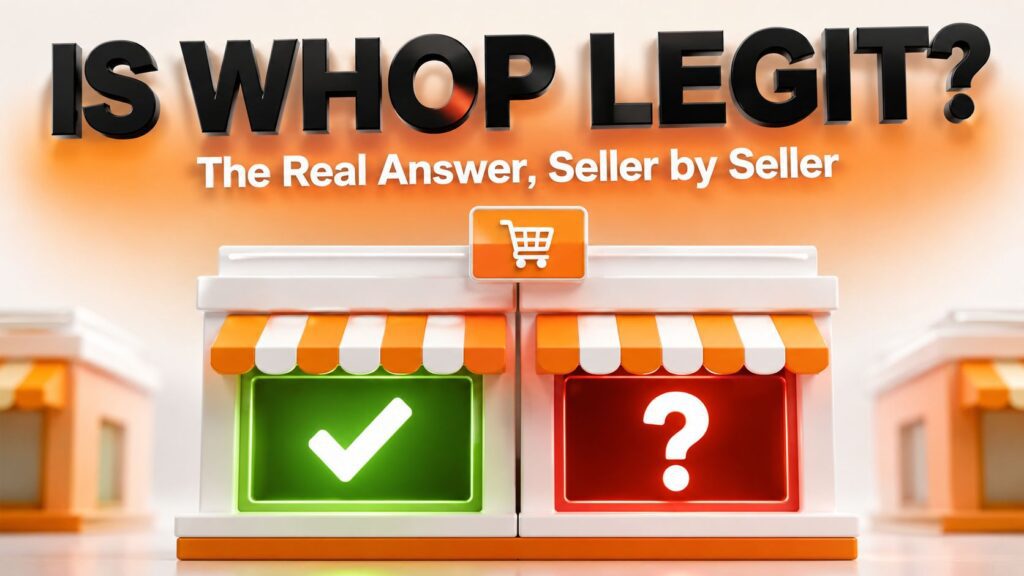
Is Whop Legit
Is Whop Legit
A friend of mine almost bought into a $300/month trading community on Whop last month. Slick landing page. Screenshots of huge profits. A countdown timer that made it feel like the offer would vanish any second.
He asked me first. Good thing too, because two minutes of digging showed the “results” were just cropped screenshots with no dates, no verification, nothing. Classic setup.
Here’s the twist though. Whop itself isn’t the problem. Whop is a real, funded, legitimate company. The issue was that one specific seller on it.
That distinction matters more than people realize, and it’s exactly what this article is going to walk through.
What Whop Actually Is
Whop is a marketplace and business platform. Think of it as Shopify, but built for digital products instead of physical ones.
Creators use it to sell courses, Discord communities, software tools, templates, trading signals, and pretty much anything else that can be delivered digitally. Whop handles the payment processing, the subscriptions, and the access control. The creator handles everything else.
It launched a Discover feature too, basically a public storefront where buyers can browse thousands of listings across categories. That’s the part that makes Whop function like an actual marketplace instead of just a checkout tool.
The Part Everyone Wants Confirmed: Is It a Scam?
No. Whop is not a scam.
The company has raised over $50 million in venture funding, with backers including Bain Capital Ventures. Payments run through Stripe, which is about as standard and trustworthy as payment infrastructure gets. According to a detailed 2026 review from TopWhops, the platform now processes payments for over 27,000 businesses across more than 160 countries.
So the company itself checks out. Real funding, real infrastructure, real scale.
But here’s the catch, and it’s the whole point of this article: Whop being legitimate doesn’t mean every seller on Whop is legitimate.
Whop Is the Mall, Not the Store
I keep coming back to this comparison because it’s the clearest way to explain it.
Asking “is Whop legit” is a bit like asking “is YouTube legit.” Sure, YouTube is real. That doesn’t mean every video on it is worth your time.
A developer who spent six months building apps on the platform put it plainly in a detailed testing writeup: after testing more than 50 communities with his own money, roughly 20 to 30% actually delivered what they promised. Another 40 to 50% were mediocre, not scams exactly, just not worth the price. The rest ranged from lazy cash grabs to outright fraud.
That’s the real picture. Solid platform. Wildly mixed marketplace sitting on top of it.
Where the Sketchy Stuff Tends to Show Up
Trading and crypto signal groups are the biggest problem zone on Whop, and it’s not close.
According to coverage from Group.app’s 2026 platform review, trading education and signal communities make up a huge share of Whop’s active marketplace. That category also happens to attract the most aggressive marketing and the least verifiable claims.
Testimonials get thrown around constantly. “I made $10K in my first week.” Some are genuine. Plenty aren’t, and a good chunk of the people posting them earn 30 to 50% commission for every sale they refer, which is worth remembering before you trust a glowing review.
Templates, prompt packs, and automation kits, the kind of listings you’ll see from smaller sellers, sit in a quieter but similarly unverified zone. Nobody at Whop is checking whether a $47 “AI automation bundle” actually works before it goes live.
A Simple Checklist Before You Buy Anything
Skip the marketing copy. Check these instead.
Look for dated proof, not screenshots. Real results come with timestamps and context. A cropped image with no date attached is worth nothing.
Read the refund policy before you pay, not after. Whop enforces refunds when sellers actually offer them. It can’t force a seller to have a fair policy in the first place.
Check how long the seller has been active. A storefront that popped up last week with no history is a different risk profile than one that’s been running for two years with a visible track record.
Be suspicious of urgency. Countdown timers, “only 3 spots left,” any kind of manufactured pressure. Legitimate sellers rarely need to rush you.
Never pay an upfront fee just to “get access” before you’ve seen anything. That’s a red flag on any platform, not just Whop.
What This Looks Like From the Seller Side
If you’re thinking about selling on Whop rather than buying, the calculation flips, but the platform mechanics stay the same.
No monthly fee to list. You pay through transaction fees and, if a sale comes through Whop’s own marketplace traffic rather than your own audience, a referral cut on top of that. One detailed breakdown from BloggingX’s 2026 review put that marketplace referral cut around 30%, which is worth factoring into your pricing if you’re counting on organic Discover traffic rather than bringing your own buyers.
The upside is real too. No monthly software cost eating into thin margins before you’ve made a single sale, built-in Discord integration if that’s where your audience already lives, and access to a large existing pool of buyers browsing the marketplace.
The tradeoff is that you’re one seller in a crowded space where trust has already taken a hit from the sketchier corners of the platform. Standing out means being the seller who actually shows proof, not just the one who claims the most.
A Quick Bit of Background
Whop isn’t some fly-by-night startup. It’s been building since 2020.
The company started small, mostly serving gaming and reselling communities. Discord was already where those groups lived, so Whop built its payment layer to plug straight into that.
It’s grown a lot since then. The platform now spans trading, AI tools, business coaching, fitness, and dozens of other niches.
App Store launched in 2024. That opened the door for developers to build their own tools directly on top of Whop’s infrastructure, the same way apps exist on top of Shopify.
None of this proves every seller is honest. It does mean the company behind it has real staying power, not just a slick homepage.
Which Niches Are Actually Worth Browsing
Not every category on Whop carries the same risk.
Trading and crypto signals are the riskiest corner, by a wide margin. Heavy marketing, unverifiable claims, high monthly prices. Proceed carefully here or skip it entirely.
AI tools and prompt bundles are hit or miss. Some sellers offer genuinely useful, well-tested prompt systems. Others repackage free ChatGPT prompts and charge for them. Check for real examples before buying.
Business coaching and courses vary the same way any course platform does. Look for a seller with a visible history, not just a launch-week hype page.
Discord communities and software tools tend to be the safer end of the spectrum, mostly because value is easier to judge upfront. You can usually see what you’re getting before you commit.
Real Red Flags, Not Vague Ones
Generic warnings like “trust your gut” don’t help much. Here’s what actually shows up before a bad purchase.
A seller with zero reviews pushing a “limited time” price cut. If nobody’s vouched for them yet, there’s no rush that benefits you.
Testimonials that are just screenshots of Venmo or crypto wallet balances. No context, no dates, easy to fake, easy to crop from someone else’s account entirely.
A refund policy buried three clicks deep, or missing altogether. Legitimate sellers put this front and center because they’re not worried about it.
Heavy reliance on affiliate promoters rather than organic reviews. If every person talking about a product is also earning a commission from it, weight that accordingly.
How Whop Actually Makes Its Money
Worth understanding, since it explains a few of the platform’s incentives.
Whop doesn’t charge sellers a monthly subscription fee to list products. Instead, it takes a percentage of each transaction.
Sales that come through Whop’s own Discover marketplace carry a higher fee, reportedly around 30%, since Whop is doing the work of bringing you that customer.
Sales you drive yourself, through your own audience or marketing, cost less. You’re doing the customer acquisition, so Whop’s cut shrinks.
That structure means Whop benefits when more products get listed and more traffic flows through Discover. It doesn’t necessarily benefit from filtering out weak sellers as aggressively as buyers might want, which is part of why quality control on the marketplace side stays looser than the payment infrastructure itself.
How Whop Compares to the Alternatives
| Platform | Monthly Fee | Marketplace Traffic | Best For |
|---|---|---|---|
| Whop | $0 (transaction fees instead) | Yes, built-in Discover | Discord-based communities, digital products, SaaS bundles |
| Skool | ~$99/month | No | Structured courses, gamified communities |
| Teachable | $0-$199/month | No | Traditional course creators |
| Gumroad | $0 (transaction fees) | Limited | Simple digital downloads, no community features |
Whop’s biggest edge is that built-in marketplace exposure. Skool and Teachable don’t hand you an audience, you have to bring your own. Whop at least gives you a shot at organic discovery, for a cut of the sale.
The tradeoff is exactly what we’ve covered: that same open marketplace is also where the low-effort and outright fraudulent listings live, sitting right next to the legitimate ones.
So Should You Actually Use It
If you’re buying, yes, cautiously. Treat every individual listing the way you’d treat a stranger’s product on any open marketplace. Verify before you pay.
If you’re selling, also yes, with a clear head about the tradeoffs. The infrastructure is solid, the fees are reasonable compared to a fixed monthly cost, and the built-in audience is a genuine advantage over a platform that leaves you to find every buyer yourself.
What Whop won’t do is vouch for you. That part’s still on you, whether you’re buying or selling.
Frequently Asked Questions
Is Whop a pyramid scheme? No. Whop is a payment and marketplace platform, similar to Shopify. It doesn’t require recruiting other people to earn money, and creators are paid for actual products or services sold, not for signing up new members.
Does Whop refund your money if a seller doesn’t deliver? Refunds depend on the individual seller’s policy. Whop enforces whatever policy a seller has published, but it doesn’t guarantee refunds across the board. Always check a seller’s specific refund terms before buying.
Is it safe to enter payment details on Whop? Yes. Payments process through Stripe, a standard and widely trusted payment processor used by millions of businesses. The payment infrastructure itself isn’t the risk, individual seller quality is.
What’s the most common scam pattern on Whop? Trading and crypto signal communities showing unverified profit screenshots, paired with high-pressure countdown timers and paid testimonials, are the most frequently reported issue.
Can you make real money selling on Whop? Yes, plenty of creators do, particularly those selling Discord-based communities, software tools, and digital products with genuine value. Success depends entirely on what you’re offering, not on the platform itself.
How is Whop different from Gumroad? Gumroad is built for simple digital downloads with minimal community features. Whop is built around ongoing memberships, Discord integration, and a public marketplace where buyers can discover new products organically.
The Bottom Line
Whop, the company, is real. Funded, processing payments safely, operating at genuine scale.
Whop, the marketplace, is a mixed bag, the same way any open platform with thousands of independent sellers ends up being a mixed bag. Some listings are genuinely excellent. Plenty are mediocre. A few are outright scams wearing a nice landing page.
The fix isn’t avoiding the platform. It’s treating every individual listing on it as its own decision, not a decision you get to outsource to Whop’s name.
MORE FROM US
CNINA CUTS 12000 AI UNIVERSITY DEGREES