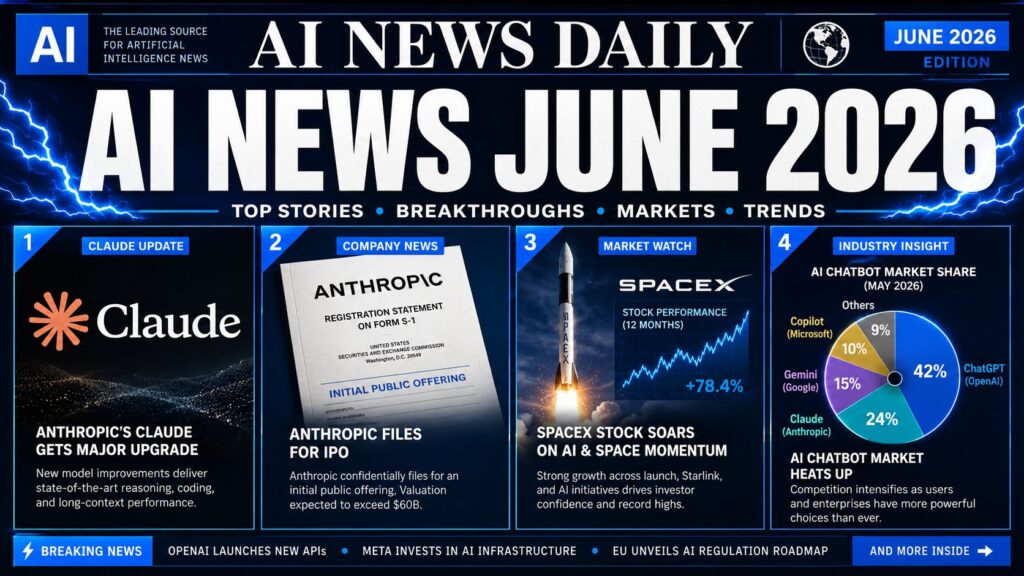
AI News June 2026
AI News June 2026
🌍 Biggest AI News This Week — June 2026 Complete Roundup
Everything that happened in AI this week — explained simply, verified, and up to date.
🚀 Introduction: The Biggest Week in AI History?
Some weeks in tech are just routine updates.
This is not one of those weeks.
In the first two weeks of June 2026, the AI world produced more major news than most years combined. A new frontier model launched. The world’s most valuable AI company filed for an IPO. The largest IPO in human history priced on Wall Street. And the AI chatbot market completely reshuffled.
If you blinked, you missed something important.
This roundup covers every major AI story from June 2026. Simple explanations. Verified facts. No hype. Just what actually happened and why it matters for you.
📅 Quick Summary: June 2026 AI News at a Glance
| 📆 Date | 📰 Story | 🔑 Key Fact |
|---|---|---|
| May 28, 2026 | Claude Opus 4.8 launched | Same price as Opus 4.7 |
| June 1, 2026 | Anthropic files IPO with SEC | $965 billion valuation |
| June 1, 2026 | ZoomMate AI launched | $20/user/month |
| June 3, 2026 | OpenAI on Amazon Bedrock | GPT-5.5 now on AWS |
| June 3, 2026 | Grok Build beta launched | xAI coding agent |
| June 11, 2026 | OpenAI Oracle deal announced | Enterprise cloud partnership |
| June 12, 2026 | SpaceX IPO prices on Nasdaq | $135/share, $1.77T valuation |
| Ongoing | AI chatbot market share shift | ChatGPT drops to 54.7% |
🤖 Story 1: Claude Opus 4.8 — Anthropic’s Most Powerful Model Yet
What Happened?
Anthropic released Claude Opus 4.8 on May 28, 2026. It builds on Opus 4.7 with improvements across benchmarks and is a more effective collaborator. It is available at the same price as its predecessor.
This was a big deal. Anthropic kept the price the same while delivering a genuinely better model.
What Is New in Claude Opus 4.8?
Claude Opus 4.8 launches alongside several new features. Users on claude.ai now have control over the amount of effort Claude puts into a task. Claude Code has a new dynamic workflows feature that allows it to tackle very large-scale problems. And fast mode for Opus 4.8 — where the model can work at 2.5 times the speed — is now three times cheaper than it was for previous models.
Let us break that down simply:
Effort Control — You can now tell Claude how hard to think. Quick task? Set it to low effort. Complex research? Set it to maximum effort. You control the balance between speed and depth.
Dynamic Workflows — This is the biggest new feature. The system is designed to help larger models like Opus manage complex tasks across hundreds of parallel subagents. Claude Code alongside Opus 4.8 can now carry out codebase-scale migrations across hundreds of thousands of lines of code from kickoff to merge, with the existing test suite as its bar.
In simple words: Claude can now split a massive task into hundreds of smaller tasks, work on all of them at the same time, and bring everything together — automatically.
Fast Mode is 3x Cheaper — The high-speed version of Opus 4.8 now costs three times less than fast mode did in Opus 4.7. This is a huge win for developers building AI applications at scale.
Claude Opus 4.8 Pricing
| 💳 Mode | 💰 Input (per 1M tokens) | 💰 Output (per 1M tokens) |
|---|---|---|
| Standard | $5 | $25 |
| Fast Mode | $10 | $50 |
Source: Anthropic Official
Claude Opus 4.8 Benchmarks
| 🏆 Benchmark | Claude Opus 4.8 | Claude Opus 4.7 | 📈 Change |
|---|---|---|---|
| GDPval-AA (Elo) | 1,890 | 1,769 | +121 points |
| OSWorld (Computer Use) | 83.4% | 71.2% | +12.2 points |
| SWE-Bench Pro (Coding) | 67.1% | 64.3% | +2.8 points |
| Context Window | 1M tokens | 1M tokens | Same |
| Max Output | 128K tokens | 128K tokens | Same |
Claude Opus 4.8 is the clear leader on agentic benchmarks right now. It sits 121 Elo points ahead of GPT-5.5 on the GDPval-AA benchmark — the most important measure of autonomous AI agent performance.
What About the Mythos Model?
Anthropic is still holding back its most advanced Mythos model after a tentative preview last month raised cybersecurity concerns. However, the company hinted in today’s Opus release that the Mythos preview period might soon end, once necessary safeguards are complete.
This is worth watching. Mythos is Anthropic’s most powerful model ever — but it is being held back specifically because of security risks. When it launches publicly, it will be another major story.
💰 Story 2: Anthropic Files for IPO at $965 Billion Valuation
What Happened?
Anthropic has confidentially submitted draft paperwork for a public listing, potentially leapfrogging longtime rival OpenAI in the race toward a Wall Street debut as soon as this fall.
This is massive news. Anthropic — the company behind Claude — is now worth nearly $1 trillion.
Anthropic announced a $65 billion Series H financing at a $965 billion valuation, a round led by Altimeter Capital, Dragoneer, Greenoaks, and Sequoia Capital. The financing puts its valuation above that of rival AI lab OpenAI.
The IPO Race — Three Giants Going Public
OpenAI, the company behind ChatGPT, most recently reached a post-money valuation of roughly $852 billion. Anthropic was recently valued at $965 billion after a Series H funding, while SpaceX is expected to pursue a valuation of about $1.77 trillion in its upcoming public debut.
Here is the full picture:
| 🏢 Company | 💰 Valuation | 📅 IPO Timeline | 📊 Status |
|---|---|---|---|
| SpaceX | $1.77 trillion | June 12, 2026 | ✅ Pricing today |
| Anthropic | $965 billion | Fall 2026 | 📄 Filed confidentially |
| OpenAI | $852 billion | Late 2026 | 📄 Filing soon |
The combined 2026 public-market push from Anthropic, OpenAI, and SpaceX totals an estimated $3 trillion in enterprise value entering markets simultaneously.
Three trillion dollars. At the same time. This is genuinely unprecedented in financial history.
Anthropic’s Revenue Numbers
The $47 billion annualized revenue run-rate cited in the primary pairs with a $1.25 billion monthly GPU commitment that Yahoo Finance flags as the key capex metric for S-1 scrutiny.
What does this mean in simple words?
- Anthropic makes $47 billion per year in revenue
- They spend $1.25 billion every month on computer chips alone
- That is $15 billion per year just on GPU costs
This shows how expensive it is to run a frontier AI company. Even at $47 billion in annual revenue, the compute costs are enormous.
Why This Matters for You
If you use Claude for work, this IPO filing is relevant. It means:
- Anthropic now has access to more capital to develop better models
- Claude will likely get faster, cheaper, and more capable over time
- Competition between Anthropic, OpenAI, and Google will intensify — which is good for users
🚀 Story 3: SpaceX Prices the Largest IPO in Human History
What Happened?
Today — June 12, 2026 — SpaceX is pricing its IPO on Nasdaq under the ticker symbol SPCX.
Elon Musk’s SpaceX is expected to launch its IPO roadshow at a fixed $135 per share, targeting about $75 billion in proceeds at a valuation of roughly $1.75 trillion. If the company raises $75 billion, it would surpass Saudi Aramco’s 2019 listing as the world’s largest IPO.
This is not just an AI story. But it is deeply connected to AI.
SpaceX merged with Elon Musk’s AI company xAI earlier in 2026. The combined company now includes Starlink, Falcon rockets, and the Grok AI model. SpaceX believes its biggest growth opportunity is artificial intelligence.
Why Does SpaceX’s IPO Matter for AI?
Three reasons:
1. It validates AI investment. When a $1.77 trillion company says AI is its biggest growth opportunity, the entire market pays attention.
2. It triggers the Anthropic and OpenAI IPO race. The order of listing matters: SpaceX first, then Anthropic, then OpenAI. The first to list sets the comparable valuation for the others.
3. It brings $75 billion of fresh capital into the tech and AI ecosystem. That money will flow into AI infrastructure, models, and applications.
📊 Story 4: AI Chatbot Market Share — The Race Is Tightening
What Happened?
The June 2026 edition of the global AI chatbot market share report was released. The results are surprising.
ChatGPT remains the leader at 54.7 percent of worldwide web visits across the seven largest AI chatbots — down from 76.5 percent in February 2025. Google Gemini is second at 27.4 percent, up roughly 104 percent in six months, making it the fastest-scaling large assistant by web traffic. Claude’s numbers are the most striking: 8.2 percent worldwide web-visit share, but growing 306 percent in a single quarter — from 203 million web visits in January 2026 to 824 million in April 2026.
The Full Market Share Picture
| 🤖 AI Chatbot | 🌍 Global Share | 🇺🇸 US Share | 📈 Trend |
|---|---|---|---|
| ChatGPT (OpenAI) | 54.7% | ~48% | 📉 Declining |
| Gemini (Google) | 27.4% | ~25% | 📈 +104% in 6 months |
| Claude (Anthropic) | 8.2% | 12.5% | 📈 +306% in one quarter |
| Others | 9.7% | ~14.5% | Mixed |
What Does This Mean?
ChatGPT is still the leader. But its dominance is shrinking fast.
Gemini doubled its share in six months. That is extraordinary growth for a product at this scale.
Claude’s 306% quarterly growth is the most dramatic story in this data. It went from 203 million monthly web visits in January 2026 to 824 million in April 2026. That is not gradual growth. That is a sudden shift in how people use AI.
The most likely reason: Claude’s reputation for accuracy and safety is driving adoption in professional and enterprise settings. People who need reliable AI are choosing Claude at a much higher rate than before.
☁️ Story 5: OpenAI Comes to Oracle Cloud
What Happened?
On June 11, 2026, OpenAI officially announced that enterprise customers can now access its frontier AI models and Codex through their existing Oracle Universal Credits. The OpenAI Oracle partnership allows Oracle Cloud Infrastructure customers to deploy OpenAI technology without creating a separate procurement channel.
This sounds technical. But the business impact is huge.
Why Does This Matter?
Oracle has some of the largest enterprise contracts in the world. Many Fortune 500 companies have multi-year, multi-million dollar Oracle cloud commitments.
Until now, those companies had to set up a separate relationship with OpenAI to use GPT-5.5 or Codex. That meant extra procurement processes, new vendor relationships, separate billing, and compliance reviews.
Now they can just use their existing Oracle credits. One vendor. One contract. Immediate access.
This removes the biggest barrier to enterprise OpenAI adoption — the procurement process. Thousands of companies that were previously held back by procurement friction can now deploy OpenAI models in days instead of months.
🛠️ Story 6: Grok Build Beta — xAI Enters the Coding Agent Race
What Happened?
On June 3, 2026, Elon Musk’s AI company xAI launched Grok Build — a new AI coding agent that competes directly with OpenAI’s Codex and Anthropic’s Claude Code.
xAI launched Grok Build beta — a terminal TUI coding agent on Grok 4.3 with headless CI scripting and Agent Client Protocol support, entering the three-way race with Codex and Claude Code.
Grok Build vs Claude Code vs OpenAI Codex
| ⚖️ Feature | 🔴 Grok Build | 🟠 Claude Code | 🔵 OpenAI Codex |
|---|---|---|---|
| Launch | June 3, 2026 (Beta) | Available | Available |
| Base Model | Grok 4.3 | Claude Opus 4.8 | GPT-5.5 |
| Interface | Terminal / TUI | Terminal + VS Code | Web + Terminal |
| Headless CI | ✅ Yes | ✅ Yes | ✅ Yes |
| Agent Protocol | ✅ ACP | ✅ MCP | ✅ MCP |
| Pricing | Cheapest ($0.50/M input) | $5/M input | $1.50/M input |
| Status | Beta | Generally Available | Generally Available |
Grok Build’s biggest advantage is price. Grok 4.3 pricing: $0.50 input and $2 output — significantly cheaper than all alternatives, partially subsidized.
The question is whether the lower price comes with lower quality. Early beta testers report mixed results — impressive on straightforward coding tasks, less reliable on complex multi-file projects.
💼 Story 7: The AI API Pricing War — Who Wins?
The Full Pricing Comparison — June 2026
One of the biggest trends this week is the dramatic shift in AI pricing. Models are getting cheaper fast.
Here is the June 2026 comparison across input and output token pricing per million: GPT-5.5 (OpenAI): $1.50 input and $9 output standard. Claude Opus 4.8 (Anthropic): $5 input and $25 output, Fast Mode at approximately 3 times cheaper. Claude Sonnet 4.6: $3 input and $15 output. Claude Haiku 4.5: $1 input and $5 output. Gemini 3.1 Pro (Google): $2 input and $12 output. Gemini 3.5 Flash: $1.50 input and $9 output. Grok 4.3 (xAI): $0.50 input and $2 output — significantly cheaper than all alternatives, partially subsidized.
| 🤖 Model | 💰 Input (per 1M) | 💰 Output (per 1M) | 🎯 Best For |
|---|---|---|---|
| Grok 4.3 | $0.50 | $2 | Budget-conscious developers |
| Claude Haiku 4.5 | $1 | $5 | Fast, cheap tasks |
| Gemini 3.5 Flash | $1.50 | $9 | Speed + quality balance |
| GPT-5.5 Standard | $1.50 | $9 | Broad ecosystem |
| Gemini 3.1 Pro | $2 | $12 | Multimodal, long-context |
| Claude Sonnet 4.6 | $3 | $15 | Balanced performance |
| Claude Opus 4.8 | $5 | $25 | Maximum capability |
| Claude Opus 4.8 Fast | $10 | $50 | Speed at top quality |
Who Wins the Pricing War?
The honest answer: everyone wins — especially developers.
Twelve months ago, GPT-4 cost $30 per million output tokens. Today, GPT-5.5 costs $9 per million output tokens and is significantly more capable. That is a 3x price reduction while capability increased dramatically.
For businesses building AI applications, this means the cost of running AI-powered products has dropped dramatically. What cost $10,000 per month to operate a year ago now costs $3,000 or less.
🍎 Story 8: Apple WWDC 2026 — Gemini-Powered Siri Is Coming
What Happened?
Apple’s Worldwide Developers Conference (WWDC 2026) opened on June 9, 2026. The biggest AI announcement: Siri is getting a major upgrade powered by Google Gemini.
Bloomberg’s Mark Gurman reports Gemini-powered Siri, iOS 20, and Apple Intelligence 2.0 are all incoming.
What Is Apple Intelligence 2.0?
Apple Intelligence 2.0 is Apple’s next-generation AI layer built into all Apple devices. The key upgrade: instead of relying only on Apple’s own models, Siri can now access Google Gemini’s capabilities for complex tasks.
This means:
- Siri becomes dramatically smarter for research and reasoning tasks
- You can ask Siri complex questions and get Gemini-quality answers
- Apple devices get multimodal AI capabilities (text, image, video understanding)
- All processing still happens with Apple’s privacy protections
Why Did Apple Choose Gemini Over ChatGPT?
Apple already has a deal with OpenAI for certain ChatGPT integrations in iOS. The addition of Gemini gives Apple users access to two frontier AI models — choosing the best one for each type of task automatically.
This is significant for Google. Having Gemini built into every iPhone and Mac gives Google’s AI model access to over 1 billion active Apple devices worldwide.
🌐 Story 9: AI Market Size — The Numbers Are Staggering
The Investment Numbers
The scale of AI investment in 2026 is hard to comprehend.
Goldman Sachs predicted earlier this year that U.S. IPO proceeds could reach a record $160 billion in 2026 if marquee names go public this year.
Most of that $160 billion is directly AI-related — SpaceX, Anthropic, and OpenAI alone represent over $3 trillion in combined valuation entering public markets.
AI Revenue Growth
| 🏢 Company | 💰 Annual Revenue | 📈 Growth |
|---|---|---|
| Anthropic | $47 billion (run rate) | Explosive |
| OpenAI | ~$40 billion (estimated) | Very fast |
| Google (Gemini/AI) | Part of $300B+ total | Accelerating |
| Microsoft (Copilot) | Part of $240B+ total | Strong |
These numbers show that AI has moved from research project to massive commercial reality in an extraordinarily short time.
🔮 What To Watch Next — The Biggest AI Stories Coming
The AI news cycle is not slowing down. Here are the stories to watch in the coming weeks:
GPT-5.6 — OpenAI’s GPT-5.6 is scheduled for June 2026 and introduces enhanced reasoning, agentic workflows, and advanced front-end generation. Prediction markets give 80–89% odds of a public release by June 30.
Anthropic Mythos Model — The most powerful AI model ever built is being held back for safety reasons. When it launches, it will be the biggest AI story of 2026.
OpenAI IPO Filing — OpenAI is expected to file its public IPO paperwork in the coming weeks, targeting a market debut as early as Q4 2026.
AI Regulation Deadline — June 30, 2026 is now 18 days away — and it is the first real AI enforcement deadline on US soil. This will affect how AI companies operate in the United States.
Apple Intelligence 2.0 Launch — Expected with iOS 20 in September 2026, bringing Gemini-powered Siri to over 1 billion devices worldwide.
📱 What All This Means for Regular AI Users
All of this big news translates into simple benefits for everyday AI users:
AI is getting better and cheaper. Every week, models improve while prices drop. The AI you use today is significantly more capable than what was available six months ago — and it costs less.
You have more choices. ChatGPT, Claude, Gemini, Grok — serious competition between these platforms means none of them can afford to stop improving.
AI is becoming part of everything. From Siri on your iPhone to Gemini in your email to AI agents completing your work tasks — AI is integrating into every tool you use daily.
Businesses are taking AI seriously. The SpaceX and Anthropic IPOs signal that the world’s biggest investors believe AI is the most important technology of our lifetimes. That belief drives more investment, which produces better tools for everyone.
✅ Conclusion
June 2026 will be remembered as the month AI went fully mainstream.
Claude Opus 4.8 pushed the frontier of what AI can do autonomously. Anthropic filed for a near-trillion-dollar IPO. SpaceX priced the largest IPO in human history — with AI at the center of its growth story. The chatbot market reshuffled dramatically. Prices dropped while capabilities soared.
The pace of change is genuinely hard to keep up with. That is exactly why staying informed matters more than ever.
Bookmark matrixviral.com for weekly AI news roundups, tool reviews, and guides to help you use AI smarter — whether you are a freelancer, a business owner, a student, or just someone who wants to understand the technology shaping the world.
❓ Frequently Asked Questions
What is the biggest AI news in June 2026? The biggest stories are Claude Opus 4.8 launch, Anthropic’s $965 billion IPO filing, SpaceX pricing the largest IPO in history at $1.77 trillion, and the dramatic shift in AI chatbot market share showing Claude growing 306% in one quarter.
What is Claude Opus 4.8? Claude Opus 4.8 is Anthropic’s latest flagship AI model, launched May 28, 2026. It includes Dynamic Workflows for large-scale autonomous tasks, effort control for users, and fast mode that is 3x cheaper than the previous version. It costs $5 per million input tokens and $25 per million output tokens.
Is Anthropic going public? Yes. Anthropic confidentially filed for an IPO with the SEC in June 2026 at a $965 billion valuation. The public listing is expected as early as fall 2026.
What is the AI chatbot market share in 2026? As of June 2026, ChatGPT leads with 54.7% of global web visits (down from 76.5% in February 2025), Gemini is second at 27.4%, and Claude is third at 8.2% globally and 12.5% in the United States. Claude is the fastest-growing with 306% growth in one quarter.
What is Grok Build? Grok Build is xAI’s new AI coding agent launched in beta on June 3, 2026. It runs on the Grok 4.3 model and competes with OpenAI’s Codex and Anthropic’s Claude Code. Its main advantage is price — Grok 4.3 costs just $0.50 per million input tokens.
What is happening with AI regulation in the US? June 30, 2026 is the first major AI enforcement deadline on US soil. This affects how AI companies can operate and what disclosures they must make about their AI systems.
Will Siri use Google Gemini? Yes. Apple announced at WWDC 2026 that Apple Intelligence 2.0 and iOS 20 will include Gemini-powered Siri capabilities, expected to launch with iOS 20 in September 2026.
What is the Dynamic Workflows feature in Claude Opus 4.8? Dynamic Workflows is a new Claude Code feature that allows Claude Opus 4.8 to split massive tasks into hundreds of parallel subtasks, work on all of them simultaneously, and combine the results. It enables codebase-scale work across hundreds of thousands of lines of code autonomously.
MORE FROM OUR BLOG
BEST AI ART GENERATOR FOR BEGINNERS