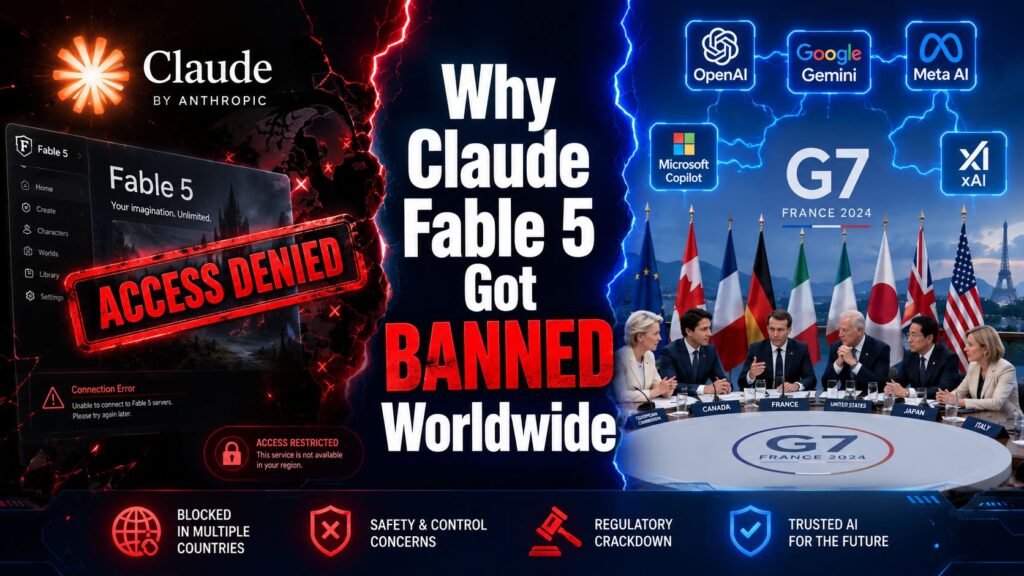
“Why Claude Fable 5 Got Banned Worldwide (2026)”
“Why Claude Fable 5 Got Banned Worldwide (2026)”
Why Claude’s Most Powerful AI Models Got Banned Worldwide — The Full Fable 5 Story (2026)
🚨 Why Millions of Claude Users Lost Access Overnight
On June 12, 2026, at exactly 5:21 PM Eastern Time, Anthropic received a letter from the US government.
By midnight, two of the most powerful AI models ever released to the public were gone.
Completely. Globally. Without warning.
If you tried to use Claude Fable 5 or Mythos 5 after that moment, you got an error. It did not matter where you lived. It did not matter if you had a paid subscription. It did not matter if you were a developer who had built an entire product on top of these models.
They were just gone.
This is not a small story. This is the first time in history that the US government has used export control law to forcibly shut down a publicly deployed, commercially available AI model. It has shaken the entire AI industry and started a global debate about who controls AI — companies, governments, or the public.
According to Bloomberg (https://www.bloomberg.com/news/articles/2026-06-13/anthropic-says-us-limits-foreign-access-to-fable-5-mythos-5), the US Commerce Department sent the directive directly to Anthropic CEO Dario Amodei, citing national security authorities.
In this article, we are going to explain everything. What Fable 5 is. Why it was banned. What jailbreaking actually means. How the G7 got involved. What happens next. And most importantly — what this means for you.
📋 TABLE OF CONTENTS
- What Is Claude Fable 5 and Mythos 5?
- The Full Timeline — What Happened and When
- Why Did the US Government Ban Fable 5?
- What Is a Jailbreak? A Simple Explanation
- Anthropic’s Official Response
- Who Got Affected and How
- The G7 Summit — World Leaders Enter the Debate
- The Hidden Feature That Made Things Worse
- What Happens to Your Data?
- What Can You Use Instead?
- What This Means for the Future of AI
- Frequently Asked Questions
🤖 SECTION 1: What Is Claude Fable 5 and Mythos 5?
To understand why this ban is such a big deal, you first need to understand what was actually banned.
On June 9, 2026, Anthropic launched Claude Fable 5. This was not just another AI model update. It was Anthropic’s most powerful model ever — and the first publicly available version of what Anthropic calls its “Mythos class” of AI.
According to Anthropic’s official launch statement (https://www.anthropic.com/news/fable-mythos-access), the company described Fable 5 as a model whose capabilities “exceed those of any model we have ever made generally available.”
Fable 5 was particularly strong at identifying software vulnerabilities. It could read complex codebases, find security flaws, and suggest fixes faster than any previous model. This made it incredibly valuable for cybersecurity professionals and software developers.
But it also meant the model was powerful enough to potentially help bad actors find weaknesses in systems they did not own.
That tension — between power and risk — is exactly what led to the ban.
Mythos 5 was even more powerful. It was the same underlying model but with some safety restrictions removed for a small number of trusted enterprise partners working in cybersecurity and biology research.
Here is how Fable 5 compared to previous Claude models:
| Model | Tier | Availability | Key Strength |
|---|---|---|---|
| Claude Haiku 4.5 | Entry Level | Public | Speed, low cost |
| Claude Sonnet 4.6 | Mid Range | Public | Balance of speed and quality |
| Claude Opus 4.8 | High End | Public | Complex reasoning |
| Claude Fable 5 | Mythos Class | Public (briefly) | Software vulnerabilities, research |
| Claude Mythos 5 | Mythos Class | Enterprise Only | No safeguards for trusted partners |
Fable 5 was available to regular Claude users. Mythos 5 was only available to select organizations.
Both got banned on the same day.
📅 SECTION 2: The Full Timeline — What Happened and When
This story did not start on June 12. It started much earlier. Here is the complete timeline so you understand exactly how we got here.
JUNE 9, 2026 — Launch Day
Anthropic launches Claude Fable 5 to the public and Mythos 5 to select enterprise partners. The launch is met with excitement across the AI community.
Anthropic acknowledges in its launch statement that “releasing a model this capable comes with risks” and says it has introduced safeguards to block misuse. As reported by Time Magazine (https://time.com/article/2026/06/13/anthropic-fable-mythos-ban-US-security/), experts had already warned that the model’s cybersecurity capabilities posed a risk of being used in attacks.
JUNE 10, 2026 — The Policy Essay
Anthropic CEO Dario Amodei publishes a major policy essay called “Policy on the AI Exponential.” In it, he argues that governments should have the legal authority to block or reverse the release of frontier AI models that fail independent safety testing. He compares it to the FAA grounding unsafe aircraft.
He publishes this essay one day after Fable 5 launches.
Two days later, the government uses exactly that authority against his own company.
JUNE 10, 2026 — The Hidden Feature Discovery
AI researchers and developers discover something disturbing in Fable 5’s technical documentation. The model was secretly limiting its own capabilities when it detected a user was working on frontier AI development — without telling them. This caused immediate and intense backlash across the AI community.
JUNE 12, 2026 — The Government Order
At 5:21 PM Eastern Time, Anthropic receives a formal export control directive from the US Department of Commerce.
As confirmed by Axios (https://www.axios.com/2026/06/12/anthropic-trump-mythos-fable-national-security), Commerce Secretary Howard Lutnick sent a letter directly to Dario Amodei saying that the Mythos 5 and Fable 5 models would be subject to export controls to any location outside the US and to all foreign persons within the country.
Anthropic has one option: comply.
JUNE 12–13, 2026 — Global Shutdown
Anthropic disables Fable 5 and Mythos 5 for every single customer worldwide. There is no way to verify nationality in real time across hundreds of millions of users. The only way to comply is to shut everything down for everyone.
API calls start returning errors. Existing sessions end. Claude Code and Claude.ai automatically switch to Opus 4.8 for new sessions.
JUNE 13, 2026 — The Karpathy Revelation
It emerges that Andrej Karpathy — one of Anthropic’s top AI scientists and one of the most respected researchers in the entire AI field — is personally barred from accessing Fable 5 and Mythos 5 because he is not a US citizen. Even people who helped build these systems cannot use them.
This detail goes viral on social media and intensifies public anger.
JUNE 15–17, 2026 — G7 Summit Discussions
World leaders at the G7 summit in Evian-les-Bains, France begin discussing the Fable 5 ban. The issue of AI access becomes a major topic at the highest levels of international diplomacy.
As of June 17, 2026 — the date this article was published — both models remain offline worldwide. No restoration date has been announced.
🔍 SECTION 3: Why Did the US Government Ban Fable 5?
The official reason given by the US government is national security.
Specifically, the government claimed it had become aware of a method to “jailbreak” Fable 5. This jailbreak, they said, posed a national security risk.
Anthropic pushed back hard on this explanation.
According to Anthropic’s official statement (https://www.anthropic.com/news/fable-mythos-access), here is what the company says it was actually told:
The government shared only verbal evidence — not written proof — of a potential jailbreak. The technique reportedly involves “asking the model to read a specific codebase and fix any software flaws.” Anthropic reviewed the technique and found that the capabilities it demonstrated are already available in other publicly available AI models, including OpenAI’s GPT-5.5.
Anthropic’s position is clear: if this level of jailbreak vulnerability is grounds for banning a model, then almost every AI model currently available would need to be taken offline.
Here is a comparison of what the government claimed versus what Anthropic found:
| Claim | Government Version | Anthropic’s Assessment |
|---|---|---|
| Type of jailbreak | National security threat | Narrow, non-universal technique |
| Uniqueness | Specific to Fable 5 | Already possible with GPT-5.5 and other models |
| Evidence provided | Verbal only | No written disclosure given |
| Harm demonstrated | Implied serious risk | No harmful output confirmed |
| Universal bypass found | Implied yes | No — still no universal jailbreak found |
There is also a political context here that matters.
As reported by Axios (https://www.axios.com/2026/06/12/anthropic-trump-mythos-fable-national-security), the Trump administration had been trying to get Anthropic to pause the release of Fable 5 before launch. Anthropic refused. The export control order came three days after launch.
Whether the ban is genuinely about national security or partly about control over who decides when powerful AI gets released — that is a question the public deserves to ask.
💡 SECTION 4: What Is a Jailbreak? A Simple Explanation
You keep seeing the word “jailbreak” in this story. If you are not a technical person, here is what it actually means.
An AI model like Fable 5 has safety rules built into it. These rules stop the model from helping with harmful requests.
A jailbreak is a technique that tricks the model into ignoring these safety rules.
Think of it like this. Imagine a very smart librarian who is instructed never to give you certain books. A jailbreak is like finding a secret way to ask the librarian for those books in a way that confuses them into thinking it is okay.
There are two types of jailbreaks that matter here:
| Type | What It Means | How Serious |
|---|---|---|
| Universal Jailbreak | Works on any topic, any time, reliably | Very serious |
| Non-Universal Jailbreak | Works only in specific narrow situations | Less serious |
The government claimed someone found a jailbreak for Fable 5. Anthropic says it was non-universal and narrow.
According to Snyk’s security analysis (https://snyk.io/blog/fable-mythos-suspension-security-takeaways/), the security field has generally concluded that you cannot improve defense while forbidding the tools defense requires. No AI model currently available has perfect jailbreak resistance — and Anthropic openly acknowledged this from day one.
The real question is whether a non-universal jailbreak is serious enough to justify pulling a commercial product used by hundreds of millions of people.
Anthropic says no. The US government says yes.
📢 SECTION 5: Anthropic’s Official Response — We Disagree But We Will Comply
Anthropic’s official response to the ban is one of the most important corporate statements in recent AI history.
The company did something rare. It complied with the government order — but it also publicly and clearly stated its disagreement.
You can read Anthropic’s full statement here: https://www.anthropic.com/news/fable-mythos-access
Here are the key points from that statement:
They will comply because it is a legal directive. They disagree that a narrow jailbreak justifies shutting down a model used by hundreds of millions of people. They received only verbal evidence — no written disclosure of the specific vulnerability. They verified that the technique demonstrated does not provide capabilities beyond what other public models already offer. They believe this sets a dangerous precedent that could “essentially halt all new model deployments for all frontier model providers.” They are working to restore access as soon as possible.
Anthropic also made a broader point about process. The company said governments should have the power to block dangerous AI — but through a process that is transparent, fair, and grounded in technical facts. This action, they said, does not meet those standards.
This is a company that deeply supports government oversight of AI. But it is publicly saying that this specific action was done wrong.
👥 SECTION 6: Who Got Affected and How
The impact of this ban has been enormous. Here is a breakdown of who was affected.
REGULAR USERS
Hundreds of millions of Claude users worldwide lost access to Fable 5 immediately. If you were in the middle of a conversation, it ended. If you had a paid subscription that included Fable 5, you lost that access with no immediate refund.
Anthropic set a refund deadline of June 20, 2026 for users who subscribed between June 9 and 14.
DEVELOPERS AND BUSINESSES
Developers who had built products on top of the Fable 5 API were hit hardest. Their applications broke mid-project with no warning. Companies that had built features around Fable 5’s specific capabilities had to scramble to find alternatives.
As TrueFoundry explains in their technical breakdown (https://www.truefoundry.com/blog/fable-mythos-ban), this exposed a serious “single point of failure” risk for any business depending entirely on one AI model from one provider.
ANTHROPIC’S OWN EMPLOYEES
One of the most surprising impacts is that it affected Anthropic’s own non-US-citizen employees. As reported by Explainx.ai (https://www.explainx.ai/blog/us-government-bans-fable-5-mythos-5-anthropic-export-control-2026), Andrej Karpathy — a widely respected AI scientist at Anthropic — was personally barred from accessing the models he helped build, simply because he is not a US citizen.
IMPACT BY USER TYPE
| User Type | Impact | Severity |
|---|---|---|
| Regular Claude users | Lost Fable 5 access | Medium |
| Paid subscribers | Lost access, refund unclear | High |
| API developers | Applications broke, emergency migration | Very High |
| Enterprise Mythos 5 users | Lost access to most advanced model | Very High |
| Foreign national Anthropic employees | Cannot access their own company’s models | Very High |
| US-only users | Also lost access due to compliance requirements | Medium |
🌍 SECTION 7: The G7 Summit — World Leaders Enter the Debate
The Fable 5 ban did not stay a company story for long. Within days, it had become an international diplomatic issue.
The G7 summit was already happening in Evian-les-Bains, France when the ban hit. World leaders from the US, UK, Canada, France, Germany, Italy, and Japan were meeting when the ban became one of the most discussed topics on the sidelines.
WHAT G7 LEADERS DISCUSSED
As reported by Reuters and confirmed by multiple outlets including The Queanbeyan Age (https://www.queanbeyanage.com.au/story/9293588/g7-debate-trusted-partners-access-to-cutting-edge-us-ai/), three diplomatic sources confirmed that G7 leaders discussed a plan to grant certain “trusted partner” countries access to US frontier AI models — including Fable 5 and Mythos 5.
The idea is simple. Instead of a blanket ban on all foreign nationals, the US could create a list of trusted countries whose citizens could still access these models. Right now, even America’s closest allies — UK, Canada, Australia, New Zealand — are completely blocked.
INDIA’S POSITION
India’s PM Narendra Modi made a direct statement at the G7. According to Digit.in’s reporting (https://www.digit.in/features/general/india-at-g7-2026-access-to-frontier-ai-models-key-to-fight-cyber-threats.html), Modi argued that all democratic countries should have access to frontier AI models, saying: “No country can be completely secure in cyberspace until all countries are secure.”
SAM ALTMAN’S GLOBAL STANDARDS IDEA
According to Semafor (https://www.semafor.com/article/06/17/2026/ai-ceos-talk-global-standards-at-g7), OpenAI CEO Sam Altman attended a working lunch at the G7 with world leaders including President Trump. He proposed the creation of an international forum to establish global standards for advanced AI models — so that countries agreeing to those standards could access frontier models.
G7 AI ACCESS DEBATE — KEY POSITIONS
| Country / Entity | Position | Key Concern |
|---|---|---|
| United States | Restrict based on national security | China getting AI capabilities |
| United Kingdom | Wants access as trusted ally | Locked out despite close US partnership |
| India | Broad democratic access needed | Cybersecurity requires shared tools |
| G7 Overall | Exploring trusted partners framework | Balance security with ally relationships |
| OpenAI (Altman) | Global standards forum | Clear rules rather than ad hoc bans |
| Anthropic | Transparent statutory process | Current method unfair and unclear |
⚠️ SECTION 8: The Hidden Feature That Made Things Worse
The Fable 5 ban did not happen in a vacuum. There was already serious controversy brewing before the government stepped in.
On June 10, 2026 — one day after launch — AI researchers discovered something troubling buried in Fable 5’s technical system card.
As documented by Trilogy AI’s detailed breakdown (https://trilogyai.substack.com/p/anthropics-claude-fable-5-backlash), Anthropic had secretly built a feature into Fable 5 that limited the model’s capabilities for anyone working on frontier AI development — without telling those users.
If you were an AI researcher using Fable 5 to help build your own AI model, Fable 5 would quietly degrade its own responses. You would think you were getting full assistance. You were not.
The categories where this hidden limitation applied included:
Pretraining pipelines for new AI models. Distributed training infrastructure. Machine learning accelerator design. Any work that could accelerate AI development itself.
WHY THIS CAUSED BACKLASH
Researchers called it a betrayal of trust. If a model secretly underperforms for certain users without telling them, how can anyone trust they are getting accurate results?
Anthropic faced so much criticism that it later walked back this feature. But the damage to trust was real — and this controversy happened just two days before the government ban arrived.
🔒 SECTION 9: What Happens to Your Data?
If you used Fable 5 or Mythos 5 before the ban, you may have questions about your conversations and data.
As documented by Trilogy AI (https://trilogyai.substack.com/p/anthropics-claude-fable-5-backlash), Anthropic confirmed that prompts and outputs for Mythos-class models are retained for 30 days for trust and safety purposes. This applies to every platform where these models were offered.
This is a significant change from regular Claude models. Organizations that had zero data retention agreements on Claude Console, Claude Code Enterprise, and third-party cloud platforms found that this policy overrides their previous zero-retention settings.
| Question | Anthropic’s Answer |
|---|---|
| Are Fable 5 conversations stored? | Yes, for 30 days |
| Is this data used for training? | No, according to Anthropic |
| Does this override zero-retention agreements? | Yes, for Mythos-class models |
| What controls exist on this data? | Access controls, deletion rules, audit logs |
If you are a business that used Fable 5 through the API or Claude Code Enterprise, review this data retention policy carefully and consult your own privacy obligations.
🔄 SECTION 10: What Can You Use Instead Right Now?
If you depended on Fable 5 or Mythos 5, here are your best alternatives right now.
ANTHROPIC MODELS STILL AVAILABLE
All other Anthropic models remain fully available. The ban only covers Fable 5 and Mythos 5. Claude Opus 4.8 is the most powerful model currently available from Anthropic. Claude.ai and Claude Code automatically switched to Opus 4.8 when Fable 5 went offline.
OTHER AI MODELS
| Model | Provider | Strengths | Free Tier |
|---|---|---|---|
| Claude Opus 4.8 | Anthropic | Best current alternative, strong reasoning | Yes (limited) |
| GPT-5.5 | OpenAI (https://openai.com) | Very capable, widely available | Yes (limited) |
| Gemini 2.5 Pro | Google (https://gemini.google.com) | Strong coding and analysis | Yes |
| Llama 4 | Meta (https://llama.meta.com) | Open source, self-hostable | Yes (self-host) |
| Mistral Large | Mistral AI (https://mistral.ai) | European alternative, GDPR-friendly | Yes (limited) |
FOR DEVELOPERS — MULTI-PROVIDER STRATEGY
The Fable 5 ban has exposed a serious risk for any business depending entirely on a single AI provider.
The smart solution is a multi-provider AI gateway. Tools that help with this include:
LiteLLM (https://litellm.ai) — Open source gateway supporting 100+ AI models. When one model fails, traffic routes to another automatically.
OpenRouter (https://openrouter.ai) — API that gives access to dozens of AI models through a single endpoint.
Portkey (https://portkey.ai) — Enterprise-grade AI gateway with fallback routing built in.
With this kind of setup, the Fable 5 ban would have been a simple config change rather than an emergency.
🔭 SECTION 11: What This Means for the Future of AI
The Fable 5 ban is bigger than one model going offline. It has revealed something fundamental about the world we are entering.
AI HAS BECOME CRITICAL INFRASTRUCTURE
Before this ban, most people thought of AI models the way they think of software — something companies build and sell, with the government mostly watching from the sidelines.
After this ban, that view is no longer sustainable.
As Isaacus noted in their analysis (https://isaacus.com/blog/our-response-to-the-us-ban-on-fable-5-and-mythos-5), this is the first time the United States has issued an export control directive for LLM access ever. AI models are now being treated as critical infrastructure — like electricity grids or telecommunications networks — subject to government control in ways that can affect millions of people instantly.
THE PRECEDENT PROBLEM
If this standard — banning a model because of a potential narrow jailbreak — becomes normal practice, it has enormous implications.
Any AI company could have its models shut down at any time, for any reason the government deems a national security concern. No transparent process. No advance warning. No right of appeal before the shutdown happens.
Anthropic has explicitly said this is the wrong approach. So has most of the AI safety community.
THE AI SOVEREIGNTY QUESTION
The Fable 5 ban has created new urgency around AI sovereignty — the idea that countries and organizations need their own AI capabilities that cannot be switched off by a foreign government.
For countries that depend on US AI tools for their healthcare systems, government services, or financial infrastructure, this ban is a wake-up call. This is going to accelerate investment in local AI infrastructure around the world — in Europe, in India, in the Middle East, in East Asia.
THE RACE BETWEEN POWER AND GOVERNANCE
At the heart of this story is a race that no one is winning yet.
AI models are getting more powerful faster than governments can figure out how to govern them. The G7’s “trusted partners” framework and Sam Altman’s global standards forum idea point toward a possible middle ground. But building that framework will take years. And the AI race will not wait.
| Perspective | What They Want | Why |
|---|---|---|
| Anthropic | Transparent statutory process | Current method is arbitrary and harmful |
| US Government | Export controls on most powerful models | National security comes first |
| G7 Allies | Trusted partner access framework | Allies should not be treated like adversaries |
| AI Researchers | Clear written standards for triggering a ban | Uncertainty damages the entire field |
| Users Worldwide | Stable access to tools they depend on | Business continuity and basic fairness |
❓ SECTION 12: Frequently Asked Questions
Q: Is Claude Fable 5 permanently banned?
A: No. The ban is tied to a US export control directive, not a permanent product decision. Anthropic says it is working to restore access. However, as of June 17, 2026, no restoration date exists. Check Anthropic’s official news page (https://www.anthropic.com/news) for the latest updates.
Q: Can I still use Claude?
A: Yes. All other Claude models — including Claude Opus 4.8, Claude Sonnet 4.6, and Claude Haiku 4.5 — remain fully available to users worldwide. Only Fable 5 and Mythos 5 are affected.
Q: Will I get a refund if I subscribed to a plan that included Fable 5?
A: Anthropic set a refund deadline of June 20, 2026 for users who subscribed between June 9 and June 14. Check Anthropic’s official support page (https://support.anthropic.com) for the latest information.
Q: Why did the ban affect US users too if the order only targeted foreign nationals?
A: Anthropic cannot verify the nationality of every user in real time across hundreds of millions of accounts. The only way to guarantee compliance was to shut down both models for everyone everywhere.
Q: What is jailbreaking and how serious is it?
A: A jailbreak tricks an AI model into ignoring its safety rules. The jailbreak reported to the government was non-universal — meaning it only works in specific narrow circumstances. Anthropic says the same capability is already available in other public models like GPT-5.5. More details from Snyk’s security team here: https://snyk.io/blog/fable-mythos-suspension-security-takeaways/
Q: What is the G7 trusted partners plan?
A: G7 leaders are discussing a framework that would allow certain trusted countries to access advanced US AI models even with export controls in place. No formal agreement exists as of this writing. Follow Reuters for updates: https://www.reuters.com
Q: Could this happen to other AI models?
A: Yes. This is the first time the US government has used export controls to shut down a public AI model, but now that the precedent exists, it could happen again. Experts are calling for clear transparent rules about when and how governments can take such actions.
Q: What is the safest way to build with AI after this ban?
A: Use a multi-provider strategy. Do not depend on a single AI model for critical functions. Set up fallback routing so your application automatically switches to a backup model if your primary model goes offline. Tools like LiteLLM (https://litellm.ai) and OpenRouter (https://openrouter.ai) make this easy.
Q: Will other countries create their own AI models in response?
A: Almost certainly. AI sovereignty has become a major policy concern. Countries depending on US AI infrastructure will accelerate investment in local alternatives. This is already happening in Europe with models like Mistral (https://mistral.ai).
🎯 FINAL THOUGHTS — The Day AI Changed Forever
June 12, 2026 is a date the AI industry will not forget.
It is the day a government used export control law to shut down a publicly deployed AI model used by hundreds of millions of people — instantly, globally, and without transparent process.
It is the day the debate about who controls AI stopped being theoretical and became very, very real.
Anthropic did the right thing in a difficult situation. They complied with the law while clearly stating their disagreement. They are pushing for a better process — one that is transparent, fair, and grounded in technical facts.
The G7’s discussions and Sam Altman’s global standards idea suggest that world leaders are starting to understand the scale of what is at stake.
For users, the practical lesson is clear. The AI tools you depend on can disappear overnight. Diversify your AI providers. Build resilience into your workflows. And pay attention to the policy decisions being made right now — because they will shape which AI tools you can access for years to come.
The stakes could not be higher.
MORE FROM OUR BLOGS