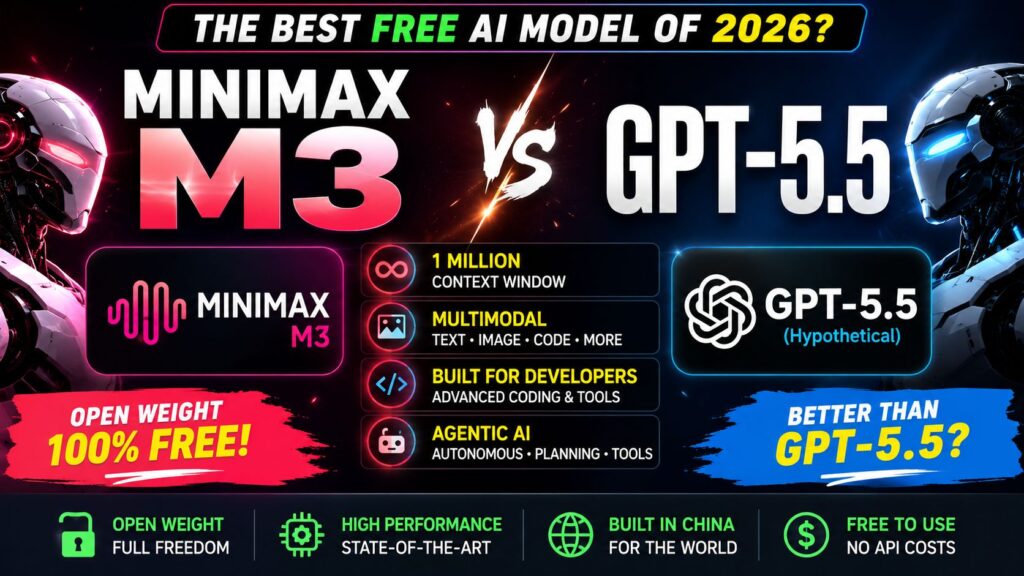
MiniMax M3 review 2026
MiniMax M3 review 2026
MiniMax M3 Review: The Free AI That Beats GPT-5.5 in 2026?
Introduction
What if there was a free, open-source AI model that could beat GPT-5.5 on coding — and cost just 5% of what OpenAI charges?
That is exactly what happened on June 1, 2026, when a Chinese AI company called MiniMax quietly launched their new model called MiniMax M3.
Within days, the entire AI world was talking about it. VentureBeat called it a model that “eclipses GPT-5.5 and Gemini 3.1 Pro on key benchmark performance for just 5–10% of the cost.” Developers started switching from expensive closed models. And AI researchers started asking one big question:
Is MiniMax M3 the most important AI launch of 2026?
In this article, I am going to give you a complete, honest review of MiniMax M3. We will look at what it is, what it can do, how it compares to GPT-5.5 and Claude Opus, who should use it, and whether the hype is real or just marketing.
Let us get into it.
What Is MiniMax M3?
MiniMax M3 is the latest flagship AI language model from MiniMax (officially known as Shanghai Hixi Technology), a Chinese AI company based in Shanghai.
The company is not new. MiniMax already has over 200 million users worldwide through products like Talkie (an AI companion app) and Hailuo (an AI video generation tool). They listed on the Hong Kong Stock Exchange in January 2026, which gives them serious financial backing.
But M3 is their biggest model yet. And it comes with three claims that the AI world has never seen combined in one open-source model before:
- Frontier-level coding performance — matching or beating GPT-5.5
- 1 million token context window — process entire codebases in one go
- Native multimodality — understands text, images, and video natively
The key word here is open-weight. This means MiniMax plans to release the model files publicly on Hugging Face and GitHub so anyone can download and run M3 on their own hardware. No monthly subscription. No API fees. Just the raw model you can use however you want.
That combination — frontier quality plus open weights plus low cost — is what makes M3 genuinely special.
The Technology Behind MiniMax M3
To understand why M3 is fast, let us look at the technology that powers it.
MiniMax Sparse Attention (MSA)
The biggest technical innovation in M3 is something called MiniMax Sparse Attention or MSA.
Here is the simple explanation. When a normal AI model reads a long document, it pays equal attention to every single word. This is called “full attention.” At 1 million tokens, this is extremely expensive and slow — like reading every page of a 1,000-page book with the same focus, even the boring parts.
MSA is smarter. It first scans the entire context quickly and identifies which parts are actually relevant. Then it only pays full attention to those relevant parts. The boring parts get skipped.
The result?
- 9.7x faster processing speed (called prefill speed)
- 15.6x faster response generation (called decode speed)
- 20x lower compute cost at 1 million tokens
Compared to the previous MiniMax M2 generation, M3 with MSA can handle the same 1 million token task at one-twentieth the cost. This is what makes long-context AI actually affordable for the first time.
Natively Multimodal from Step Zero
Most AI models start as text models and then add vision capabilities later. This usually means the image understanding is an “add-on” that feels separate from the text reasoning.
MiniMax built M3 differently. They rebuilt their entire data pipeline to train text, images, and video together from the very beginning — what they call “Step Zero.” This means M3 does not just see images. It genuinely understands visual content at the same level it understands text.
The practical result is that you can feed M3 a screenshot of a chart, a video frame, a diagram, or a complex image — and it will reason about it just as naturally as it reads text.
Thinking Mode
M3 also has a toggleable Thinking Mode. When you turn it on, M3 spends more time reasoning through complex problems step by step before answering. When you turn it off, M3 gives faster responses for simpler tasks.
This is similar to how Claude Opus and GPT-5.5 handle extended reasoning — but M3 gives you the choice to control it.
MiniMax M3 Key Specifications
| Feature | Details |
|---|---|
| Release Date | June 1, 2026 |
| Developer | MiniMax (Shanghai Hixi Technology) |
| Model Type | Open-weight Large Language Model |
| Context Window | Up to 1 million tokens (512K guaranteed minimum) |
| Multimodal | Text, image, video input — text output |
| Computer Use | Yes — can use desktop applications |
| API Pricing | $0.60/M input tokens, $2.40/M output tokens |
| Launch Promo Price | $0.30/$1.20 (50% discount, limited time) |
| Token Plans | Plus ($20/mo), Max ($50/mo), Ultra ($120/mo) |
| Open Source | Yes — weights on Hugging Face and GitHub |
| Thinking Mode | Yes — toggleable |
| Available Via | MiniMax API, MiniMax Code, OpenRouter, HuggingFace |
MiniMax M3 Benchmark Performance
Now let us talk about the numbers. This is where M3 made headlines.
SWE-Bench Pro — Coding Benchmark
SWE-Bench Pro measures how well an AI model can fix real-world software bugs from GitHub. It is widely considered the most realistic test of AI coding ability.
| Model | SWE-Bench Pro Score |
|---|---|
| Claude Opus 4.8 | 69.2% |
| Claude Opus 4.7 | 64.3% |
| MiniMax M3 | 59.0% |
| GPT-5.5 | 58.6% |
| Gemini 3.1 Pro | 54.2% |
| DeepSeek-V4 Pro Max | 55.4% |
What this means: M3 beats GPT-5.5 by a small margin (59.0% vs 58.6%) and beats Gemini 3.1 Pro clearly (59.0% vs 54.2%). Claude Opus 4.8 still leads at 69.2%.
Important caveat: These benchmark numbers were reported by MiniMax themselves. Independent verification from platforms like Artificial Analysis and LMArena was still pending at launch. Treat vendor-reported benchmarks as directional — not final proof.
BrowseComp — Autonomous Web Browsing
BrowseComp tests how well an AI can browse the internet, find information, and complete research tasks autonomously.
| Model | BrowseComp Score |
|---|---|
| MiniMax M3 | 83.5 |
| Claude Opus 4.7 | 79.3 |
Here M3 actually beats Claude Opus 4.7 — which is a real achievement for an open-weight model.
Terminal-Bench 2.1 — Command Line Tasks
| Model | Terminal-Bench Score |
|---|---|
| GPT-5.5 (with Codex CLI) | 83.4% |
| GPT-5.5 (standard) | 72.1% |
| Claude Opus 4.8 | 74.6% |
| MiniMax M3 | 66.0% |
On terminal and command-line tasks, M3 is competitive but not the leader. GPT-5.5 with its native Codex CLI integration is stronger here.
MCP Atlas — Tool Use
MCP Atlas measures how well a model uses external tools — like web search, code execution, file systems, and APIs.
| Model | MCP Atlas Score |
|---|---|
| MiniMax M3 | 74.2% |
M3 scores well on tool use, which is essential for real-world agentic workflows.
PostTrainBench — Training AI Models Autonomously
This is perhaps the most impressive benchmark. PostTrainBench measures whether M3 can autonomously train other AI models without human help.
MiniMax gave M3 four base AI models and asked it to complete the entire training pipeline — data synthesis, training, evaluation, and iteration — within 12 hours, with zero human intervention.
| Model | PostTrainBench Score |
|---|---|
| Claude Opus 4.7 | 42.4 (1st) |
| GPT-5.5 | 39.3 (2nd) |
| MiniMax M3 | 37.1 (3rd) |
M3 ranked third globally in this benchmark — ahead of all other models except Claude Opus 4.7 and GPT-5.5. For an open-weight model, this is remarkable.
BenchLM Global Ranking
According to BenchLM.ai, an independent benchmark tracking platform:
- MiniMax M3 ranks #25 out of 124 models overall
- M3 ranks #9 out of 124 models specifically in agentic tool use
This places M3 firmly in the top tier of AI models globally.
The Real-World Tests That Matter
Benchmarks are one thing. Real-world performance is another. Here is what independent testers found:
Coding Test: Multi-File Code Repository
Developers who tested M3 on real coding tasks found it performed at a level “right up there with the closed frontier models.” When fed a complex multi-file code repository and asked to implement new features, M3 handled cross-file dependencies accurately and produced clean code.
Web Design Test
Independent testers found M3 produced clean, well-considered web designs comparable to GPT-5.5. On one standard web design prompt, M3’s results were described as “one of the best results I’ve gotten for this prompt to date — right up there with the closed frontier models.”
CUDA Kernel Optimization: The 24-Hour Test
MiniMax ran an impressive stress test on M3. They asked it to optimize an extremely complex piece of code (called a CUDA kernel for FP8 GEMM operations) on NVIDIA Hopper GPUs — starting from a non-working skeleton.
Over 24 hours, M3:
- Made 147 benchmark submissions
- Made 1,959 tool calls
- Pushed hardware performance from 7.6% utilization to 71.3%
- Achieved a 9.4x speedup — with zero human help
12-Hour Research Paper Reproduction
M3 was given a research paper from ICLR 2025 and asked to reproduce all its experiments completely autonomously. Over 12 hours, M3 made 18 code commits and generated 23 experimental figures — successfully replicating the paper’s core experiments with no human help at any stage.
MiniMax M3 vs GPT-5.5: Detailed Comparison
| Feature | MiniMax M3 | GPT-5.5 |
|---|---|---|
| SWE-Bench Pro | 59.0% | 58.6% |
| Terminal-Bench | 66.0% | 72.1–83.4% |
| BrowseComp | 83.5 | Not published |
| Context Window | 1M tokens | 1M-class |
| Multimodal | Text, image, video | Omnimodal |
| Computer Use | Yes | Limited |
| Open Weight | Yes | No |
| Input Price | $0.60/M tokens | $5.00/M tokens |
| Output Price | $2.40/M tokens | $30.00/M tokens |
| Ecosystem | New — growing | Mature — broad |
| Fine-tuning | Yes (open weights) | Yes (via API) |
Cost comparison: For a team spending $5,000 per month on GPT-5.5, switching to M3 would cost approximately $350 per month — saving around $55,000 per year while getting similar or better coding performance.
When M3 wins: Coding tasks, long-context work, budget-conscious teams, self-hosting needs When GPT-5.5 wins: Terminal and command-line heavy work, teams already in the OpenAI ecosystem, tasks needing the broadest tool ecosystem
MiniMax M3 vs Claude Opus 4.8: Detailed Comparison
| Feature | MiniMax M3 | Claude Opus 4.8 |
|---|---|---|
| SWE-Bench Pro | 59.0% | 69.2% |
| BrowseComp | 83.5 (vs Opus 4.7: 79.3) | ~79–80 |
| PostTrainBench | 37.1 (3rd) | 42.4 (1st) |
| Context Window | 1M tokens | 1M tokens |
| Multimodal | Text, image, video | Text, image |
| Open Weight | Yes | No |
| Input Price | $0.60/M tokens | $5.00/M tokens |
| Output Price | $2.40/M tokens | $25.00/M tokens |
| Cost Ratio | ~8–12x cheaper | Premium |
Honest verdict: Claude Opus 4.8 is still the better model for the hardest coding tasks — a 10-point gap on SWE-Bench Pro is real and meaningful. But M3 delivers 85-90% of Opus quality at roughly 10% of the price. For most everyday coding and agentic tasks, that trade-off makes M3 the smarter choice for cost-sensitive teams.
MiniMax M3 vs Gemini 3.1 Pro: Comparison
| Feature | MiniMax M3 | Gemini 3.1 Pro |
|---|---|---|
| SWE-Bench Pro | 59.0% | 54.2% |
| Context Window | 1M tokens | 1M tokens |
| Multimodal | Text, image, video | Text, image, video, audio |
| Open Weight | Yes | No |
| Pricing | Much lower | Premium |
M3 clearly outperforms Gemini 3.1 Pro on the most important coding benchmark. Gemini’s advantage is native audio understanding and Google’s broader ecosystem.
Pricing: The Real Game Changer
Let us talk about the pricing in detail because this is where M3 changes everything.
API Pricing Comparison
| Model | Input (per 1M tokens) | Output (per 1M tokens) |
|---|---|---|
| MiniMax M3 | $0.60 | $2.40 |
| MiniMax M3 (promo) | $0.30 | $1.20 |
| Claude Sonnet 4.6 | $3.00 | $15.00 |
| Claude Opus 4.8 | $5.00 | $25.00 |
| GPT-5.5 | $5.00 | $30.00 |
Real-World Cost Example
For a task that uses 500,000 input tokens and 100,000 output tokens:
| Model | Cost Per Task |
|---|---|
| MiniMax M3 (standard) | $0.54 |
| Claude Sonnet 4.6 | $3.00 |
| Claude Opus 4.8 | $5.00 |
| GPT-5.5 | $5.50 |
M3 completes the same task for $0.54 versus $5.50 for GPT-5.5. That is a 10x cost difference.
Token Plans for Non-Developers
If you are not a developer and just want to use MiniMax M3 directly, the Token Plans are the way to go:
| Plan | Price | Best For |
|---|---|---|
| Plus | $20/month | Individuals and light users |
| Max | $50/month | Regular creators and professionals |
| Ultra | $120/month | Heavy users and small teams |
These plans give you access to M3’s coding, multimodal, and agentic features through MiniMax Code without needing to set up an API.
How to Access MiniMax M3
There are four ways to use MiniMax M3, depending on your needs:
Option 1: MiniMax Code (Easiest)
Go to code.minimax.io — this is MiniMax’s own agentic coding interface built on M3. No coding required. Just sign up and start using it.
Option 2: MiniMax API
Go to platform.minimax.io and get an API key. Use M3 in your own applications with the standard model ID: MiniMax-M3.
python
import requests

url = "https://api.minimax.io/v1/text/chatcompletion_v2"

payload = {
    "model": "MiniMax-M3",
    "messages": [
        {"role": "user", "content": "Hello"}
    ]
}

headers = {"Authorization": "Bearer YOUR_API_KEY"}
response = requests.post(url, json=payload, headers=headers)
print(response.text)
Option 3: OpenRouter
If you already use OpenRouter, M3 is available there with an OpenAI-compatible API. This is the easiest path if you are already working with multiple AI models.
Option 4: Self-Hosting via Hugging Face
Once the weights are fully released on Hugging Face, you can download M3 and run it on your own servers. No API fees. Complete privacy. Full control.
Compatible Coding Tools
M3 works with major coding tools including:
- Claude Code
- Cursor
- Roo Code
- Cline
- Codex CLI
- OpenCode
- Kilo Code
What MiniMax M3 Does Best
Based on all the data and real-world tests, here is where M3 genuinely excels:
1. Long-Context Coding Projects
M3’s 1 million token context window with MSA means it can load an entire large codebase — multiple files, documentation, and test cases — in one go. This is transformative for developers working on large software projects.
2. Autonomous Agentic Tasks
M3 can run complex multi-step tasks for hours without human input. The CUDA kernel test (24 hours, 1,959 tool calls) showed it can handle genuinely hard long-running agentic workflows.
3. Understanding Visual Content
Because M3 was trained multimodally from Step Zero, it genuinely understands charts, diagrams, code screenshots, and UI layouts — not just describes them. This makes it excellent for tasks like:
- Reading a UI screenshot and writing code to replicate it
- Analyzing a chart and extracting data
- Understanding visual documentation
4. Budget-Conscious AI Development
For startups, indie developers, and small teams who cannot afford to spend $5/1M tokens on Claude Opus or GPT-5.5, M3 delivers 85-90% of the quality at 10-15% of the cost.
5. Autonomous Research
M3’s ability to browse the web autonomously (BrowseComp score of 83.5) makes it an excellent research assistant for finding, synthesizing, and analyzing information from across the internet.
Where MiniMax M3 Falls Short
Being honest means talking about the weaknesses too. M3 is not perfect.
1. Resolution Cap on Complex Reasoning
On the absolute hardest reasoning tasks, Claude Opus 4.8 and GPT-5.5 still have a clear edge. The 10-point gap on SWE-Bench Pro (59% vs 69.2% for Opus 4.8) is real. For the most complex engineering challenges, closed models still lead.
2. Token Burning on Simple Tasks
Testers noted that M3’s thinking mode sometimes “over-thinks” simple problems. It can spend many tokens reasoning through something that does not need deep analysis, which wastes time and money.
3. Terminal and Command-Line Tasks
GPT-5.5 with Codex CLI integration significantly outperforms M3 on shell-heavy DevOps and command-line automation tasks. If this is your primary use case, GPT-5.5 is still the better choice.
4. Ecosystem Maturity
M3 is brand new. GPT-5.5 has months of production data, a massive ecosystem (DALL-E, Whisper, Assistants API, Azure integration), and extensive community support. M3 is growing fast but is starting from scratch on ecosystem maturity.
5. Unverified Benchmarks
All M3 benchmark numbers at launch were vendor-reported — run by MiniMax on their own infrastructure with baselines they chose. Independent verification from neutral platforms was still pending. Treat the benchmarks as a strong signal, not final proof.
6. Data Privacy Concern
The hosted MiniMax API is run by a company based in China. China’s National Intelligence Law of 2017 can require companies to cooperate with the government. For sensitive business or personal data, you need to either self-host M3 (using the open weights) or carefully review your compliance requirements before using the hosted API.
Who Should Use MiniMax M3?
✅ Perfect For:
- Developers and startups who need frontier AI quality at low cost
- Content creators and bloggers who want AI assistance without expensive subscriptions
- AI researchers who want to study and fine-tune an open-weight frontier model
- Teams running high-volume AI workflows where the cost savings are massive
- Enterprises with data privacy needs who want to self-host their AI
- Anyone building agentic AI applications for long-context or coding tasks
⚠️ Think Twice If:
- Your work involves highly sensitive data and you cannot self-host
- You primarily do terminal and DevOps automation (GPT-5.5 is better)
- You need the most reliable, battle-tested model for mission-critical production (Claude Opus 4.8 has a longer track record)
- You are deeply embedded in the OpenAI or Anthropic ecosystem
The Smart Strategy: Use Both
The smartest approach that many experienced AI developers are now using is a routing strategy — using multiple models for different tasks:
| Task Type | Best Model |
|---|---|
| Bulk coding and agentic work | MiniMax M3 (cost-efficient) |
| Long-context document analysis | MiniMax M3 |
| Hardest reasoning challenges | Claude Opus 4.8 |
| Terminal and shell automation | GPT-5.5 |
| Everyday chat and writing | Claude Sonnet 4.6 |
This hybrid approach lets you get frontier quality where it matters most while keeping costs low for the rest.
MiniMax’s Other Products Worth Knowing
MiniMax is not just M3. They have a full suite of AI products:
- MiniMax Hailuo 2.3 — AI video generation (direct competitor to Sora and Veo)
- MiniMax Speech 2.8 — AI voice and speech generation
- MiniMax Music 2.6 — AI music creation
- Talkie — AI companion app with 200M+ users
- MiniMax Code — Agentic coding platform built on M3
This makes MiniMax one of the most complete AI product companies in the world — not just a model lab.
MiniMax M3 vs The Open-Source AI Competition
MiniMax M3 is not the only open-weight model competing at the frontier. Here is how it fits in the broader landscape:
| Model | Strengths | Weaknesses vs M3 |
|---|---|---|
| DeepSeek-V4 Pro Max | Strong terminal tasks (67.9% Terminal-Bench) | Lower SWE-Bench Pro (55.4%) |
| Meta Llama 4 Scout | Massive community | Not at frontier coding level |
| Qwen 3.7 Max | Strong reasoning | Less multimodal capability |
| Kimi K2.6 | 1T parameters, agent swarms | No native multimodal |
M3’s unique advantage over all of them is the combination of frontier coding + 1M context + native multimodality + low price — all in one model.
What Experts Are Saying About MiniMax M3
The reaction from the AI community has been overwhelmingly positive, with important caveats:
VentureBeat reported that M3 “eclipses GPT-5.5 and Gemini 3.1 Pro on key benchmark performance for just 5-10% of the cost.”
Independent developer Thomas Wiegold ran his standard battery of coding tests and concluded: “I think M3 is a real winner. The results across my tests were strong, the pricing is excellent, and for the first time a MiniMax model genuinely sits in the conversation with GPT and Opus rather than a tier below it.”
South China Morning Post noted that M3’s architecture “reduced computational requirements to as little as one-twentieth of previous levels.”
The consistent theme across expert reviews: M3 is genuinely impressive for an open-weight model, the price-to-performance ratio is exceptional, but the benchmarks need independent verification and Claude Opus 4.8 still leads on the hardest tasks.
Frequently Asked Questions
What is MiniMax M3? MiniMax M3 is an open-weight AI language model launched on June 1, 2026 by MiniMax, a Shanghai-based AI company. It combines frontier coding performance, a 1 million token context window, and native multimodal understanding in a single model.
Is MiniMax M3 free? M3 will be available for free via open weights on Hugging Face and GitHub for self-hosting. The hosted API costs $0.60 per million input tokens and $2.40 per million output tokens. Token plans start at $20/month for direct access.
Does MiniMax M3 beat GPT-5.5? On the SWE-Bench Pro coding benchmark, M3 scores 59.0% vs GPT-5.5’s 58.6% — a narrow win for M3. However, GPT-5.5 outperforms M3 on terminal and command-line tasks. The benchmarks are vendor-reported and awaiting independent verification.
What is MiniMax Sparse Attention (MSA)? MSA is MiniMax’s new architecture that makes processing 1 million tokens 15.6x faster and 9.7x faster to start compared to the previous generation — at one-twentieth the compute cost.
How does MiniMax M3 compare to Claude Opus 4.8? Claude Opus 4.8 leads on the hardest coding benchmark (69.2% vs 59.0% on SWE-Bench Pro). However, M3 beats Claude Opus 4.7 on BrowseComp (83.5 vs 79.3) and costs roughly 8-10x less.
Is MiniMax M3 safe to use for sensitive data? The hosted MiniMax API is operated by a China-based company. For sensitive business or personal data, consider self-hosting M3 using the open weights to keep data on your own infrastructure.
What coding tools work with MiniMax M3? M3 is compatible with Claude Code, Cursor, Roo Code, Cline, Codex CLI, OpenCode, and TRAE. You can also access it via OpenRouter for OpenAI-compatible workflows.
When will MiniMax M3 open-source weights be available? MiniMax committed to releasing open weights on Hugging Face and GitHub within roughly 10 days of the June 1, 2026 launch — making them available around June 10-11, 2026.
What is MiniMax M3-highspeed? M3-highspeed is an alternate API version of M3 that produces identical results but with faster inference speed. Both versions are available through the MiniMax API.
Can MiniMax M3 handle video input? Yes. M3 is natively multimodal and can process video input alongside text and images. This makes it capable of tasks like analyzing video frames, understanding visual documentation, and interpreting complex visual data.
Final Verdict: Is MiniMax M3 Worth It?
After going through all the data, the benchmarks, the real-world tests, and the expert opinions — here is my honest conclusion:
MiniMax M3 is absolutely worth trying in 2026.
The combination of frontier coding performance, a genuine 1 million token context window, native multimodality, and a price tag of $0.60/M tokens is something the AI world has never seen before in an open-weight model.
Is it perfect? No. Claude Opus 4.8 still leads on the hardest tasks. The benchmarks need independent verification. The ecosystem is immature. And data privacy with the hosted API needs careful consideration.
But for the vast majority of developers, teams, and creators who need capable AI at a price that makes sense — MiniMax M3 is the most exciting open-weight model launched in 2026.
The AI world just changed. And this time, the change came from Shanghai.
Try MiniMax M3 yourself:
- MiniMax Code — No coding needed
- MiniMax API Platform — For developers
- OpenRouter — For existing OpenRouter users
- HuggingFace MiniMax — For self-hosting
- MiniMax Official Website — Official MiniMax homepage
- MiniMax M3 Official Page — Official M3 model page
- MiniMax Code — MiniMax agentic coding platform
- MiniMax API Platform — Developer API access
- HuggingFace MiniMax — Open weights repository
- OpenRouter — Multi-model API access
- VentureBeat — MiniMax M3 Launch Coverage — Independent news coverage
- South China Morning Post — MiniMax M3 — News coverage
- BenchLM.ai — MiniMax M3 Rankings — Independent benchmark data
- Artificial Analysis — Independent AI benchmarking platform
- OpenAI GPT-5.5 — GPT-5.5 official page
- Anthropic Claude — Claude Opus official page
- Google DeepMind — Gemini 3.1 Pro developer
- GitHub — MiniMax open source repository
- SWE-Bench — The standard AI coding benchmark
- Cursor AI — AI coding tool compatible with M3
- Cline — Open-source coding agent for M3
- Meta AI — Llama open-weight models
- DeepSeek — Chinese open-weight AI competitor
- Hailuo AI Video — MiniMax’s AI video product
- Talkie AI — MiniMax consumer product
- MiniMax Investor Relations — Company financial data
- ICLR Conference — Research conference M3 replicated papers from
- NVIDIA Developer — CUDA optimization reference
- Hugging Face — Open-source AI model hub
MORE BLOGS
HOW TO SELL AI GENERATED CONTENT LEGALLY

Pingback: Future of AI Predictions