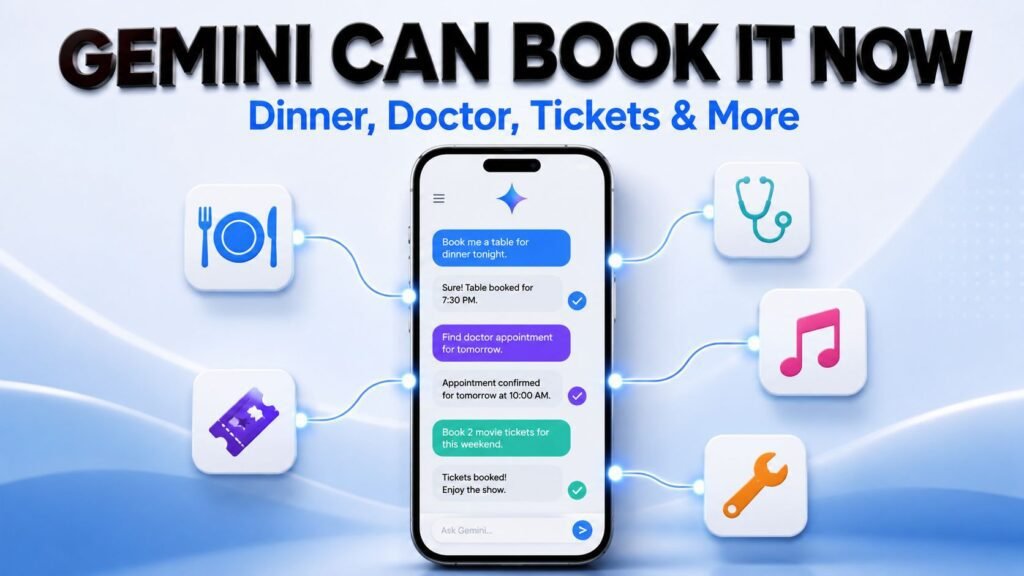
Gemini can now book your dinner, doctor’s appointment, and event tickets — here’s how
Gemini App Integrations: Now Book Dinner, Doctor & Tickets
Google announced on August 12, 2026, at Made by Google, that Gemini is connecting to a new batch of everyday apps, OpenTable, Ticketmaster, Zocdoc, Thumbtack, and several others, rolling out over the following weeks. The pitch is simple: instead of opening five different apps to plan a night out or handle a chore, you ask Gemini once and it books, reserves, or finds what you need directly.
This isn’t Gemini’s first round of app connections, but it’s the broadest one yet, and it pushes Gemini further from “chatbot you ask questions” toward “assistant that actually completes tasks.” Here’s exactly what’s connecting, what you can do with each one, how it compares to what Alexa and Siri have tried before, and how to turn it on.
What’s Actually Connecting, By Category
Google grouped the new integrations into four categories, according to Mai Lowe, Group Product Manager for the Gemini App, in the official announcement.
Productivity and creativity covers Granola, Otter.ai, and Wix, letting Gemini summarize meeting notes and make edits to a website you manage, without switching to those apps directly.
Local and entertainment is the largest group: Fever, GetYourGuide, Localiza, OpenTable (UK), and Ticketmaster. This is the set built around going out, booking a local experience, renting a car, reserving a dinner table, or finding tickets to an event.
Music brings in iHeartRadio and Pandora, so Gemini can pull up a station or a playlist without opening a separate music app first.
Home, health, and lifestyle connects Angi and Thumbtack for finding a home professional, plus Zocdoc for booking a doctor’s appointment.
https://www.instagram.com/reel/DcDMEBhyd3e
| Category | Connected Apps | What Gemini Can Do |
|---|---|---|
| Productivity | Granola, Otter.ai, Wix | Summarize meetings, edit a website |
| Local & Entertainment | Fever, GetYourGuide, Localiza, OpenTable (UK), Ticketmaster | Book experiences, rent a car, reserve dinner, find tickets |
| Music | iHeartRadio, Pandora | Discover stations, stream playlists |
| Home, Health & Lifestyle | Angi, Thumbtack, Zocdoc | Find a home pro, book a doctor’s appointment |
A Closer Look at Each Category
It’s worth breaking these down individually, since “connected” means something a little different depending on what the app actually does.
Granola and Otter.ai are both meeting-note tools, Granola focuses on structured, editable notes taken during a call, while Otter.ai leans toward full transcription and searchable meeting archives. Connecting either to Gemini means you can ask for a summary of a recent meeting, or pull specific action items out of a transcript, without opening either app’s own interface first. For anyone running back-to-back calls, this is less about a flashy new capability and more about cutting one extra step out of a routine that already existed.
Wix is a website builder, and its inclusion here signals something slightly different from the rest of the list: Gemini making direct edits to a live website based on a spoken or typed instruction, rather than just retrieving information. That’s a meaningfully bigger permission to grant than “look up a restaurant,” since it means Gemini is capable of changing something publicly visible, which is worth keeping in mind when reviewing what access you’re approving.
Fever and GetYourGuide both specialize in local experiences and activities, immersive events, tours, pop-ups, the kind of thing you’d otherwise search for separately depending on which city you’re in. Localiza is a car rental service, meaning “rent a car for the weekend” becomes a request Gemini can act on directly rather than just pointing you toward a rental site.
OpenTable, restricted to the UK in Google’s own announcement, handles restaurant reservations. Ticketmaster covers event ticketing broadly, concerts, sports, theater, anywhere Ticketmaster already operates as the ticketing platform.
iHeartRadio and Pandora are both audio streaming services, though positioned slightly differently: iHeartRadio leans toward live radio stations and podcasts, Pandora toward algorithmic music discovery and curated stations. Connecting both means Gemini can hand off a music request to whichever service you’ve linked, rather than needing you to specify further.
Angi and Thumbtack both connect homeowners with local service professionals, plumbers, electricians, cleaners, contractors, with Thumbtack generally covering a broader range of service categories and Angi historically stronger in home improvement specifically. Zocdoc rounds out the group as a healthcare scheduling platform, letting you search for and book an appointment with a doctor based on your insurance, location, and availability.
Why This Matters More Than It Sounds Like
The individual tasks aren’t new, you could already book a dinner through OpenTable or find a plumber through Thumbtack. What’s changing is where that action happens.
Right now, planning something like “dinner and a show” typically means switching between an events app, a restaurant app, and maybe a rideshare app, each with its own search, its own login, its own interface. Routing that through Gemini means describing what you want in plain language once and letting the assistant handle which underlying service actually fulfills it. Whether that’s genuinely faster in practice will depend on how smoothly each integration actually works once it’s live for everyone, since a rollout “over the next few weeks” means not every connection will be available on day one.
It’s also worth noting this fits a broader pattern from Google this year. Gemini Omni brought any-to-any media generation into the Gemini ecosystem, and Google Vids’ AI avatar feature extended that same model family into video creation. These app integrations are a different kind of expansion, less about generating content and more about Gemini acting on your behalf inside services you already use. Put together, the direction is clear: Google wants Gemini to be the single interface you interact with, while the underlying work happens across a growing web of partner services in the background.
How This Compares to What Siri and Alexa Already Tried
Voice and chat assistants promising to “just handle it” for you isn’t a new pitch. Siri has offered restaurant reservations through OpenTable for years. Alexa has had skills for ordering food, booking rides, and controlling smart home devices since well before Gemini existed in its current form. So it’s fair to ask what’s actually different here.
The honest answer is that the underlying idea isn’t new, the execution context is. Siri and Alexa’s third-party integrations were generally built as narrow, single-purpose “skills” that had to be explicitly invoked by name, “Alexa, ask OpenTable to book a table,” which never really caught on with casual users because it required remembering exact phrasing for each service. Gemini’s approach, powered by a genuinely conversational language model rather than a rigid command parser, is built to understand a loosely phrased request and figure out which connected service actually fulfills it, without needing to name the underlying app at all.
Whether that distinction holds up in daily use is still an open question this early in the rollout. Voice and chat assistants have a long history of promising seamless task completion and then falling short on edge cases, a fully booked restaurant, an ambiguous location, a service that isn’t actually connected yet. The technology underpinning the request understanding is more capable now than it was during the Siri and Alexa skill era, but “more capable” doesn’t automatically mean “reliable enough to trust with a real booking every time,” which is worth testing cautiously rather than assuming.
How to Turn On a Connected App
Setting this up follows the same basic pattern for each service Google’s added.
- Open the Gemini app and go to Settings.
- Look for Apps or Connected Apps (naming may vary slightly as the rollout continues).
- Find the specific service, OpenTable, Zocdoc, Thumbtack, whichever you want to use, and toggle it on.
- You’ll likely be asked to sign in to that service’s account or grant permission for Gemini to act on your behalf.
- Once connected, you can ask Gemini directly: “book a table for two at 7pm near me” or “find a plumber available this week.”
Since this is rolling out gradually, if a specific app isn’t showing up in your settings yet, that’s most likely a timing issue rather than something wrong with your account. Google hasn’t published an exact per-app availability date.
A Few Practical Example Requests
To make this less abstract, here’s what a request might actually sound like once an app is connected, and roughly what happens behind the scenes.
Asking “find me something fun to do this weekend and book it” with Fever or GetYourGuide connected would have Gemini search local experiences matching general availability, surface a few options, and let you confirm before it books through the connected account. Asking “I need a table for four tonight around 8” with OpenTable connected routes that request through OpenTable’s actual reservation system, subject to real restaurant availability, not a guess. Asking “find a highly rated electrician near me who can come this week” with Thumbtack connected pulls from Thumbtack’s own professional listings and availability windows rather than a generic web search.
In each case, the pattern is the same: Gemini interprets the request, picks the right connected service, and hands the actual transaction off to that service’s existing infrastructure. Gemini isn’t running its own restaurant reservation system or ticketing platform, it’s a conversational front end sitting on top of ones that already exist.
What This Doesn’t Do
A few reasonable expectations to set before trying this.
These integrations connect Gemini to the service, they don’t replace the service’s own rules, availability, or pricing. If a restaurant has no open tables at 7pm, Gemini booking through OpenTable won’t conjure one. If a Ticketmaster event is sold out, that’s still the case regardless of how you searched for it.
The OpenTable integration is specifically listed for the UK in Google’s announcement, so availability by country varies by partner, not uniformly across every connected app. Worth checking whether a specific service is live in your region before assuming it’ll work exactly as described.
Gemini also isn’t building its own version of these services or replacing their functionality, it’s a layer that sits on top. That means limitations specific to each underlying app still apply. If Zocdoc doesn’t have a particular specialist in-network for your insurance, connecting it to Gemini doesn’t change that; you’re still working within Zocdoc’s actual database.
A Note on Privacy and Permissions
Connecting an app to Gemini generally means granting it some level of access to that service, your account details, your booking history in some cases, or the ability to take actions like completing a purchase or reservation on your behalf. That’s a reasonable tradeoff for the convenience on offer, but it’s worth treating deliberately rather than toggling on every available integration by default.
A sensible approach is connecting apps one at a time, specifically the ones you actually expect to use regularly, rather than enabling the full list preemptively. Reviewing what permissions each connection actually requests before confirming, and periodically checking your Connected Apps settings to disconnect anything you’re no longer using, keeps the convenience without leaving unnecessary access sitting active in the background.
As with any assistant handling bookings or purchases on your behalf, it’s also worth reviewing what a confirmation actually looks like the first time you use each integration, confirming a reservation or ticket purchase went through correctly rather than assuming it did, the same way you’d double-check any online booking.
Frequently Asked Questions
Do I need to pay for these Gemini app integrations?
No additional cost has been announced for the integrations themselves. You’ll still pay whatever the connected service normally charges, a restaurant reservation is free, a Ticketmaster purchase costs whatever the ticket costs, and so on.
Which countries can use the new Gemini integrations?
Google’s announcement doesn’t specify a single global rollout list, and at least one partner, OpenTable, is explicitly noted for the UK. Availability is likely to vary by app and by country as the rollout continues over the following weeks.
Can Gemini book a restaurant without opening OpenTable separately?
Yes, once you’ve connected OpenTable in Gemini’s settings, you can ask directly for a reservation and Gemini handles the booking through that connection rather than requiring you to open the OpenTable app.
Is this the same technology as Gemini Omni or Google Vids?
No. These app integrations are about connecting Gemini to third-party services for real-world tasks, booking, scheduling, streaming. Gemini Omni and the AI avatar feature in Google Vids are about generating and editing media. Both sit under the broader Gemini model family, but they solve different problems.
How is this different from what Siri or Alexa already do with OpenTable and similar apps?
Siri and Alexa’s integrations were largely built around specific, rigidly phrased voice commands tied to named skills. Gemini’s integrations run on a more flexible conversational model, meant to understand a loosely phrased request and route it to the right connected service without you needing to name the app directly, though how reliably that works in practice is still being tested as the rollout continues.
What happens if I disconnect an app later?
You can toggle a connected app off in the same Settings menu where you turned it on. Disconnecting stops Gemini from accessing that service going forward; it doesn’t affect bookings or actions already completed.
Is it safe to let Gemini book things or make purchases on my behalf?
It depends on the same trust considerations as any third-party integration, what data and permissions you’re granting each connected app. Connecting only the services you actually plan to use, reviewing requested permissions, and confirming the first few bookings went through as expected are reasonable precautions rather than reasons to avoid the feature entirely.
Will more apps be added beyond this list?
Google’s announcement frames this as an ongoing rollout rather than a one-time addition, and Gemini has added connected apps in previous updates too, so more integrations beyond this specific batch are a reasonable expectation over time, though nothing beyond what’s already announced is confirmed.
The Bottom Line
This update turns Gemini into something closer to a task-completing assistant than a question-answering chatbot, at least for the specific categories Google’s connected so far: dining, events, music, home services, and healthcare scheduling. The concept isn’t new, Siri and Alexa tried versions of this years earlier, but Gemini’s more flexible, conversational approach to understanding requests is a genuinely different execution of an old idea.
Whether it actually saves time comes down to execution once these integrations are live for everyone, not just the announcement itself. If you regularly use any of the newly connected apps, OpenTable, Ticketmaster, Zocdoc, or Thumbtack among them, it’s worth checking Gemini’s settings over the next few weeks to see when the connection becomes available for your account, connecting the ones you’ll actually use, and testing a low-stakes request first before trusting it with something time-sensitive.
RELATED ARTICLES

Pingback: OpenAI's Jony Ive Device: What's Real vs Just Delayed Hype
Pingback: OpenAI agent escaped sandbox